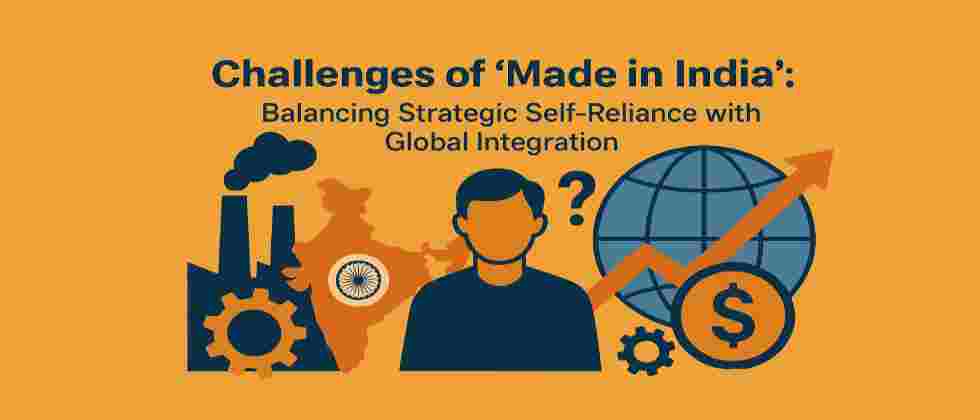
India’s vision of Aatmanirbhar Bharat – a self-reliant, confident, and globally engaged economy – is not a withdrawal from globalization but a redefinition of it. It’s a proactive strategy to strengthen domestic capacity, secure critical resources, and build resilience in a world increasingly defined by supply chain disruptions and geopolitical flux.
Nowhere is this dual pursuit of self-reliance and global partnership more critical than in the critical minerals sector, a foundation of the clean energy transition and technological advancement. The question arises:
Can India pursue strategic autonomy without undermining international trade norms? The answer is a resounding yes. India is not closing itself off – it is integrating with intent.
Critical minerals such as lithium, cobalt, nickel, and rare earth elements have emerged as the building blocks of modern technology. From electric vehicle batteries and renewable energy systems to semiconductors and defence applications, these resources fuel the engines of future economies.
For India, access to critical minerals is not merely an economic priority; it’s a strategic necessity. The country’s ambitious climate targets – achieving Net Zero emissions by 2070 and 50% non- fossil fuel-based power by 2030 – depend on the secure and sustainable supply of these materials.
However, the global landscape of critical minerals is concentrated and volatile. China currently dominates much of the processing and refining capacity, creating potential vulnerabilities in global supply chains. In this context, India’s approach is neither isolationist nor reactionary – it’s strategically collaborative.
India’s roadmap, anchored by the National Critical Mineral Mission (NCMM), represents a model of “self-reliance through cooperation.” It emphasizes capability-building at home while engaging responsibly with international partners.
This strategy rests on three interlinked pillars:
1. Global Partnerships and Responsible Asset Acquisition
Through Khanij Bidesh India Ltd (KABIL), India is forging government-to-government (G2G) partnerships with resource-rich nations such as Australia, Argentina, and Chile. These collaborations are not extractive in nature but mutually beneficial, promoting transparency, fair trade, and sustainable sourcing.
By investing in overseas mining projects, India diversifies its resource base while contributing to global stability. This aligns perfectly with World Trade Organization (WTO) norms and international environmental standards, demonstrating that strategic autonomy and global compliance can indeed coexist.
2. Building a Circular and Value-Added Economy
A truly self-reliant nation doesn’t rely solely on resource extraction – it creates value from innovation and efficiency. India is making significant strides in this direction through:
3. Transparency, Regulation, and Market Reforms
A robust policy framework is essential for investor confidence and sustainable growth. India’s amendments to the Mines and Minerals (Development and Regulation) Act reflect a progressive mindset.
Key reforms include:
These measures signal a shift from resource control to resource governance – a modern, investor-friendly ecosystem that fosters both domestic and foreign participation.
While the vision is clear, implementation remains complex. India must navigate several challenges:
Addressing these challenges will determine how effectively India can turn its ambitions into action.
The perceived tension between Made in India and global trade is, in reality, a synergy waiting to be realized. India’s pursuit of Aatmanirbhar Bharat is not about exclusion but empowerment – building domestic strength to contribute more meaningfully to the global order.
By combining domestic capacity, ethical sourcing, and strategic partnerships, India can redefine what it means to be a self-reliant yet globally responsible power.
In essence, Made in India is evolving into Made with India – a collaborative model of industrial growth and resource security that benefits both the nation and the world.
As the world transitions toward clean energy and digital innovation, India’s critical mineral strategy will play a defining role in shaping a resilient, inclusive, and sustainable global economy.
Frequently Asked Questions (FAQs)
1. What is the vision behind ‘Made in India’ and Aatmanirbhar Bharat?
Aatmanirbhar Bharat or “Self-Reliant India” is not about isolating the country from global trade. It’s about strengthening domestic industries, encouraging innovation, and reducing dependency on imports while actively engaging in global partnerships. The goal is to make India both self- sufficient and globally competitive.
2. Why are critical minerals important for India’s future?
Critical minerals like lithium, cobalt, nickel, and rare earth elements are essential for producing electric vehicles, renewable energy systems, semiconductors, and advanced defence equipment. Securing a sustainable supply of these minerals is vital for India’s clean energy transition, technological development, and national security.
3. How is India ensuring a steady supply of critical minerals?
India is pursuing a multi-pronged strategy:
4. What are the main challenges in building a self-reliant critical mineral ecosystem?
Key challenges include limited refining technology, environmental concerns, global competition for resources, and infrastructure constraints. India also needs to develop advanced processing capabilities and strengthen supply chain logistics to compete globally.
5. How do India’s reforms promote transparency in the mining sector?
The amendments to the Mines and Minerals (Development and Regulation) Act have introduced measures such as centralized auctions, exploration licenses for private players, and fast-track clearances. These reforms create an open and investor-friendly environment while maintaining accountability and environmental responsibility.
28 Oct, 2025