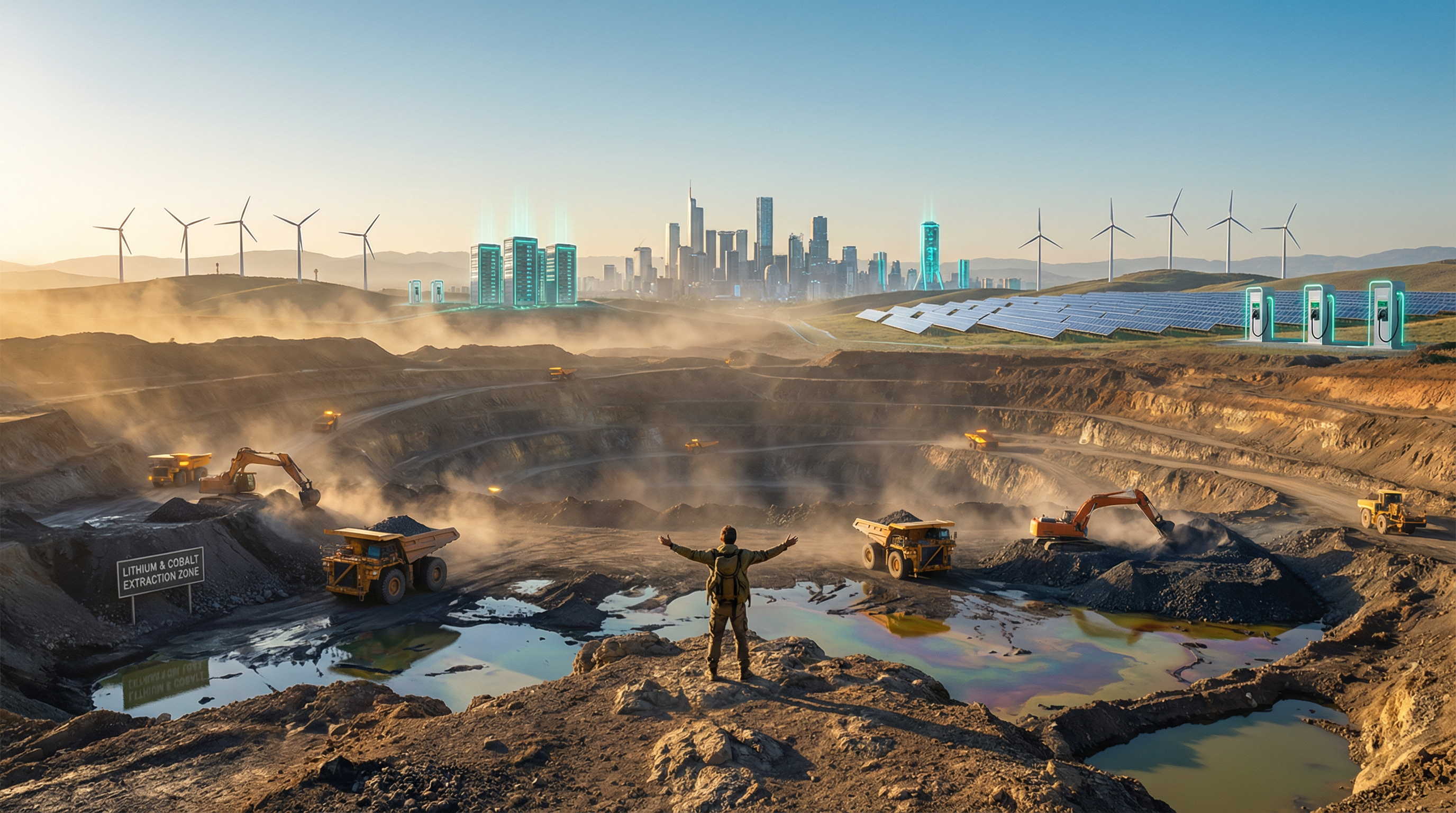
Critical minerals such as lithium, cobalt, nickel, copper, and rare earth elements have become indispensable to the modern world. They are the backbone of electric vehicles, renewable energy systems, digital infrastructure, and advanced manufacturing. As nations accelerate their transition towards low-carbon economies, these minerals are increasingly framed as enablers of sustainability.
Yet a fundamental question persists: Are we merely replacing one environmental challenge with another? As demand for critical minerals surges, concerns around land degradation, water stress, biodiversity loss, and community displacement are growing louder. The global energy transition may be green in its intent, but its material footprint demands closer scrutiny.
This blog explores whether technology alone can address the environmental impacts of critical mineral extraction, or whether a broader, more holistic approach is essential.
The Hidden Cost of the Green Transition
The global shift towards cleaner energy is mineral-intensive by design. According to international projections, demand for critical minerals is expected to double by 2030 and nearly triple by 2050, driven by rapid electrification, renewable energy deployment, battery storage systems, and digital infrastructure expansion.
Lithium plays a central role in energy storage technologies, while copper enables electrification and connectivity. Nickel and cobalt remain essential for battery performance, and rare earth elements are critical for wind turbines and electric motors.
Estimates from global development institutions suggest that achieving climate and sustainability targets will require unprecedented volumes of mineral extraction. This reality underscores a pressing challenge: how to scale mineral production responsibly without undermining the very environmental goals these minerals are meant to support.
Environmental and Social Pressures
Critical mineral extraction often occurs in ecologically sensitive or water-stressed regions. For instance:
• Lithium mining in South Americahas raised concerns over groundwater depletion and impacts on indigenous livelihoods.
• Nickel mining in Indonesiahashas highlighted risks related to deforestation, marine pollution, and waste disposal.
• Cobalt mining in parts of Africahas exposed governance gaps, safety issues, and social inequities.
These challenges are real, but so is the industry’s growing commitment to addressing them through better practices, tighter regulations, and technological innovation.
Can Technology Be the Solution?
In response to mounting scrutiny, the mining sector is undergoing a profound transformation. Technology is increasingly positioned as the key to reducing environmental impact, but the question remains: is innovation enough, or is it simply mitigating symptoms rather than addressing root causes?
Promising Technological Advances
Several advancements are already reshaping mining operations:
• Closed-loop water systems that significantly reduce freshwater consumption and prevent contamination/span>
• Low-emission extraction techniques that eliminate fossil fuel-based smelting and high-temperature processes
• Advanced mineral processing technologies that improve recovery rates while reducing waste
• Battery-electric and autonomous mining equipment, lowering fuel use and improving operational safety
In some regions, mining operations are transitioning entirely to renewable energy-powered sites, combining solar, wind, and battery storage to decarbonise extraction and logistics.
Data, Automation, and AI
Digital transformation is also playing a critical role. AI-powered predictive maintenance, real-time environmental monitoring, and automated material handling systems are improving efficiency while reducing unnecessary energy use and emissions.
These technologies demonstrate measurable improvements, but their impact is maximised only when applied consistently across the value chain.
Beyond the Innovation Narrative
While extraction technologies have evolved, sustainability challenges persist beyond the mine gate.
Refining and Processing Bottlenecks
In regions dependent on coal-based power, mineral refining remains a carbon-intensive process, limiting overall emissions reductions. Without cleaner energy integration in downstream processes, gains achieved during extraction risk being offset during processing and manufacturing.
Water Stewardship as a Critical Priority
Approximately 16% of the world’s critical mineral resources are located in water-stressed regions, making water management one of the sector’s most pressing challenges. Lithium extraction, in particular, requires careful stewardship.
Emerging solutions include:
• Dry processing techniques
• High-efficiency water recycling systems
• Collaborative water governance models involving local communities
Leading mining operations are proving that with planning, transparency, and innovation, mineral development and water security can coexist.
Time Pressure and the Supply Challenge
The mining sector faces an unprecedented timing challenge. While global mineral demand is expected to surge by 2030, new mine development typically takes 10–15 years from discovery to production.
To address this mismatch, stakeholders are pursuing:
• Expansion of existing operations alongside new projects
• Streamlined permitting processes without compromising safeguards
• Cross-sector partnerships between governments, industry, and academia
• Faster deployment of proven technologies rather than experimental delays
This sense of urgency is reshaping how innovation is adopted, faster, more collaborative, and more outcome-driven.
Beyond Technology: A Holistic Approach
Technology alone cannot deliver sustainability. A responsible critical minerals strategy must integrate circularity, governance, and social inclusion.
Circular Economy and Recycling
By 2040, recycling of copper, lithium, nickel, and cobalt from clean energy systems could reduce primary mineral demand by 10–30%. This secondary supply eases pressure on new mining while strengthening regional supply security.
However, achieving this potential requires:
• Investment in recycling infrastructure
• Design-for-recycling product standards
• Improved collection and processing systems
Urban mining, recovering minerals from end-of-life electronics, offers promise, but current recycling rates for many critical minerals remain below 10%, highlighting both opportunity and challenge.
Demand Management and Material Efficiency
Reducing the need to mine is just as important as improving how we mine. Innovations in:
• Battery chemistries that require fewer critical minerals
• Material substitution
• Longer product lifecycles
can significantly moderate demand growth. These strategies must balance performance, affordability, and scalability.
Governance and Social License to Operate
Responsible mining depends on strong governance frameworks, transparent supply chains, and meaningful community engagement.
Experiences from mineral-rich regions around the world demonstrate that technology delivers its greatest value when paired with:
• Ethical labor practices
• Inclusive decision-making
• Local economic participation
• Environmental accountability
When communities benefit alongside industry, mining becomes a platform for shared progress rather than conflict.
Charting a Responsible Path Forward
Critical minerals are essential to the global energy transition, but their extraction comes with undeniable environmental responsibilities. Technology is already reducing impacts, and future innovations will go further. Yet true sustainability lies in coordination, not isolation.
Success depends on ensuring that:
• Technology deployment accelerates alongside strong safeguards
• Circular economy principles are embedded from the outset
• Communities share equitably in economic benefits
• Innovation targets both efficiency and demand reduction
• Transparency strengthens trust across supply chains
When managed responsibly, the environmental footprint of critical minerals is far lower than the cost of unchecked climate change.
iCEM: Advancing Responsible Mining for the Future
With a strong focus on safety, environmental stewardship, and net-zero transitions, iCEM bridges innovation with on-ground implementation. Drawing from the operational experience of the Gujarat Mineral Development Corporation, the centre enables industry-wide collaboration to translate global best practices into scalable, real-world solutions.
By aligning technology, safety, sustainability, and skill development, iCEM contributes to shaping a mining ecosystem that is not only productive but also responsible, resilient, and future-ready.
FAQs
1. Why are critical minerals essential for the energy transition?
Critical minerals enable renewable energy systems, electric vehicles, energy storage, and electrification infrastructure, making them indispensable for reducing global carbon emissions.
2. Does mining critical minerals negate climate benefits?
While mining has environmental impacts, responsible practices and modern technologies significantly reduce these risks and are far less damaging than continued fossil fuel dependence.
3. Can recycling replace mining entirely?
Recycling will play a crucial role, but cannot fully replace primary mining in the near term. A balanced approach combining both is essential.
4. What role does technology play in sustainable mining?
Technology improves efficiency, reduces emissions, optimises water use, enhances safety, and enables cleaner operations, but must be supported by governance and circularity.
5. How does iCEM support sustainable mining practices?
iCEM fosters innovation, safety, automation, and environmental responsibility through industry collaboration, training, and real-world application of advanced mining solutions.