Introduction: The Hidden Power Behind Critical Minerals
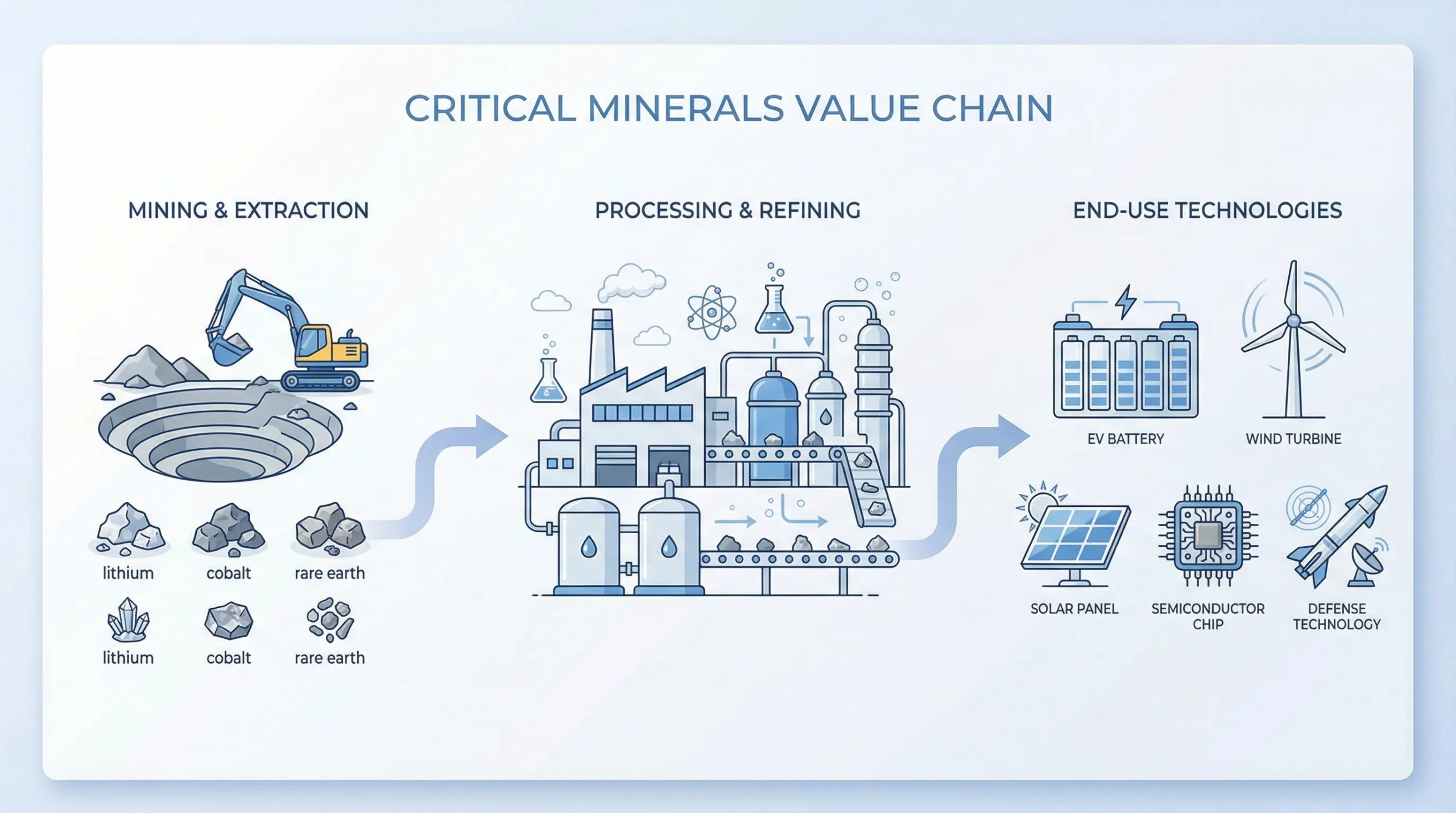
As the world accelerates toward clean energy, electrification, and advanced digital technologies, critical minerals have become the foundation of modern industrial growth. Lithium powers electric vehicles, cobalt strengthens battery performance, and rare earth elements enable wind turbines, semiconductors, and defence technologies.
In response, nations across the globe are racing to secure mining rights, expand exploration programs, and announce new mineral discoveries. While ownership of mineral reserves remains important, a deeper industry reality is reshaping global strategy: true economic value and supply-chain influence lie not only in extraction, but in processing and refining capabilities.
Mining extracts raw materials from the earth, but processing transforms them into usable, high- performance inputs for manufacturing. Without refining, mineral reserves alone cannot power electric vehicles, renewable energy systems, or advanced electronics. The transition from ore to usable material is where value multiplies, technology evolves, and strategic control is established.
Understanding this shift from “mine ownership” to “value-chain ownership” is essential for countries seeking long-term industrial competitiveness.
The Complete Value Chain: From Raw Ore to Advanced Materials
The critical minerals supply chain consists of multiple stages:
1- Exploration and Mining locating and extracting mineral deposits.
2- separating impurities and converting ore into usable chemical or metallic forms.
3- Component Manufacturing producing batteries, magnets, electronics, or alloys.
4- End-Use Industries electric vehicles, renewable energy systems, aerospace, and consumer technology.
While mining generates initial economic activity, the greatest value addition occurs in the midstream stage, processing and refining. For example:
• Lithium ore must be converted into battery-grade lithium chemicals.
• Cobalt requires advanced refining to meet battery manufacturing standards.
• Rare earth elements undergo complex separation processes before becoming permanent magnets.
Each stage adds technological sophistication and economic value, but refining acts as the critical bridge connecting natural resources to industrial production.
The Processing Advantage: Where Value is Truly Created
Global mineral markets reveal a striking imbalance between mining and refining capabilities.
Australia produces nearly half of the world’s lithium through mining operations, yet a majority of lithium refining capacity exists elsewhere. Similarly, the Democratic Republic of Congo dominates cobalt mining, while refined cobalt production is heavily concentrated in countries with advanced processing infrastructure. In rare earth elements, refining capacity is even more centralized globally.
This imbalance demonstrates a crucial lesson: resource ownership does not automatically translate into supply-chain leadership.
Processing facilities capture higher margins because they:
• Convert bulk commodities into specialized materials.
• Require advanced technology and operational expertise.
• Establish long-term industrial ecosystems around them.
• Create downstream manufacturing opportunities.
As a result, nations with strong refining capabilities often exert greater influence over pricing, supply reliability, and technological development, even if they possess fewer natural reserves.
Why Processing Capabilities Create Competitive Advantage
1. Technical Complexity and Knowledge Capital
Mineral refining is one of the most technologically demanding industrial activities. Rare earth separation, for instance, can involve dozens or even hundreds of chemical extraction stages requiring precise engineering control.
Developing such expertise takes years of operational learning, skilled manpower, and research investment. Over time, this accumulated knowledge becomes intellectual capital that is difficult for competitors to replicate quickly.
Countries that master these processes build long-term technological advantages that extend beyond mining into advanced manufacturing sectors.
2. Capital Investment and Long-Term Strategy
Processing infrastructure requires substantial investment and planning. Establishing a modern refining facility can take five to ten years from feasibility studies to commercial operation, with investments often reaching hundreds of millions of dollars.
These long development timelines create high entry barriers. Early investors benefit from economies of scale and operational maturity, while late entrants must overcome both financial and technological challenges.
Strategic policy support, patient capital, and industrial coordination are therefore essential for developing successful refining ecosystems.
3. Environmental Innovation as a Competitive Differentiator
Mineral processing presents environmental challenges, including waste management, chemical handling, and energy consumption. However, these challenges also create opportunities for innovation.
Countries adopting advanced environmental standards are developing cleaner refining technologies such as:
• Closed-loop water systems
• Improved waste recovery methods
• Low-emission chemical processes
• Renewable-energy-powered refineries
Sustainable processing practices increasingly influence global sourcing decisions, as manufacturers seek responsibly produced materials. Environmental excellence is becoming not just a regulatory requirement but a market advantage.
4. Integration with Manufacturing Ecosystems
Processing achieves maximum economic impact when integrated with downstream industries. Refining facilities support:
• Battery manufacturing
• Automotive production
• Electronics and semiconductor industries
• Renewable energy equipment manufacturing
This integration creates industrial clusters where skills, infrastructure, and innovation reinforce one another. Countries with strong manufacturing bases naturally develop competitive refining sectors because demand, talent, and technological collaboration exist within the same ecosystem.
The Global Shift Toward Supply Chain Resilience
Growing awareness of supply concentration risks has encouraged countries to diversify processing capacity. Governments worldwide are now prioritizing midstream investments alongside mining expansion.
Several strategic approaches are emerging:
Strategic Partnerships and Friendshoring
No single nation can meet the global demand for critical minerals independently. Collaborative supply chains among trusted partners are becoming increasingly important to ensure stability and resilience.
Technology and Innovation
New technologies are reshaping processing efficiency. Direct lithium extraction, AI-driven mineral analysis, and reprocessing of mine waste are improving recovery rates while reducing environmental impact.
Policy Coordination
Long-term industrial policies in major economies aim to strengthen domestic capabilities across mining, refining, recycling, and manufacturing through incentives, funding, and regulatory support
Recycling and Circular Economy
Recycling critical minerals from used batteries and electronics represents a growing secondary supply source. However, recycling infrastructure remains geographically concentrated, highlighting opportunities for new entrants.
Despite diversification efforts, global refining capacity remains highly concentrated, indicating significant room for emerging economies to participate more actively.
India’s Strategic Opportunity in Critical Mineral Processing
India stands at a pivotal moment in the evolution of global critical mineral supply chains. While domestic mineral reserves are important, the country’s real advantage lies in its ability to develop midstream processing capabilities.
Several structural strengths support this opportunity:
• A rapidly expanding manufacturing sector.
• Strong engineering and technical talent.
• Growing domestic demand from electric mobility and renewable energy.
• Strategic partnerships with mineral-rich nations.
• Policy momentum supporting industrial self-reliance.
By investing in refining technologies and processing infrastructure, India can capture greater value domestically while reducing dependence on imported refined materials.
Developing processing capabilities would also stimulate job creation, technological innovation, and industrial diversification, transforming minerals from a raw-commodity sector into a high-value industrial ecosystem.
Building Capability: The Role of Institutions and Collaboration
Developing a robust critical minerals ecosystem requires more than infrastructure, it demands skills, research, and global collaboration.
Institutions focused on mining innovation and workforce development play a key role in bridging this gap. Through training programs, technology adoption initiatives, and international partnerships, such organizations help prepare industries for increasingly complex processing requirements.
By emphasizing safety, automation, advanced technologies, and skill development, industry-led institutions are helping India transition toward a more modern and integrated minerals value chain, one that extends beyond extraction into processing and advanced manufacturing.
Moving Beyond Reserves Toward Value Creation
The global critical minerals race is no longer defined solely by who owns the largest reserves. Instead, leadership increasingly belongs to those who control processing technologies, refining capacity, and integrated industrial ecosystems.
Processing transforms geological potential into economic power. It generates skilled employment, fosters innovation, strengthens supply security, and enables participation in high- value manufacturing industries.
For emerging economies, the path forward lies in embracing the full “mine-to-market” journey, building capabilities not just to extract resources, but to refine, manufacture, and innovate.
As the clean energy transition accelerates, nations that invest in processing today will shape the industrial landscape of tomorrow.
FAQs
1. Why is processing more important than mining in the critical minerals industry?
Mining extracts raw materials, but processing converts them into usable industrial inputs such as battery-grade chemicals or rare earth compounds. Most economic value and supply-chain control are created during refining.
2. What makes mineral processing technologically challenging?
Processing involves complex chemical separation, precision engineering, environmental management, and specialized expertise developed through years of operational experience.
3. How does refining capacity influence global supply chains?
Countries with strong refining capabilities often control pricing, supply availability, and downstream manufacturing opportunities, even if they do not possess the largest mineral reserves.
4. Can recycling reduce dependence on mining?
Yes. Recycling batteries and electronic waste can recover valuable minerals, supporting a circular economy. However, recycling infrastructure must expand significantly to meet future demand.
5. Why is India well-positioned to develop processing capabilities?
India’s manufacturing growth, skilled workforce, rising EV and renewable energy demand, and strategic partnerships create strong conditions for developing a competitive critical minerals processing sector.
24 Feb, 2026