The Human Dimension of the Global Critical Minerals Race
The global race for critical minerals is accelerating at an unprecedented pace. Resources such as lithium, cobalt, nickel, graphite, copper, and rare earth elements have become the backbone of modern industrial transformation. They power electric vehicles, renewable energy systems, advanced electronics, and next-generation defense technologies.
As countries pursue aggressive decarbonization goals and energy transition strategies, demand for these minerals is projected to surge exponentially over the coming decades. Governments are strengthening supply chains, companies are expanding exploration, and investors are channeling capital into mineral-rich regions worldwide.
Yet, beneath this technological and geopolitical competition lies a less visible, but equally decisive, factor: community acceptance.
Mining projects do not exist in isolation. They operate within complex ecosystems shaped by local communities, environmental sensitivities, cultural heritage, and economic livelihoods. Even the most technically sound and financially viable projects can face delays, resistance, or cancellation if they fail to secure the trust and support of the communities they impact.
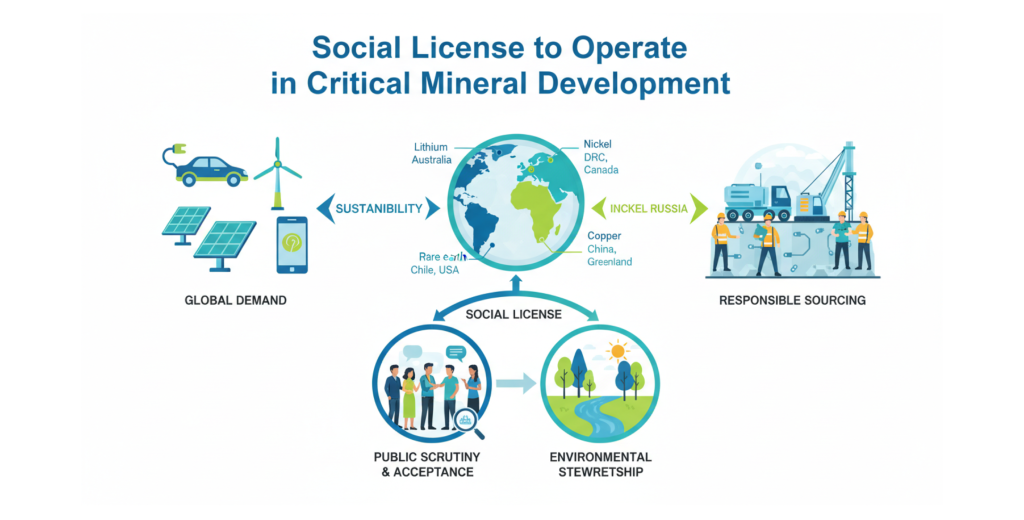
This reality has elevated the concept of Social License to Operate (SLO) to a central position in global mineral development. Increasingly, it is being recognized not as a soft, optional consideration, but as a critical strategic resource.
Understanding the Social License to Operate
The Social License to Operate is not a formal permit issued by governments. Instead, it is an informal yet powerful form of approval granted by communities, stakeholders, and society at large.
It is built, not granted, through consistent and responsible actions over time.
A strong SLO is grounded in:
• Transparent and honest communication
• Responsible environmental stewardship
• Fair and inclusive economic participation
• Respect for cultural values and rights
• Long-term engagement with stakeholders
When communities feel informed, respected, and included, mining operations are far more likely to proceed smoothly and contribute meaningfully to regional development. Conversely, a lack of trust can lead to protests, litigation, regulatory barriers, and reputational damage.
In recent years, several globally significant mining projects have faced suspension or delays due to community opposition, despite strong economic potential. These cases underscore a critical lesson: technical feasibility alone is no longer sufficient.
The mining industry is therefore evolving toward a broader development paradigm; one where social trust is treated as a core operational asset.
Why Social License Matters More in the Critical Minerals Era
While community engagement has always been important in mining, its significance has intensified in the context of critical minerals for several key reasons:
1. Rapid Expansion of Mining Activities
The energy transition is driving an unprecedented increase in mineral demand. Meeting this demand requires new mines, expanded operations, and additional processing facilities, often located near populated or ecologically sensitive regions.
This expansion increases the frequency and intensity of community interactions, making trust- building essential for long-term project viability.
2. Environmental Sensitivity and Public Scrutiny
Critical mineral extraction involves complex chemical and metallurgical processes. Concerns around water consumption, land degradation, waste disposal, and biodiversity loss are increasingly under public scrutiny.
Communities today are more informed and environmentally conscious. Companies must go beyond compliance and demonstrate proactive environmental responsibility through:
• Water recycling and conservation systems
• Tailings and waste management innovations
• Land rehabilitation and reclamation
• Continuous environmental monitoring and disclosure
3. Rising ESG Expectations
Environmental, Social, and Governance (ESG) considerations are now central to investment decisions and corporate strategy.
Institutional investors, global manufacturers, and governments are demanding responsible sourcing of minerals. Companies with strong social and environmental performance are more likely to:
• Attract long-term capital
• Secure global partnerships
• Access premium markets
SLO has therefore become closely linked with financial performance and investor confidence.
4. Strategic Importance of Supply Chains
Critical minerals are essential for clean energy technologies, semiconductors, and national security infrastructure.
Disruptions caused by social conflicts can ripple through global supply chains, affecting industries far beyond mining. As a result, governments and corporations increasingly view community stability as a strategic necessity.
Key Pillars of a Strong Social License
Building and sustaining a Social License to Operate requires a structured, long-term approach. Successful mining projects typically focus on the following pillars:
1. Transparent Communication
Trust begins with clarity.
Mining companies must engage in open, continuous dialogue with stakeholders, sharing information about project plans, environmental safeguards, risks, and benefits.
Effective strategies include:
• Public consultations and town hall meetings
• Community information centers
• Transparent reporting and disclosures
• Grievance redressal mechanisms
Clear communication reduces misinformation and builds credibility.
2. Inclusive Development and Local Participation
Communities are more supportive when they experience direct and tangible benefits. Inclusive development strategies may include:
• Water recycling and conservation systems
• Tailings and waste management innovations
• Land rehabilitation and reclamation
• Continuous environmental monitoring and disclosure
3. Environmental Stewardship
Environmental responsibility is fundamental to long-term acceptance.
Leading companies are adopting advanced technologies and best practices to minimise ecological impact, including:
• Closed-loop water systems
• Renewable energy integration in mining operations
• Progressive land reclamation
• Biodiversity conservation initiatives
Demonstrating environmental accountability builds long-term trust.
4. Respect for Cultural and Indigenous Rights
In many regions, mining activities intersect with indigenous lands and culturally significant areas.
Respecting these contexts requires:
• Recognition of land rights and traditional ownership
• Incorporation of indigenous knowledge systems
• Free, Prior, and Informed Consent (FPIC) practices
• Culturally sensitive engagement frameworks
Development must align with both economic and cultural priorities.
The Economic Value of Social License
A strong Social License is not just a social asset; it delivers measurable economic benefits.
Projects with high community acceptance often experience:
• Faster regulatory approvals
• Reduced operational disruptions
• Lower conflict management costs
• Higher workforce retention and morale
• Improved investor confidence
In contrast, projects that neglect community engagement can incur significant financial losses due to delays, shutdowns, and reputational risks.
At a macro level, responsible mining contributes to regional development by:
• Creating employment opportunities
• Enhancing infrastructure
• Stimulating local entrepreneurship
In the critical minerals sector, where timelines and reliability are crucial, these advantages are particularly valuable.
Global Trends Strengthening Social License
The importance of SLO is reflected in emerging global trends:
1. Community Participation in Policy Development
Governments are increasingly involving local stakeholders in decision-making processes related to mining regulations, environmental standards, and land use.
2. Integration of ESG Metrics
Companies are embedding social and environmental performance indicators into corporate governance and reporting systems.
3. Transparency in Supply Chains
Global manufacturers, especially in the automotive and technology sectors, are demanding traceability to ensure responsible sourcing.
4. Collaborative Development Models
Public–private partnerships and community development agreements are becoming standard mechanisms to share benefits and responsibilities.
These trends highlight a shift toward more inclusive and accountable mining practices.
Social License in India’s Critical Minerals Landscape
India is steadily strengthening its approach to responsible mining, particularly in the critical minerals sector.
Key initiatives include:
• CDistrict Mineral Foundation (DMF):Allocates a portion of mining revenues to the welfare of mining-affected communities.
• Pradhan Mantri Khanij Kshetra Kalyan Yojana (PMKKKY):Focuses on improving infrastructure, healthcare, education, and livelihoods in mining regions.
Additionally, reforms such as:
• Auction-based mineral allocation
• Expanded exploration by national agencies
• Increased state-level participation
have improved transparency and governance.
India’s evolving framework reflects a balanced approach, integrating economic growth with social responsibility and environmental sustainability.
The Road Ahead: Trust as a Strategic Asset
As global demand for critical minerals continues to rise, the mining sector faces a fundamental challenge: building systems that are not only efficient and profitable, but also socially sustainable.
The Social License to Operate is no longer a peripheral concern, it is a strategic imperative. Projects that prioritize trust, transparency, and shared value creation are far more likely to succeed in an increasingly complex and interconnected world. Those that ignore these factors risk delays, disruptions, and long-term instability.
In the evolving critical minerals economy, success depends on more than geological resources and financial capital. It requires a deep commitment to people, communities, and ecosystems. Social License to Operate represents this commitment. It is the foundation upon which resilient, sustainable, and future-ready mining ecosystems are built.
iCEM: Advancing Responsible and Sustainable Mining
Institutions that support the mining sector increasingly play a critical role in strengthening operational standards, safety systems, and technological capability.
The International Centre of Excellence in Mining Safety & Automation (iCEM) focuses on advancing knowledge, research, and professional capacity in areas that directly influence responsible mineral development, including mine safety, automation, risk management, and operational efficiency.
By facilitating dialogue between policymakers, industry leaders, and academic institutions, iCEM contributes to strengthening institutional capability across the mining ecosystem. As critical minerals become central to global industrial transformation, strengthening safety, governance, and technological capability will remain fundamental to building resilient and socially responsible mining systems.
Frequently Asked Questions (FAQs)
1. What is the Social License to Operate (SLO)?
SLO refers to the ongoing acceptance and approval of a mining project by local communities and stakeholders. It is not a legal requirement but a critical factor for operational success.
2. Why is SLO important in critical mineral development?
Because critical minerals are essential for global industries, any disruption due to community opposition can impact supply chains, investments, and national strategies.
3. How can mining companies build a strong SLO?
By ensuring transparent communication, environmental responsibility, inclusive development, and respect for local and cultural values.
4. What happens if a project lacks Social License?
Projects may face protests, delays, legal challenges, reputational damage, and even cancellation, leading to significant financial and operational losses.
5. How is India promoting Social License in mining?
Through initiatives like DMF and PMKKKY, along with policy reforms that enhance transparency, community welfare, and sustainable development practices.
31 Mar, 2026