Beneath the Surface: The Story That Truly Matters
There is something quietly transformative unfolding in the world of critical minerals. While headlines often focus on lithium, cobalt, nickel, graphite, and rare earth elements, the essential building blocks of electric vehicles, renewable energy systems, and advanced technologies, the real story runs much deeper.
It is not only about what is extracted from the earth, but about what is built above it.
Across regions rich in mineral resources, a new narrative is emerging, one that goes beyond extraction to focus on empowerment. Communities are gaining access to skills they never had before. Infrastructure is connecting once-isolated regions. Young people are discovering meaningful employment opportunities close to home. Local businesses are thriving as they become part of new supply chains.
This is the evolving face of responsible mining: a model where economic development, community upliftment, and environmental stewardship move forward together.
The question is no longer just “Can we mine these resources?” It is now “How can we ensure this development creates lasting value for everyone involved?”
This shift in perspective is one of the most promising developments in the global mining sector today.
The Rising Importance of Critical Minerals
The urgency surrounding critical minerals is closely tied to the global energy transition. As countries accelerate efforts to reduce carbon emissions and move toward cleaner energy systems, the demand for these minerals is rising at an unprecedented rate.
According to projections by the International Energy Agency (IEA), demand for critical minerals could:
• Triple by 2030
• Quadruple by 2040
• Increase up to ninefold for minerals like lithium
These materials are no longer peripheral commodities, they are now central to national economic strategies, energy security, and geopolitical stability.
For mineral-rich regions across South Asia, Africa, Latin America, and Southeast Asia, this surge presents a historic opportunity. These regions are not just resource providers, they are potential hubs of economic transformation.
However, unlocking this opportunity depends on one crucial factor:
How responsibly and inclusively these resources are developed.
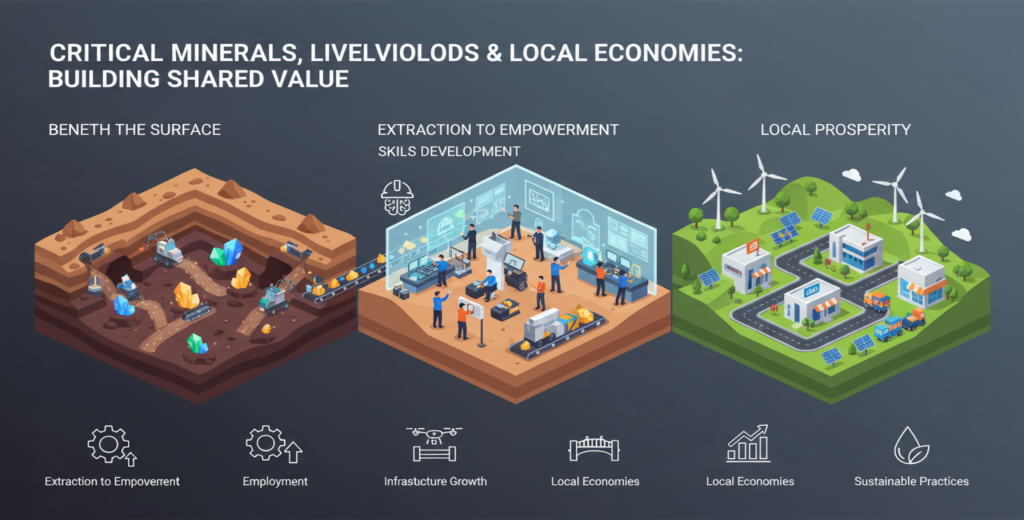
From Extraction to Empowerment
Modern mining is no longer defined solely by production output. Instead, its success is increasingly measured by its ability to create long-term value for communities.
When done thoughtfully, mining becomes a catalyst for:
• Employment generation
• Skill development
• Infrastructure growth
• Local entrepreneurship
• Regional economic diversification
This broader impact is what transforms a mining project into a development engine.
Enduring Skills in a Temporary Industry
Mining projects have a finite lifespan, but the skills they create can last generations.
A well-structured mining operation requires expertise across multiple domains:
• Engineering and geology
• Environmental management
• Health and safety
• Logistics and supply chain
• Data analytics and digital operations
• Community development and public health
Each of these areas represents a pathway for local employment and professional growth.
In India, regulatory frameworks such as Corporate Social Responsibility (CSR) mandates encourage companies to invest in education and skill development. Many mining organizations allocate 2% of their net profits toward community development initiatives, including vocational training programs
Globally, there are inspiring examples where mining companies have:
• Established training centers
• Partnered with technical institutes
• Created apprenticeship programs
• Promoted women’s participation in the workforce
The most impactful projects go beyond entry-level hiring. They actively nurture career progression, enabling local talent to move into technical, managerial, and leadership roles.
Most importantly, these skills are transferable.
Even after a mine closes, trained professionals continue contributing to other industries, construction, manufacturing, environmental services, and more.
This is how mining creates human capital that outlives the mine itself.
Infrastructure: The Silent Catalyst of Change
One of the most tangible and lasting contributions of mining projects is infrastructure development.
To operate efficiently, mining projects require:
• Roads and transportation networks
• Reliable electricity
• Water management systems
• Communication infrastructure
When designed with a community-first approach, these assets extend far beyond operational needs.
Consider the real-world impact:
• Roads reduce travel time, improve market access, and enhance connectivity
• Electricity enables small businesses, education, and healthcare services
• Water systems support agriculture and improve the quality of life
• Telecommunications connect communities to the digital economy
These are not just convenience, they are the foundations of development
Increasingly, governments are integrating community benefit frameworks into mining policies to ensure that infrastructure investments serve broader public needs.
The result is long-term value:
• The roads remain
• The power systems continue
• The connectivity endures
Even after mining operations conclude, the infrastructure continues to support regional growth and prosperity.
Local Economies and Supply Chain Development
Another powerful dimension of shared value lies in local procurement and enterprise development.
Mining projects require a wide range of goods and services, including:
• Equipment maintenance
• Catering and hospitality
• Transportation and logistics
• Construction and fabrication
• Environmental services
By prioritising local suppliers, companies can stimulate the growth of small and medium enterprises (SMEs) in surrounding regions.
This creates a multiplier effect:
• Local businesses grow
• Employment opportunities expand
• Income circulates within the community
• Economic resilience increases
Successful mining ecosystems often evolve into regional economic clusters, attracting additional industries and investment
This transition, from a single project to a diversified local economy, is a hallmark of sustainable development.
Building Trust: The Foundation of Shared Value
At the heart of every successful mining project lies one critical factor: trust.
Communities are no longer passive stakeholders, they are active participants in the development process. Their expectations include:
• Transparency in decision-making
• Fair distribution of benefits
• Respect for cultural and environmental values
• Opportunities for meaningful engagement
Projects that prioritize early and continuous dialogue with communities are more likely to achieve a social licence to operate, a level of trust and acceptance that ensures long-term stability.
Shared value is not a theoretical concept, it is a practical approach built on:
• Community participation
• Inclusive planning
• Ethical governance
• Environmental responsibility
When these elements align, mining becomes a collaborative effort, not a contested activity.
Environmental Responsibility and Sustainable Practices
No discussion of modern mining is complete without addressing environmental stewardship.
Responsible critical mineral development must balance economic growth with ecological preservation.
Key practices include:
• Land rehabilitation and biodiversity conservation
• Water management and recycling
• Waste reduction and tailings management
• Use of renewable energy in operations
• Monitoring and reducing carbon emissions
Technology is playing an increasingly important role, with innovations such as:
• Remote sensing and environmental monitoring
• Automation and precision mining
• AI-driven resource optimization
Sustainable mining is not just about compliance, it is about commitment to future generations.
Local Prosperity and National Security: A Shared Vision
An important realization among policymakers and industry leaders is that local prosperity and national resource security are deeply interconnected.
Countries that manage their mineral resources responsibly tend to experience:
• Greater political and social stability
• Higher investor confidence
• More efficient and productive mining sectors
When communities benefit directly from resource development, they become partners in progress rather than sources of resistance.
This alignment creates a virtuous cycle:
Trust → Stability → Investment → Growth
In this way, local development and national interests reinforce each other.
iCEM: Enabling a Responsible Mining Future
The International Centre of Excellence in Mining (iCEM) represents a forward-thinking approach to the sector’s evolution.
Established as a not-for-profit initiative, iCEM aims to:
• Enhance mining efficiency
• Promote sustainability
• Build technical capabilities
• Strengthen community engagement
With a vision rooted in shared value, iCEM works to ensure that mining contributes not only to economic output but also to social progress and environmental responsibility.
Its role is particularly significant in shaping India’s position in the global critical minerals landscape, ensuring that growth is both inclusive and sustainable.
A Future Built on Shared Value
Critical minerals are essential to building a cleaner, more sustainable world. But their true potential lies not just in powering technologies, but in empowering people and communities.
The future of mining is not defined by extraction alone. It is defined by:
• Skills that endure
• Infrastructure that uplifts
• Economies that diversify
• Communities that thrive
When approached responsibly, mining becomes more than an industry, it becomes a force for transformation.
The path forward is clear:
Develop resources, but also develop regions.
Create value, but ensure it is shared.
Because the most successful projects are not those that take the most from the earth, but those that leave the most behind.
FAQs
1. What are critical minerals and why are they important?
Critical minerals are natural resources essential for modern technologies, including electric vehicles, renewable energy systems, and electronics. They are crucial for achieving global sustainability and energy transition goals.
2. How does mining contribute to local economic development?
Mining supports local economies by creating jobs, developing infrastructure, promoting small businesses, and generating income through local procurement and supply chains.
3. What is meant by “shared value” in mining?
Shared value refers to a model where mining projects create economic benefits for companies while simultaneously improving social, economic, and environmental outcomes for local communities.
4. How can mining projects ensure sustainability?
Sustainable mining involves responsible resource management, environmental protection, community engagement, and long-term planning for economic and social development beyond the life of the mine.
5. What happens to communities after a mine closes?
If planned effectively, communities benefit from lasting infrastructure, skilled workforce development, and diversified local economies that continue to thrive even after mining operations end.