Introduction: A Defining Decade for Critical Minerals
The global economy is entering a decisive and transformative phase- one driven by the accelerating demand for critical minerals. Lithium powers electric vehicles, cobalt supports advanced battery storage, and rare earth elements are indispensable for wind turbines, semiconductors, and cutting-edge defense technologies. As nations commit to decarbonization and energy transition goals, these minerals are no longer just commodities- they are strategic assets.
Governments across the world have responded with urgency and intent. Policy frameworks such as the European Union’s Critical Raw Materials Act, the United States’ strategic mineral initiatives, and India’s Mines and Minerals (Development and Regulation) Amendment Act, 2023 reflect a collective shift toward securing resilient, diversified, and sustainable supply chains.
On paper, the global policy landscape has never been stronger.
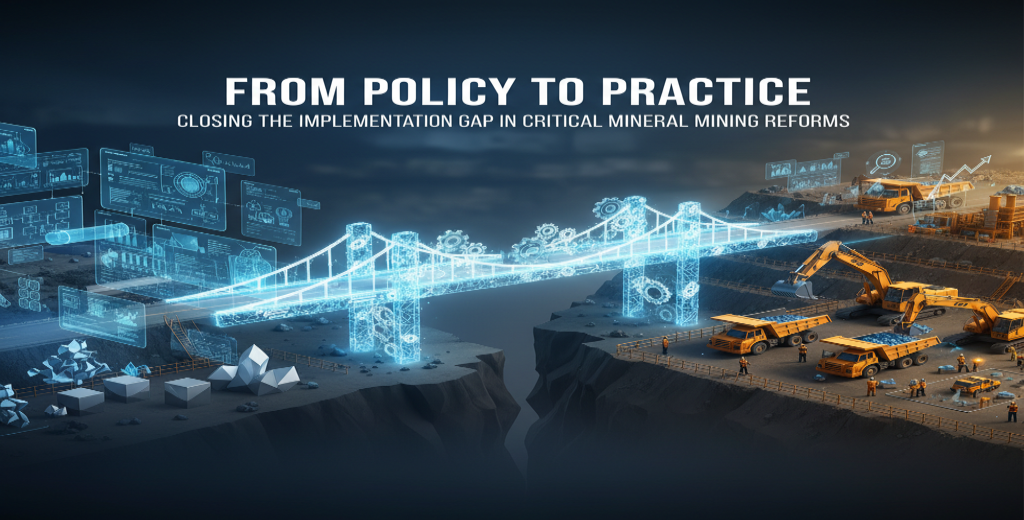
Yet, the real challenge lies beyond policy formulation. The defining question of this decade is not whether we have the right policies- it is whether we can effectively implement them. Bridging the gap between intent and execution will determine which nations lead in the critical minerals economy and which fall behind.
The Implementation Gap: Understanding the Disconnect
Despite the surge in policy activity, a noticeable implementation gap persists. According to global policy trackers, hundreds of policies across dozens of countries have been introduced in recent years. This reflects strong political will- but also highlights a critical reality: policies alone do not produce minerals, build mines, or develop supply chains.
The challenge lies in translating frameworks into functional systems.
1. Permitting and Regulatory Delays
One of the most significant bottlenecks is the lengthy and complex permitting process. In some developed economies, the timeline from mineral discovery to production can extend to nearly three decades. While environmental and social safeguards are essential, inefficiencies in approval systems often delay projects unnecessarily.
In emerging economies, the issue is not just speed but coordination. Fragmented governance across national and regional bodies can slow decision-making and create uncertainty for investors.
2. Gaps in Geological Data and Infrastructure
Reliable geological data is the foundation of mining development. However, many regions still lack high-resolution exploration data, making it difficult to attract private investment.
Similarly, infrastructure gaps- particularly in processing and refining- limit the ability of countries to move beyond raw material extraction. Without midstream and downstream capabilities, value addition remains constrained.
3. Supply Chain Concentration Risks
Global supply chains for critical minerals remain highly concentrated. A few countries dominate the production and processing of key resources such as rare earth elements and graphite. This creates vulnerabilities, especially during geopolitical disruptions.
Interestingly, studies indicate that the issue is not always resource scarcity- but rather the pace at which projects are developed and scaled.
4. Financing and Investment Challenges
Mining is capital-intensive, with long gestation periods and high risks. While demand projections are strong, mobilizing financial capital- especially for early-stage projects- remains a challenge.
There is a growing need for innovative financing mechanisms that can de-risk investments and accelerate project pipelines.
Bridging the Gap: Turning Policy into Practice
Closing the implementation gap requires a holistic, systems-level approach. It is not about fixing one issue- it is about aligning multiple enablers to create a seamless value chain.
Regulatory Clarity with Accountability
Effective policies are those that go beyond intent and define clear execution pathways. Time- bound approvals, transparent processes, and measurable outcomes are essential.
Frameworks that incorporate performance-linked incentives and accountability mechanisms ensure that policies translate into tangible results. When stakeholders know what is expected- and by when- execution becomes more efficient and predictable.
Technology as the Bridge
Technology plays a critical role in transforming policy into impact. Innovations in exploration, extraction, and processing can significantly enhance efficiency and sustainability.
Advancements such as:
• Processing of lower-grade ores
• Reduction in water and energy usage
• Recovery of minerals from tailings and waste
are expanding the scope of viable resources. Additionally, digital technologies- such as AI-driven exploration and automation- are redefining how mining operations are conducted.
Technology, in this context, is not just an enabler- it is a multiplier of policy effectiveness.
Skill Development as a Strategic Priority
No policy can succeed without the right human capital. The transition to advanced mining practices requires a workforce skilled in automation, environmental management, safety protocols, and digital systems.
Investing in education, vocational training, and industry-aligned curricula is critical. Institutions must evolve to produce professionals who can operate in a technologically advanced and sustainability-driven mining ecosystem.
A strong talent pipeline ensures that policies are supported by the capabilities needed for execution.
Community and Sustainability as Core Enablers
Mining projects do not operate in isolation- they are deeply connected to local communities and ecosystems. Projects that fail to address social and environmental concerns often face delays, resistance, or even shutdowns.
Successful implementation requires:
• Early and transparent community engagement
• Fair benefit-sharing mechanisms
• Strong environmental safeguards
When communities are treated as stakeholders rather than obstacles, projects gain a social license to operate- leading to smoother execution and long-term sustainability.
Public-Private-Academic Collaboration
The complexity of the critical minerals ecosystem demands collaboration. Governments, industry players, and academic institutions must work together to bridge knowledge, funding, and execution gaps.
Examples of effective collaboration include:
• Shared geological data platforms
• Joint research and innovation programs
• Blended finance models for high-risk projects
Such partnerships accelerate innovation and ensure that policy objectives are aligned with ground realities.
A Moment of Strategic Opportunity
The global transition to clean energy presents a once-in-a-generation opportunity for the mining sector. However, it also comes with significant challenges.
Estimates suggest that hundreds of billions of dollars in investment will be required to meet future demand for critical minerals. At the same time, countries are rethinking their roles in the value chain- moving from raw material exporters to processors and manufacturers.
For instance, localized processing can significantly increase export value and create domestic employment opportunities. Similarly, developing end-to-end ecosystems- from exploration to refining- can reduce import dependence and strengthen economic resilience.
India, with its geological potential and policy momentum, is well-positioned to capitalize on this opportunity. However, success will depend on how effectively it can implement its reforms and build the necessary infrastructure and capabilities.
From Ambition to Action: The Role of Institutions
While policies provide direction, institutions provide execution.
Organizations that focus on research, training, and innovation play a critical role in bridging the gap between policy and practice. They act as connectors- linking global best practices with local challenges.
Such institutions contribute by:
• Identifying and testing emerging technologies
• Building industry-ready talent
• Facilitating collaboration between stakeholders
Their role becomes even more important in a rapidly evolving sector like critical minerals, where adaptability and continuous learning are key.
The Road Ahead: Execution as the Ultimate Differentiator
The global race for critical minerals leadership is no longer about policy announcements- it is about execution capability.
Countries that succeed will be those that:
• Streamline regulatory processes without compromising safeguards
• Invest in technology and innovation
• Build a skilled and future-ready workforce
• Engage communities proactively
• Foster strong partnerships across sectors
In essence, the winners will not just be resource-rich nations- but those that can effectively convert resources into resilient and sustainable supply chains.
FAQs
1. What are critical minerals and why are they important?
Critical minerals are essential resources used in key technologies such as electric vehicles, renewable energy systems, and electronics. They are vital for achieving energy transition goals and ensuring economic and national security.
2. What is the implementation gap in mining reforms?
The implementation gap refers to the disconnect between policy frameworks and their on- ground execution. While policies may be well-designed, challenges in regulation, infrastructure, financing, and skills often hinder effective implementation.
3. How can technology help in closing the implementation gap?
Technology improves efficiency, reduces environmental impact, and expands resource usability. Innovations in extraction, processing, and digital tools enable faster and more sustainable project development.
4. Why is skill development important in the mining sector?
Modern mining requires expertise in automation, safety, environmental management, and digital systems. A skilled workforce ensures that advanced technologies and policies are effectively implemented.
5. What role do communities play in mining projects?
Communities are key stakeholders. Their support is essential for project success. Engaging them through transparent communication, fair benefits, and environmental responsibility ensures smoother implementation and long-term sustainability.