Fueling Innovation
for Excellence
Fueling Innovation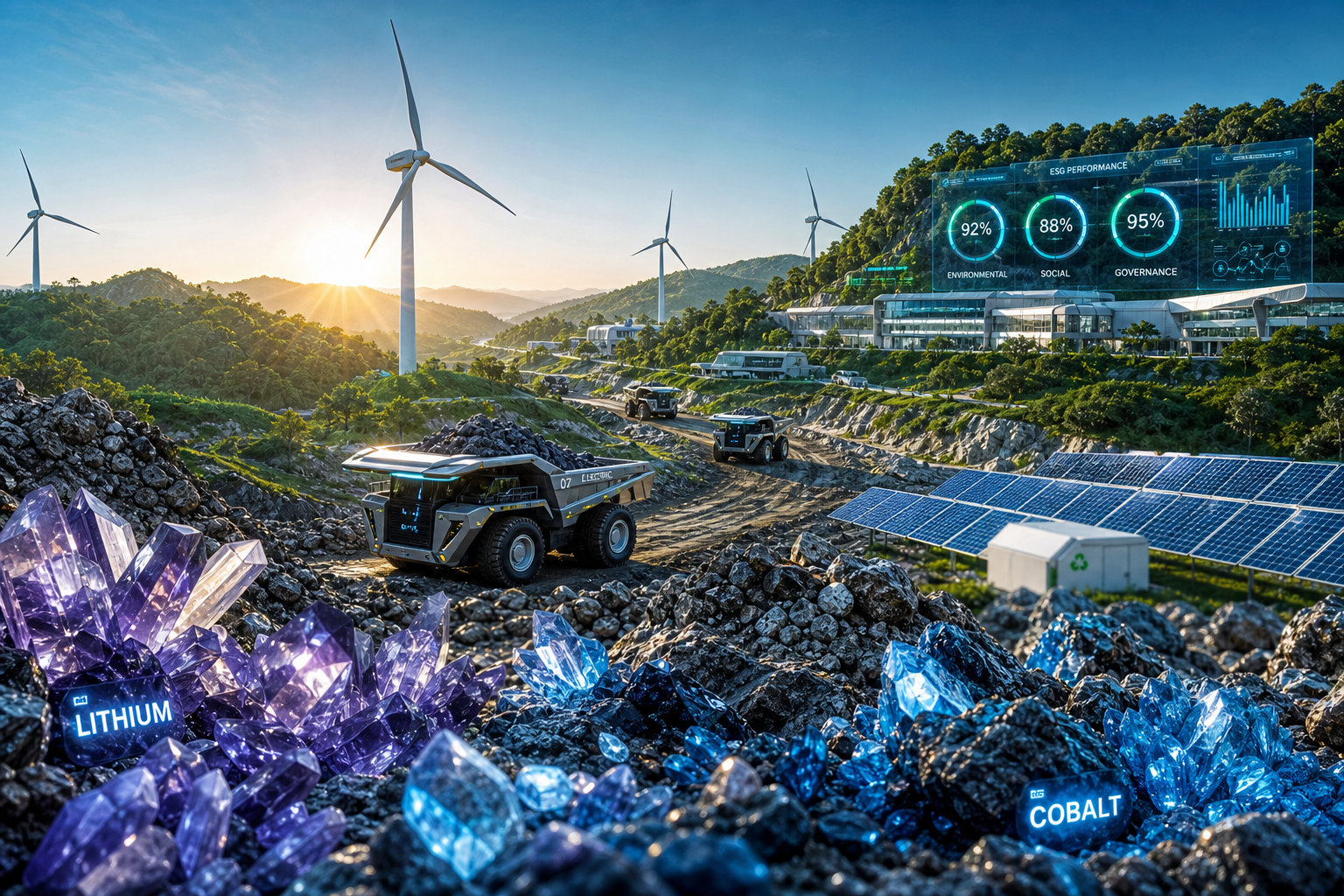
For decades, mining and sustainability have been viewed as opposing forces. Mining is fundamentally about extracting finite natural resources from the Earth, while sustainability focuses on conserving those very resources for future generations. At first glance, the two appear incompatible.
Yet today’s global economy tells a different story.
The transition toward renewable energy, electric mobility, digital infrastructure, and advanced manufacturing has created an unprecedented demand for critical minerals. Lithium, cobalt, nickel, copper, graphite, and rare earth elements (REEs) have become indispensable for building electric vehicle batteries, wind turbines, solar panels, energy storage systems, semiconductors, and countless modern technologies.
Ironically, building a sustainable future now depends on mining.
This reality has transformed the industry’s priorities. Mining companies are no longer evaluated solely by production volumes or profitability- they are increasingly judged by how responsibly they extract resources, manage environmental impacts, protect biodiversity, engage local communities, and contribute to long-term social value.
The question is therefore no longer whether mining and sustainability can coexist. Instead, it is:
Can mining evolve quickly enough to meet global demand while protecting people and the planet?
The answer lies in how effectively the industry embraces innovation, responsible governance, and a sustainability-first mindset.
The Rising Demand for Critical Minerals
The world’s clean energy transition is accelerating at an extraordinary pace.
Governments across the globe have committed to reducing carbon emissions, industries are electrifying operations, and consumers are increasingly adopting cleaner technologies. Every electric vehicle requires significantly more minerals than conventional vehicles, while renewable energy systems demand vast quantities of copper, rare earth elements, nickel, and lithium.
As a result, demand for critical minerals is expected to continue growing substantially over the coming decades.
However, this growing demand presents a significant challenge.
Mining activities inevitably disturb land, consume water, generate waste, and require considerable energy. Without responsible management, these impacts can affect ecosystems, biodiversity, indigenous communities, and local livelihoods.
This creates one of the mining industry’s greatest balancing acts: delivering the materials essential for a low-carbon future while minimizing environmental and social impacts throughout the mining lifecycle.
ESG: From Regulatory Obligation to Business Strategy
Environmental, Social, and Governance (ESG) principles have fundamentally changed how mining companies operate.
What was once considered a compliance requirement has become a core business strategy.
Today, investors, governments, financial institutions, technology companies, and automotive manufacturers increasingly evaluate mining companies based on ESG performance alongside traditional financial metrics.
Strong ESG performance delivers tangible business advantages, including:
○ Easier access to investment and sustainable financing
○ Faster regulatory approvals
○ Lower operational and reputational risks
○ Stronger community acceptance
○ More resilient supply chains
○ Preferred partnerships with global manufacturers
Companies supplying critical minerals are now expected to demonstrate not only operational excellence but also ethical sourcing, transparent governance, responsible environmental management, and measurable climate commitments.
For many organizations, sustainability has become a competitive advantage rather than simply a regulatory obligation.
Building a More Sustainable Mining Industry
While mining will always have environmental impacts, significant progress is being made across the industry. Sustainability is increasingly becoming embedded in day-to-day operations rather than existing solely in annual sustainability reports.
Several important developments are driving this transformation.
Better Tailings and Water Management
Tailings storage remains one of mining’s most significant environmental responsibilities.
Following several high-profile failures globally, the industry has significantly strengthened standards for tailings management.
Many member companies of the International Council on Mining and Metals (ICMM) now report approximately 67% conformance with the Global Industry Standard on Tailings Management (GISTM). Improved monitoring systems, transparent reporting, and stronger governance are helping reduce risks while improving investor confidence.
Water stewardship has also become a major focus area. Modern operations increasingly prioritize water recycling, closed-loop systems, and responsible watershed management to reduce freshwater consumption and protect surrounding ecosystems
Decarbonizing Mining Operations
Mining itself is becoming cleaner.
Companies are investing heavily in renewable energy, battery-powered equipment, electrified haulage fleets, and low-carbon mineral processing technologies.
Industry surveys indicate that approximately 68% of mining companies plan to electrify at least one-quarter of their haulage fleets by 2030.
Major global operators are backing these ambitions with substantial investments:
○ BHP aims to reduce operational greenhouse gas emissions by at least 30% by 2030 compared to its 2020 baseline.
○ Rio Tinto has committed $5–6 billion toward decarbonization projects by 2030 as part of its pathway to achieving net-zero Scope 1 and Scope 2 emissions by 2050.
These initiatives demonstrate that reducing emissions is no longer viewed solely as an environmental responsibility- it is increasingly recognized as a long-term business investment.
Greater Transparency Through Standardised Reporting
Reliable sustainability reporting has become essential for maintaining stakeholder trust.
Global frameworks such as:
○ IFRS S1 and S2 issued by the International Sustainability Standards Board (ISSB)
○ The European Union’s Corporate Sustainability Reporting Directive (CSRD)
○ GRI 14 – Mining Sector Standard
are creating greater consistency in ESG disclosures across the mining industry.
By 2026, more than 60% of publicly listed mining companies are expected to report standardised ESG metrics within their annual disclosures.
This growing transparency enables investors, regulators, customers, and communities to evaluate sustainability performance using credible and comparable information rather than marketing claims.
Technology is Making Mining Smarter
Digital transformation is rapidly reshaping mining.
Artificial Intelligence (AI), machine learning, satellite monitoring, drones, Internet of Things (IoT) sensors, autonomous equipment, and digital twins are helping companies improve operational efficiency while reducing environmental impacts.
These technologies enable organisations to:
○ Optimise exploration with minimal land disturbance
○ Monitor water quality in real time
○ Track air emissions continuously
○ Predict equipment failures before they occur
○ Improve tailings management
○ Restore mined land more effectively
○ Enhance worker safety
Rather than treating sustainability as a separate initiative, digital technologies are integrating environmental responsibility directly into everyday operational decision-making.
Communities at the Center of Sustainable Mining
True sustainability extends beyond environmental protection.
Mining projects can only succeed when local communities benefit alongside businesses.
Progressive mining companies are increasingly investing in:
○ Local employment opportunities
○ Workforce development
○ Community healthcare
○ Education initiatives
○ Local supplier development
○ Infrastructure improvements
○ Indigenous engagement
○ Transparent stakeholder consultation
Investors are also placing greater emphasis on social responsibility.
More than 179 financial institutions managing over $22 trillion in assets now consider nature-related and community-related risks when making investment decisions through the Taskforce on Nature-related Financial Disclosures (TNFD).
Strong community relationships are increasingly recognised as critical drivers of long-term operational success.
The Next Frontier: Circular Mining
Another emerging trend reshaping the industry is the concept of a circular economy. Rather than relying exclusively on newly extracted resources, mining companies are increasingly exploring opportunities to recover valuable minerals through recycling, urban mining, reprocessing historical mine waste, and improving resource efficiency across supply chains.
Although primary mining will remain essential for decades, integrating circular economy principles can significantly reduce environmental impacts while extending the value of existing resources.
This shift represents another important step toward making mining more sustainable over the long term.
Challenges Still Remain
Despite remarkable progress, sustainability in mining remains an ongoing journey rather than a completed achievement.
Several challenges continue to require industry-wide collaboration:
○ Increasing global demand for critical minerals
○ Protecting biodiversity in sensitive ecosystems
○ Managing water scarcity
○ Reducing greenhouse gas emissions further
○ Responsible mine closure and land rehabilitation
○ Ethical sourcing throughout global supply chains
○ Balancing economic development with community expectations
Addressing these challenges will require continued innovation, stronger governance, supportive public policies, and sustained collaboration between governments, industry, academia, and local communities.
Building the Workforce for Sustainable Mining
Technology, policies, and ESG frameworks alone cannot transform the mining industry.
People remain the driving force behind sustainable change.
As mining operations become increasingly digital, automated, and sustainability-focused, organisations need professionals equipped with new technical competencies, environmental awareness, leadership capabilities, and governance expertise.
This growing demand has made workforce development one of the industry’s highest priorities.
At iCEM, we believe that building sustainable mining begins with building capable professionals. Through industry-aligned training, competency development programs, technical education, and capacity-building initiatives, iCEM helps prepare today’s workforce for tomorrow’s mining challenges.
Our programs emphasise environmental stewardship, occupational safety, ESG readiness, responsible resource management, operational excellence, and emerging mining technologies. By working closely with industry, government, and academic partners, iCEM bridges the gap between evolving industry expectations and workforce capability.
As sustainability becomes central to mining operations, developing skilled professionals who understand both productivity and responsibility will be essential to achieving long-term success.
Conclusion
Mining and sustainability are no longer mutually exclusive concepts.
The minerals required to build a cleaner, greener future can only be sourced through mining, but how those minerals are extracted matters more than ever before.
Encouragingly, the industry is demonstrating that responsible mining is not only possible but increasingly essential. Investments in cleaner technologies, stronger ESG frameworks, digital innovation, transparent reporting, community engagement, and workforce development are reshaping mining into a more accountable and resilient industry.
The journey is far from complete, and important challenges remain. However, the direction is clear.
The future of mining is not about choosing between economic growth and environmental responsibility. It is about integrating both to create an industry that delivers the resources society depends on while safeguarding the planet and supporting the communities it serves.
For organisations, governments, and institutions committed to this transformation, sustainability is no longer an aspiration- it is becoming the foundation upon which the next generation of mining will be built.
Frequently Asked Questions (FAQs)
1. Can mining truly be sustainable?
Yes. While mining inevitably impacts the environment, sustainable mining focuses on minimising those impacts through responsible resource extraction, efficient water and energy use, biodiversity conservation, waste management, land rehabilitation, and meaningful engagement with local communities. The goal is to balance economic development with environmental and social responsibility.
2. Why are critical minerals essential for a sustainable future?
Critical minerals such as lithium, cobalt, nickel, copper, and rare earth elements are the building blocks of clean energy technologies. They are used in electric vehicle batteries, solar panels, wind turbines, energy storage systems, and advanced electronics. Without these minerals, achieving global climate and net-zero goals would be extremely difficult.
3. What role does ESG play in modern mining?
Environmental, Social, and Governance (ESG) principles help mining companies operate responsibly while improving business performance. Strong ESG practices enhance investor confidence, improve regulatory compliance, strengthen community relationships, reduce operational risks, and create long-term value for stakeholders.
4. How is technology making mining more sustainable?
Modern technologies such as Artificial Intelligence (AI), digital twins, drones, satellite monitoring, IoT sensors, and automation enable mining companies to optimise exploration, reduce emissions, improve water management, monitor environmental performance in real time, enhance worker safety, and support more effective mine rehabilitation.
5. How does iCEM contribute to sustainable mining?
iCEM (International Center of Excellence in Mining) supports the mining industry’s sustainability journey by developing skilled professionals through industry-focused training and competency development programs. Its initiatives equip individuals and organisations with expertise in ESG practices, environmental stewardship, safety, governance, and modern mining technologies, helping build a future-ready workforce capable of driving responsible and sustainable mining operations.
10 Aug, 2026