Fueling Innovation
for Excellence
Fueling Innovation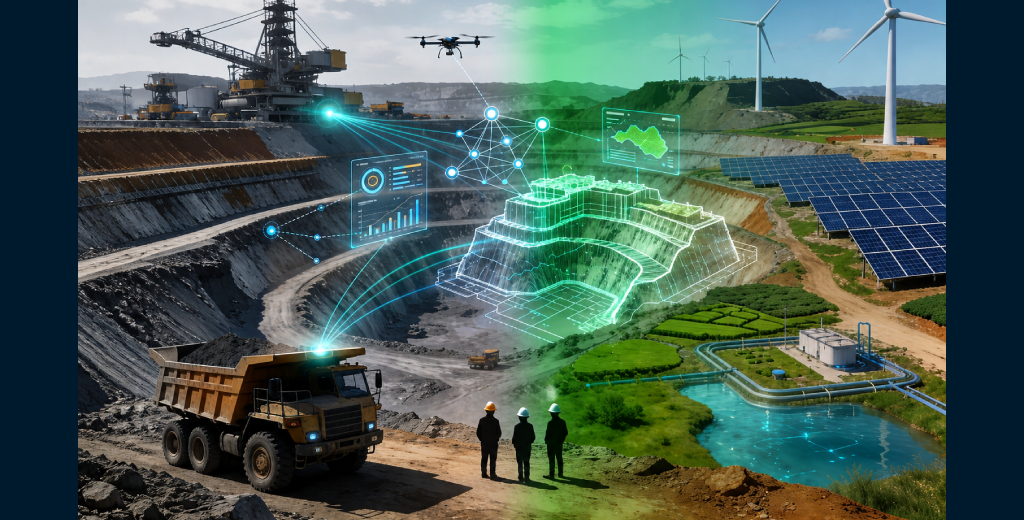
Mining remains fundamental to modern economies. From infrastructure and manufacturing to renewable energy systems, electric mobility and rapidly expanding digital infrastructure, minerals are essential to economic development and the global energy transition.
At the same time, mining has a significant environmental footprint. Operations can consume substantial quantities of energy, water and fuel, while generating tailings, wastewater, dust and greenhouse-gas emissions. Mining also changes landscapes and interacts with surrounding ecological, hydrological and community systems.
The challenge facing the industry, therefore, is not simply to produce more. It is to produce more efficiently, safely and responsibly while continuously improving environmental performance.
Digital technology is becoming an important enabler of this transition. Artificial Intelligence (AI), the Internet of Things (IoT), remote sensing, Geographic Information Systems (GIS), drones, automation, advanced analytics and digital twins are changing how mines are operated, monitored and managed.
However, digital transformation is not simply about adopting more technology. Its real value lies in converting data into insight, insight into better decisions, and better decisions into measurable improvements in sustainability and operational performance.
From Mining 4.0 to Sustainable Mining
Mining 4.0 introduced a new level of connectivity to the industry. Equipment, infrastructure, processes and people can increasingly be connected through digital networks, generating operational and environmental data continuously.
The next stage is broader.
The emerging Mining 5.0 approach places digitalisation within a more human-centred framework built around sustainability, resilience and responsible development. Technology is no longer viewed only as a means of improving production; it can also support safer workplaces, more efficient resource utilisation, stronger environmental management and better-informed decision-making.
This distinction matters.
A mine should not adopt a technology simply because it is available. Digital investment needs to solve a defined operational, environmental or safety challenge and deliver measurable value.
For sustainable mining, that value can broadly be seen across three interconnected areas: reducing resource intensity, identifying and managing environmental risks earlier, and strengthening transparency, monitoring and compliance.
Improving Energy, Water and Fuel Efficiency
Mining and mineral processing are resource-intensive activities, making efficiency one of the most immediate opportunities for digitalisation.
IoT sensors and connected systems can provide continuous visibility into energy, fuel and water consumption across different areas of an operation. AI and advanced analytics can then analyse this information to identify inefficiencies, detect abnormal consumption patterns and recommend improved operating parameters.
In mineral processing, for example, data-driven optimisation can support more efficient grinding and flotation by responding to changes in ore characteristics and operating conditions.
Similarly, smart water-management systems can monitor pipelines, tanks and processing facilities to identify leaks, losses or unusual consumption. This can support faster corrective action while improving opportunities for water recovery and reuse.
AI-enabled fleet management can also optimise haul routes, reduce unnecessary idling and improve equipment utilisation, helping reduce fuel consumption alongside operating costs.
The result is an important convergence: better resource efficiency can improve both environmental and economic performance.
Moving from Periodic Monitoring to Environmental Intelligence
Traditional environmental monitoring often depends on scheduled sampling, inspections and reporting. These remain essential, but environmental conditions can change between inspection cycles.
Digital technologies can help provide a more continuous picture.
IoT sensors, drones, satellite imagery, GIS and machine learning can be integrated to monitor parameters such as air quality, water quality, dust, land conditions and vegetation. Instead of simply recording what has already happened, these systems can help organisations identify developing trends and investigate anomalies earlier.
For example, rising dust levels could prompt adjustments to watering schedules, vehicle speeds or operating practices. Changes in water-quality parameters could trigger an investigation before conditions develop into a larger environmental issue.
This represents a shift from periodic observation to continuous environmental intelligence.
Strengthening Tailings Risk Management
Tailings Storage Facilities (TSFs) require rigorous engineering, monitoring and governance because of the potential safety and environmental consequences associated with failure.
Digital technologies can strengthen existing surveillance systems by combining ground-based sensors, rainfall information, satellite-based Interferometric Synthetic Aperture Radar (InSAR) and predictive analytics.
InSAR can help detect surface deformation over time, while sensors can continuously monitor selected physical and environmental parameters. When these datasets are integrated, analytics can help identify anomalies or changing conditions that warrant investigation.
The objective is not to replace engineering judgement or physical inspection. Instead, digital tools provide another layer of information that can support earlier investigation and better-informed risk management. The original draft appropriately emphasises that digital monitoring should complement established engineering, governance and damsafety practices.
Supporting Progressive Rehabilitation and Mine Closure
Sustainable mining extends beyond the operational life of a mine. Land rehabilitation, ecological restoration and mine closure require long-term monitoring of vegetation, erosion, drainage, landforms and post-mining land use.
Satellite imagery, drones, GIS and machine learning can help organisations monitor these changes over time. Remote sensing can reveal land-cover changes, while drone surveys can provide high-resolution information for specific rehabilitation areas.
This creates an evidence-based approach to rehabilitation. Instead of viewing restoration primarily as an end-of-mine activity, digital monitoring can support progressive rehabilitation, allowing performance to be measured and corrective action to be taken throughout the mining lifecycle.
Digital Twins: Moving from Monitoring to Prediction
One of the more advanced applications of digitalisation is the digital twin – a virtual representation of a physical asset, process or system that can be continuously informed by operational data.
When combined with sensors, AI, simulation and analytics, digital twins can help mining organisations understand how systems are performing and explore how they may respond under different scenarios.
This can support a fundamental shift in management:
Detect → Respond → Predict → Prevent → Optimise
Rather than waiting for a problem to occur, organisations can increasingly use data to anticipate potential issues, evaluate alternatives and make informed interventions.
Digital twins can therefore become valuable decision-support tools for operational resilience, maintenance, resource efficiency and environmental risk management.
Building a Connected Digital Ecosystem
No single technology will make mining sustainable.
The greatest potential comes from connecting complementary technologies. IoT sensors generate realtime information. Drones and satellites provide spatial visibility. GIS brings location-based datasets together. AI and analytics identify patterns and anomalies. Digital twins support simulation. Dashboards translate complex information into accessible decision support.
For this ecosystem to work effectively, however, mines also need strong digital foundations.
Data quality, system interoperability, cybersecurity and data governance become increasingly important as more operational systems are connected. Organisations also need clearly defined responsibilities for how digital alerts are validated, escalated and converted into action.
A sophisticated dashboard has limited value if the information behind it is unreliable or decision-makers do not know how to respond to it.
Technology Alone Is Not Enough
Perhaps the most important aspect of digital transformation is also the easiest to overlook: people.
Mining organisations need professionals who understand both digital tools and the realities of mine operations. They need people capable of interpreting data, recognising environmental and operational risks and translating digital insights into practical decisions.
That requires investment not only in hardware and software but also in digital and data literacy, sustainability competencies, analytical capability, cybersecurity awareness, cross-functional collaboration and continuous professional development.
Successful transformation also requires collaboration across traditionally separate functions. Mining engineers, geologists, environmental professionals, data specialists, equipment teams and management increasingly need to work within a connected decision-making environment.
The future of mining will therefore be shaped not simply by how advanced its technologies become, but by how effectively people can use them.
iCEM: Building Capability for Digitally Enabled Sustainable Mining
The International Centre of Excellence in Mining (iCEM) can contribute to this transition by helping bridge academic knowledge, industry experience, emerging technologies and practical mine-site requirements.
The opportunity goes beyond teaching professionals how to operate individual digital tools. The larger objective is to develop professionals who can understand where technology creates meaningful value, how it can be integrated into mining operations and how digital insights can be converted into measurable outcomes.
Through industry-aligned training, professional competency development, applied learning and academic–corporate collaboration, iCEM can help strengthen the capabilities required for digitally enabled sustainable mining.
Towards a Smarter and More Responsible Mining Future
Digital technology offers mining organisations unprecedented visibility into their operations and environmental performance. But visibility alone does not create sustainability.
The real transformation occurs when reliable information enables earlier action, better decisions and measurable improvements.
For India, where mining will continue to support infrastructure, industry and the energy transition, developing this combination of technological capability, professional expertise and responsible governance will be increasingly important.
The opportunity is not merely to use technology to mine better.
It is to use technology to mine more intelligently, safely and responsibly.
That is the real promise of digitally enabled sustainable mining.
Frequently Asked Questions
1. How can digital technology make mining more sustainable?
Digital technologies can improve energy, water and fuel efficiency; strengthen environmental monitoring; support predictive maintenance and risk management; monitor rehabilitation; and provide more reliable data for operational and environmental decision-making.
2. What is the role of AI in sustainable mining?
AI can analyse large volumes of operational and environmental data to identify patterns, detect anomalies, optimise processes and support predictive decision-making. Applications can range from mineral-processing optimisation and fleet management to environmental monitoring and risk detection.
3. How do IoT sensors support mining operations?
IoT sensors enable continuous monitoring of equipment and selected operational or environmental parameters. They can help track water and energy consumption, equipment conditions, environmental indicators and other variables, allowing unusual conditions to be identified earlier.
4. What are digital twins, and how are they used in mining?
A digital twin is a data-informed virtual representation of a physical asset, process or system. In mining, digital twins can support simulation, scenario analysis, predictive monitoring and optimisation, helping teams understand potential outcomes before making operational decisions.
5. Will digital technology replace mining professionals?
Digitalisation changes the capabilities required of mining professionals rather than eliminating the need for human expertise. Engineering judgement, field knowledge, environmental understanding and responsible decision-making remain essential. The strongest model combines technology with skilled professionals who can interpret information and translate it into practical action.