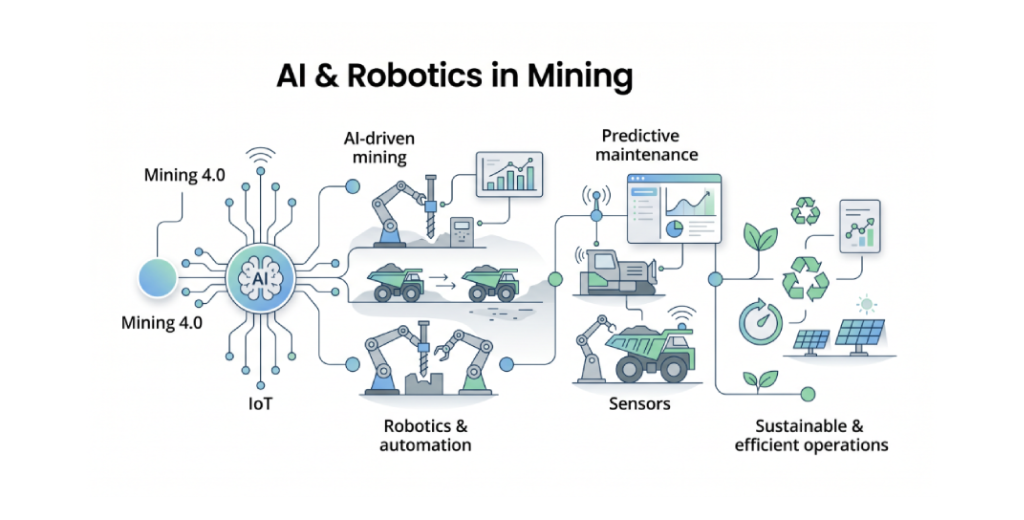
The global mining industry is undergoing a profound transformation, one that is redefining its identity far beyond the traditional perception of heavy machinery, manual labour, and resource extraction. Today, mining stands at the intersection of technology, sustainability, and intelligence. At the core of this evolution lies the integration of Artificial Intelligence (AI) and Robotics, emerging as the central nervous system of modern smart mining ecosystems.
From lithium-rich landscapes in South America to rare earth operations in Australia and Africa, intelligent mining systems are no longer conceptual, they are operational realities. This shift represents more than just technological advancement; it signals a transition toward a mining paradigm that is safer, more efficient, environmentally responsible, and aligned with the demands of a rapidly evolving global economy.
Encouragingly, this transformation is not decades away. The technologies required to build smart mines already exist, and adoption is accelerating. What we are witnessing is a steady, positive progression toward a future where mining is as much about data and intelligence as it is about extraction.
The Rise of Intelligent Mining
The global demand for critical minerals, such as lithium, cobalt, nickel, copper, and rare earth elements like neodymium and dysprosium, is surging. These materials form the backbone of modern technologies, powering electric vehicles, renewable energy systems, advanced electronics, and defense infrastructure.
However, accessing these resources presents significant challenges. Deposits are increasingly located in remote, geologically complex, and environmentally sensitive regions. Traditional mining approaches, while proven, are no longer sufficient to meet the scale, speed, and sustainability expectations of today’s world.
This is where AI and robotics offer a transformative opportunity.
The AI in mining market, currently valued between USD 2.5–3 billion (2024), is projected to grow to USD 7–10 billion by 2030, with a strong CAGR of 20–25%. This growth is driven by multiple factors:
• Rising demand for critical minerals
• Increasing operational complexity
• Pressure to reduce costs and improve efficiency
• Heightened focus on worker safety and environmental responsibility
AI-enabled exploration alone is expected to unlock up to USD 150 billion in new mineral discoveries over the next decade, highlighting the immense potential of intelligent mining technologies.
Artificial Intelligence: The Brain Behind Smart Mining
AI and Machine Learning are now embedded across the entire mining value chain, from exploration and planning to extraction and processing. These technologies are not just enhancing operations; they are fundamentally redefining how decisions are made.
1. Smarter Exploration
Traditional mineral exploration is time-intensive and costly, often taking over a decade to transition from discovery to production. AI is dramatically compressing this timeline.
Machine learning models analyze vast datasets, including satellite imagery, geological surveys, geophysical data, and historical drilling records, to identify high-probability mineral zones. This data-driven approach significantly improves accuracy and efficiency.
Key benefits include:
• Up to 50% reduction in exploration costs
• 3–5x increase in drilling success rates
• Faster identification of viable deposits
AI-led exploration has already demonstrated its value by uncovering large-scale mineral deposits in previously overlooked regions. These breakthroughs are not incremental, they are reshaping how the industry approaches resource discovery.
2. Predictive Maintenance: Minimising Downtime
Unplanned equipment failures remain one of the most expensive challenges in mining operations. A single breakdown of critical equipment, such as a haul truck, can halt production and incur substantial losses.
AI-driven predictive maintenance systems address this issue by continuously monitoring equipment health through sensors that track:
• Temperature
• Vibration
• Pressure
• Wear patterns
Using advanced analytics, these systems predict potential failures before they occur, enabling proactive maintenance.
Impact:
• 10–40% reduction in maintenance costs
• Up to 50% decrease in downtime
• Increased asset lifespan and operational reliability
Additionally, digital twins, virtual replicas of physical equipment, simulate real-time performance, allowing operators to optimize maintenance schedules and operational efficiency.
3. AI in Ore Processing: Efficiency at the Source
Ore processing is one of the most resource-intensive stages in mining. AI is transforming this phase through intelligent ore sorting systems powered by computer vision and machine learning.
Instead of processing bulk material indiscriminately, AI systems identify and separate high-value ore from waste at the extraction point.
Benefits:
• 10–15% increase in ore grade
• Up to 20% reduction in water usage
• Lower energy consumption
• Improved recovery rates
These improvements not only enhance profitability but also significantly reduce environmental impact, making operations more sustainable.
4. Safer Mines Through Intelligent Monitoring
Safety has always been a critical priority in mining. AI is now playing a pivotal role in enhancing workplace safety through real-time monitoring and predictive analytics.
Computer vision systems track worker movements and equipment interactions, enabling immediate alerts in hazardous situations. AI platforms also analyze historical and real-time data to identify risk patterns and prevent accidents.
Outcomes:
• 10–20% reduction in Lost Time Injuries (LTIs)
• Improved situational awareness
• Enhanced emergency response capabilities
The shift toward remote operations and automation is further reducing human exposure to high-risk environments, creating safer, more controlled mining ecosystems.
Robotics & Automation: The Muscle of Smart Mines
If AI serves as the brain, robotics represents the physical force driving execution. Autonomous and semi-autonomous systems are now integral to mining operations, transforming how tasks are performed across both surface and underground environments.
1. Autonomous Haulage Systems
Autonomous trucks equipped with GPS, LiDAR, radar, and AI navigation are revolutionizing material transport in mines.
These systems operate continuously with high precision, optimizing routes and minimizing human error.
Advantages:
• 15–20% increase in productivity
• 10–15% reduction in fuel consumption
• Up to 30% reduction in operating costs
• 20–25% improvement in fleet utilization
• Up to 40% reduction in safety incidents
Remote operation centers allow centralized control, enabling efficient management of large fleets even in remote locations.
2. Robotic Drilling & Blast Optimization
AI-guided drilling systems analyze geological data in real time to determine optimal drilling patterns. This ensures maximum extraction efficiency while minimizing waste.
Automated blasting systems further enhance precision by calculating optimal explosive placement and timing.
Results:
• ±2–5 cm drilling accuracy
• 10–20% productivity increase
• 15–25% improvement in fragmentation
• Reduced environmental impact
• Lower cost per tonne
These technologies enable more controlled, efficient, and environmentally responsible extraction processes.
3. Drones & Robotic Inspection
Drones and robotic systems have become essential tools for surveying and monitoring mining environments.
They are used for:
• Aerial mapping of open-pit mines
• Inspection of tailings and pit walls
• Underground exploration in hazardous zones
Impact:
• 60–80% reduction in survey time
• 30–50% cost savings
• 1–3 cm mapping accuracy
• Up to 90% reduction in human risk exposure
This “eyes everywhere” capability provides real-time insights and enhances decision-making across operations.
4. Precision Mining: Maximising Value, Minimising Waste
Precision mining represents one of the most exciting advancements in the industry. AI-guided robotic systems enable targeted extraction of high-value ore, reducing unnecessary excavation.
Benefits:
• 20–30% increase in ore recovery
• 30–50% reduction in waste
• 12–3x improvement in resource efficiency
• 15–25% lower energy consumption
This approach is particularly valuable for extracting narrow, high-grade mineral deposits that were previously uneconomical.
The Convergence: Toward Mining 4.0
The true power of this transformation lies not in individual technologies, but in their convergence.
AI, robotics, IoT (Internet of Things), digital twins, and data analytics are coming together to form an integrated ecosystem known as Mining 4.0.
This new paradigm is characterized by:
• Data-driven decision-making
• High levels of automation
• Real-time operational visibility
• Improved sustainability and compliance
• Enhanced safety and workforce efficiency
Mining 4.0 is not just about operational improvements, it is about strategic resilience. Nations and organizations that embrace this transition will play a defining role in shaping the future of global supply chains, particularly for critical minerals essential to the green economy.
Sustainability & ESG: A Critical Advantage
Beyond efficiency and productivity, AI and robotics are enabling mining companies to meet Environmental, Social, and Governance (ESG) goals more effectively.
Key contributions include:
• Reduced carbon emissions through optimized operations
• Lower water consumption in processing
• Minimized land disturbance through precision extraction
• Improved transparency in supply chains
As investors and regulators place increasing emphasis on sustainability, these capabilities are becoming essential, not optional.
Building the Future: The Role of Institutions like iCEM
As the mining industry evolves, the need for skilled professionals and knowledge ecosystems becomes critical.
Institutions like iCEM (International Centre of Excellence in Mining), established under the Government of Gujarat, are playing a pivotal role in shaping India’s smart mining future.
By focusing on:
• Advanced training programs
• Research and innovation
• Industry collaboration
• Technology adoption
iCEM is bridging the gap between traditional mining expertise and next-generation digital capabilities.
It is not just preparing a workforce, it is building an ecosystem that aligns India’s mining sector with global standards of safety, efficiency, and sustainability.
The Mine of Tomorrow is Already Here
The transformation of mining through AI and robotics is not a distant vision, it is happening now.
Smart mines are:
• More productive
• Safer for workers
• Environmentally responsible
• Economically efficient
As the world accelerates toward a clean energy future, the importance of critical minerals will only grow. Meeting this demand responsibly requires a new approach, one powered by intelligence, automation, and innovation.
The mine of tomorrow is being built today, through data, technology, and a bold reimagining of what mining can achieve.
FAQs
1. How is AI used in mining operations?
AI is used across the mining value chain, including exploration, predictive maintenance, ore processing, and safety monitoring. It analyzes large datasets to improve decision-making, reduce costs, and enhance operational efficiency.
2. What are the benefits of robotics in mining?
Robotics improves productivity, reduces human exposure to hazardous environments, enhances precision in drilling and extraction, and lowers operational costs through automation.
3. What is predictive maintenance in mining?
Predictive maintenance uses AI and sensor data to monitor equipment health and predict failures before they occur, helping reduce downtime and maintenance costs.
4. What is Mining 4.0?
Mining 4.0 refers to the integration of advanced technologies like AI, IoT, robotics, and data analytics to create intelligent, automated, and sustainable mining operations.
5. How do AI and robotics support sustainable mining?
They reduce energy consumption, minimize waste, optimize resource use, lower emissions, and improve environmental monitoring, helping mining companies meet sustainability and ESG goals.