Fueling Innovation
for Excellence
Fueling Innovation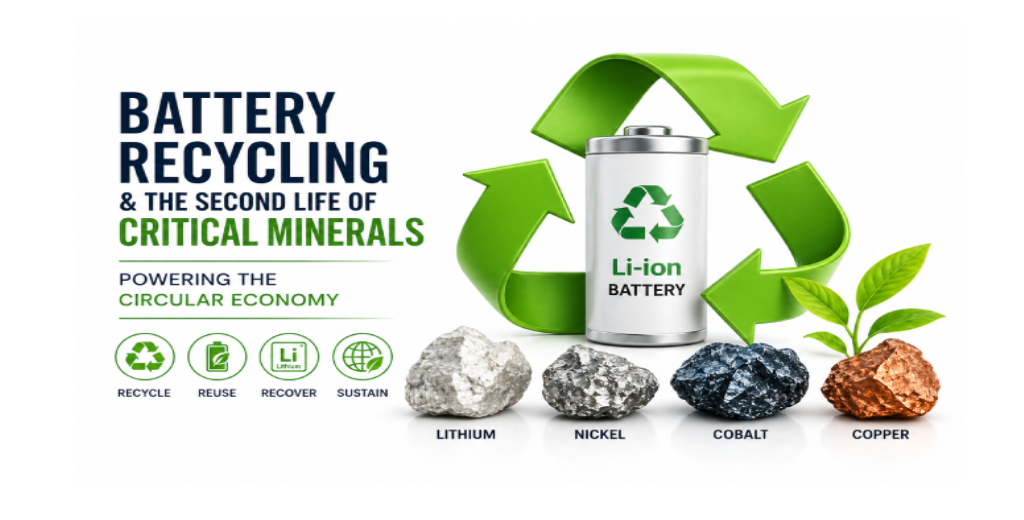
The global transition toward clean energy is no longer a distant ambition, it is happening now. Electric vehicles (EVs), battery energy storage systems (BESS), renewable energy infrastructure, and advanced industrial technologies are rapidly reshaping how the world produces, stores, and consumes energy. At the heart of this transformation lies a group of highly valuable resources known as critical minerals.
Lithium, cobalt, nickel, graphite, manganese, and copper are the foundational elements powering modern battery technologies. These minerals are essential for electric mobility, solar storage, wind power systems, and grid-scale energy resilience. However, as demand accelerates, the challenge becomes increasingly clear: these minerals are finite, geographically concentrated, and vulnerable to supply chain disruptions.
This is where battery recycling and the concept of the second life of critical minerals emerge as powerful solutions.
Rather than treating used batteries as waste, industries and policymakers are now recognizing them as strategic assets, valuable urban mines capable of supplying the next generation of clean technologies. Recycling and repurposing batteries are no longer sustainability side projects; they are becoming central pillars of global energy security, circular economy planning, and net-zero strategies.
As the world races toward decarbonization, battery recycling is transforming from an environmental necessity into a major economic opportunity.
Battery Recycling & the Second Life of Critical Minerals: Powering the Circular Economy
From Rising Demand to Strategic Opportunity
The scale of demand for critical minerals is unprecedented.
According to the International Energy Agency (IEA), lithium demand increased by nearly 30% in 2024 alone, significantly outpacing the average annual growth rate of the previous decade. Demand for nickel, cobalt, and graphite also grew by approximately 6-8% during the same period, driven largely by electric vehicles and energy storage technologies. Today, the clean energy sector accounts for nearly 85% of total demand growth for battery metals.
This surge presents both a challenge and an opportunity.
Currently, the global supply of these minerals is heavily concentrated:
Such concentration creates supply risks, geopolitical dependencies, price volatility, and strategic vulnerabilities for countries building clean energy economies.
To reduce dependence on primary mining and create resilient supply chains, nations are increasingly investing in alternative solutions, particularly battery recycling.
The IEA estimates that by 2040, recycled quantities of lithium, nickel, cobalt, and copper from spent batteries could reduce primary supply requirements by 10-30%, while a successful scale-up of recycling could reduce new mining activity by 25-40% by 2050.
In a net-zero scenario, the market value of recycled energy transition minerals could reach an astonishing USD 200 billion by 2050, representing a fivefold increase from current levels.
This is not simply waste management, it is the creation of a new industrial economy.
Battery Recycling & the Second Life of Critical Minerals: Powering the Circular Economy
Modern lithium-ion batteries are rich in recoverable materials. The cathode, the most valuable component, typically contains combinations of lithium, nickel, manganese, cobalt (NMC), or nickel, cobalt, and aluminum (NCA).
Recovering these materials efficiently requires advanced metallurgical processes.
1. Pyrometallurgy
Pyrometallurgy involves high-temperature smelting of spent batteries to recover metals like cobalt, nickel, and copper.
Advantages:
Limitations:
Although widely used, pyrometallurgy is increasingly being supplemented by more efficient methods.
2. Hydrometallurgy
Hydrometallurgy uses chemical leaching solutions to dissolve battery materials and selectively recover metals at high purity.
Advantages:
This method is becoming the preferred route for next-generation recycling facilities due to its efficiency and ability to produce cathode-active materials directly.
3. Direct Recycling
Direct recycling is an emerging innovation that aims to preserve and regenerate the cathode structure itself rather than breaking it down into individual metals.
Potential Benefits:
Though still developing commercially, direct recycling could become one of the most important breakthroughs in the sector.
Battery Recycling & the Second Life of Critical Minerals: Powering the Circular Economy
Battery recycling technology has advanced significantly in recent years.
The IEA reports that in 2023:
Governments are also strengthening policy frameworks.
The EU Battery Regulation now mandates:
Globally, more than 30 new policy measures related to critical mineral recycling have been introduced since 2022, reflecting a decisive policy shift toward circular battery ecosystems.
Battery Recycling & the Second Life of Critical Minerals: Powering the Circular Economy
Battery recycling begins only after a battery is truly exhausted.
Before that stage, many EV batteries still have significant usable capacity.
An EV battery is generally considered to have reached end-of-automotive-life when its performance drops to around 70-80% of its original capacity. However, for less demanding applications, that remaining capacity is extremely valuable.
This is known as the second life battery concept.
Instead of immediate recycling, retired EV batteries are repurposed for:
This creates both environmental and financial advantages.
In 2025, second-life battery systems can be 30-70% less expensive than equivalent new battery energy storage systems, making them highly attractive for cost-sensitive industries.
By 2030, second-life EV battery supply is projected to exceed 200 GWh per year, creating an entirely new resource pipeline that barely existed a decade ago.
Battery Recycling & the Second Life of Critical Minerals: Powering the Circular Economy
Major global players are actively building second-life ecosystems.
Examples include:
This demonstrates that second-life batteries are not experimental, they are commercially viable and rapidly scaling.
Environmental Benefits: Lower Emissions, Less Mining
The environmental case for recycling and second-life applications is exceptionally strong.
Studies show:
Additionally, recycling reduces:
Every tonne of recovered lithium is one less tonne that must be mined, refined, transported, and processed from scratch.
That is the true power of circularity.
Battery recycling is not an isolated activity, it is the cornerstone of the circular mineral economy.
Unlike fossil fuels, which are consumed once and lost forever, critical minerals can be recovered, refined, and reused repeatedly. This makes them strategic assets rather than disposable commodities.
The journey becomes:
This closed-loop system transforms how industries think about resource security.
For mineral-rich economies, recycling supports:
For importing economies, it provides:
Challenges still remain:
However, policy support, technology innovation, and investor interest are accelerating progress.
The future is not just about mining more, it is about using better.
At the forefront of this transformation stands iCEM – International Center of Excellence in Mining Safety and Automation, an institution promoted by the Gujarat Mineral Development Corporation (GMDC) and established by the Government of Gujarat.
iCEM serves as a dedicated hub for:
Its work in battery recycling, mineral lifecycle analysis, and second-life applications is helping shape India’s long-term strategy for sustainable mineral security.
Through collaborations with:
and flagship initiatives such as the Australia-India Critical Minerals Research Hub, iCEM bridges global expertise with India’s strategic priorities.
As India advances its National Critical Mineral Mission, institutions like iCEM are building the intellectual, policy, and industrial foundation needed for a resilient circular mineral economy.
Battery recycling is no longer a downstream afterthought, it is a strategic necessity for the future of clean energy.
As the world accelerates toward electrification and net-zero goals, the second life of critical minerals will determine how sustainable that transition truly becomes.
The shift is clear:
From extraction to regeneration.
From waste to resource.
From linear consumption to circular value creation.
The batteries powering today’s vehicles and industries are also the mines of tomorrow.
The countries, companies, and institutions that recognize this early will lead the next phase of the global energy transition.
And in that future, recycling will not be the end of the story, it will be where the next one begins.
1. What are critical minerals in battery manufacturing?
Critical minerals are essential raw materials used in battery production, including lithium, cobalt, nickel, graphite, manganese, and copper. These minerals are crucial for EV batteries, renewable energy storage systems, and advanced clean technologies.
2. Why is battery recycling important for the clean energy transition?
Battery recycling helps recover valuable minerals from used batteries, reducing dependence on new mining, lowering carbon emissions, improving supply chain security, and supporting a circular economy for sustainable energy systems.
3. What is meant by the “second life” of EV batteries?
Second-life batteries are retired EV batteries that still retain 70-80% of their capacity and can be reused for stationary energy storage, solar backup systems, microgrids, and industrial power applications before final recycling.
4. How much can recycling reduce the need for new mining?
According to the IEA, successful battery recycling scale-up could reduce the need for new mining activity by 25-40% by 2050, significantly lowering environmental impact and improving mineral supply resilience.
5. How is India preparing for the circular critical mineral economy?
India is strengthening research, policy, and industry collaboration through initiatives like the National Critical Mineral Mission and institutions such as iCEM, which focus on battery recycling, mineral intelligence, and sustainable critical mineral development.