Fueling Innovation
for Excellence
Fueling Innovation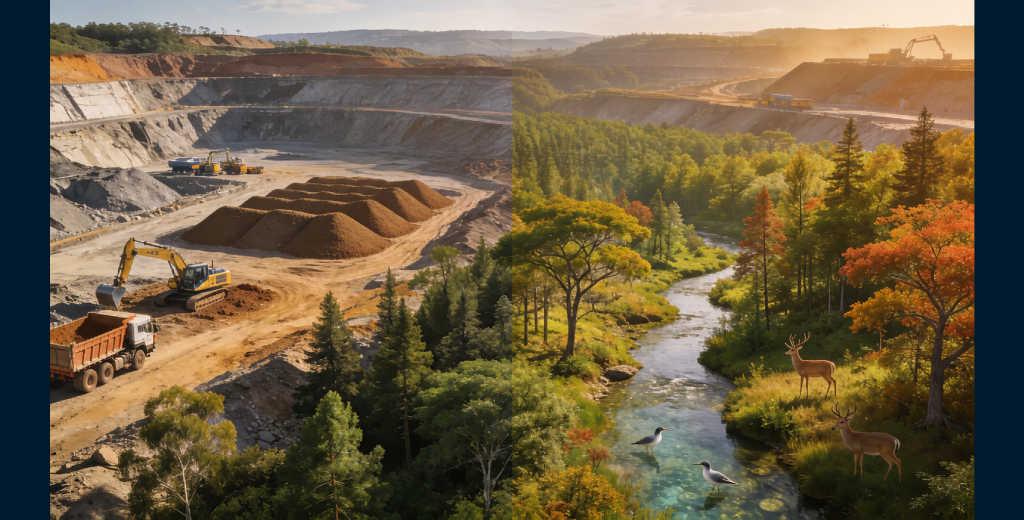
Mining plays a fundamental role in modern society. From infrastructure and transportation to renewable energy systems, electronics and advanced technologies, minerals support almost every aspect of economic development. As demand for critical minerals grows, however, an equally important question must be addressed: how can mineral resources be developed while protecting biodiversity and ensuring that mined landscapes remain valuable for future generations?
Responsible mining extends far beyond efficient extraction. It involves avoiding unnecessary environmental impacts, protecting sensitive ecosystems, managing land and water responsibly, and progressively rehabilitating disturbed areas so that ecological functions and productive land uses can recover after mining.
This makes biodiversity conservation and mine rehabilitation not simply activities undertaken at closure, but essential components of responsible mine planning from exploration through operations and into the postclosure period.
Minerals for the Future, Landscapes for Generations
Critical minerals and rare earth elements are increasingly important to clean-energy technologies, high-technology industries, defence applications and economic development.
India’s National Critical Mineral Mission, approved in January 2025 and planned for the period from 2024–25 to 2030–31, reflects the country’s growing focus on securing critical-mineral supply chains. The mission envisages government expenditure of ₹16,300 crore, alongside an expected ₹18,000 crore contribution from public-sector companies and other stakeholders.
Growing mineral production creates an opportunity to demonstrate that resource development and environmental responsibility can be integrated.
The objective should therefore extend beyond extracting minerals efficiently. It should also consider the condition in which land, water systems, habitats and surrounding communities are left once mining activities conclude.
A mine may have a finite operating life. The landscape does not.
Why Biodiversity Belongs at the Heart of Mining
Mining and biodiversity are closely connected. Mineral deposits may occur within or near ecologically sensitive landscapes, while mining operations themselves depend on ecosystem services including water availability, erosion control, soil stability and functioning landscapes.
Effective biodiversity management therefore begins before major disturbance occurs.
This requires establishing a robust environmental baseline, identifying important habitats and species, understanding ecological connectivity, assessing potential impacts and determining which areas should be avoided or carefully managed. The original paper rightly emphasises that rehabilitation should include native vegetation and habitat restoration, invasive-species management, water-resource protection and long-term monitoring
The importance of careful planning becomes clearer when viewed globally. A satellite-based study referenced in the original document mapped 44,929 mining areas covering approximately 101,583 km². While mining occupies a relatively small proportion of the world’s land surface, individual mining areas can overlap with landscapes of considerable ecological significance
The global biodiversity agenda is also evolving. The Kunming-Montreal Global Biodiversity Framework establishes 23 targets for 2030, including ambitions to conserve 30% of terrestrial, inland-water, coastal and marine areas and restore 30% of degraded ecosystems.
For the mining sector, this reinforces the importance of moving beyond basic compliance towards measurable biodiversity outcomes.
The Mitigation Hierarchy: Protect First, Restore Next
One of the most useful principles for managing miningrelated biodiversity impacts is the mitigation hierarchy.
Its logic is straightforward:
1. Avoid environmental impacts wherever possible.
2. Minimise impacts that cannot reasonably be avoided.
3. Rehabilitate or restore areas that have been disturbed.
4. Offset or compensate for significant residual impacts only where appropriate and as a last resort.
In other words: protect first, restore next, compensate last.
This approach is important because even well-designed ecological restoration cannot always recreate every feature of an original ecosystem. Mature forests, complex soil systems, habitat structures and ecological relationships may take decades or considerably longer to develop
A strong biodiversity baseline is therefore critical. Without understanding the original ecosystem, its important species, habitats and ecological functions, it becomes difficult to define what successful rehabilitation should ultimately achieve.
Progressive Rehabilitation: Restoring While Mining Continues
Modern mine rehabilitation is increasingly based on the principle of progressive rehabilitation.
Rather than waiting until the entire mine reaches closure, rehabilitation begins in areas where mining activities have already been completed.
A well-documented example comes from bauxite mining in Western Australia’s jarrah forest. The rehabilitation sequence highlighted in the original document provides a useful practical model.
First, valuable topsoil is conserved. Because topsoil contains seeds, organic matter and microorganisms, preserving and directly transferring it can significantly support natural regeneration.
Next, disturbed land is reshaped to integrate with the surrounding landscape and relieve soil compaction. Overburden and topsoil are then returned, together with woody debris that can provide habitat for fauna.
Finally, appropriate native vegetation is established and monitored, with ecological indicators tracked over time so management practices can be adapted when required.
This sequence is also clearly illustrated by the rehabilitation diagram on page 2 of the original document: Save Topsoil → Reshape Land → Return Soil → Plant & Monitor.
Progressive approaches are relevant in India as well. The source document highlights phased afforestation practices associated with coal mining and backfilling during beachsand mining at Chavara, Kerala. The central principle is the same: restoration should begin wherever practicable while mining is still underway rather than being postponed entirely until closure.
What Does Successful Mine Rehabilitation Actually Mean?
Rehabilitation should not be measured simply by the number of trees planted.
Successful rehabilitation is better understood through ecological function, resilience and long-term land capability.
Depending on the mine and its agreed post-closure objectives, useful indicators can include vegetation survival and diversity, soil stability, erosion rates, water quality, invasive-species presence, habitat development, wildlife return and the ability of the ecosystem to sustain itself with progressively less intervention.
Global examples demonstrate what sustained rehabilitation can achieve.
In Western Australia’s jarrah forest, more than 75% of areas cleared for bauxite mining have been rehabilitated. Research cited in the original paper reports the return of all mammal species and around 90% of bird and reptile species, while ecosystem functions such as nutrient cycling have shown positive recovery trajectories.
Examples from Papua, Indonesia, and Bolivia similarly demonstrate the use of native vegetation, monitoring and rehabilitation designed around future land use.
The broader lesson is significant: mine rehabilitation is ecological recovery, not landscaping.
Strengthening Rehabilitation Through Technology and Monitoring
Technology can further strengthen biodiversity management.
Remote sensing, satellite imagery, drones, GIS-based mapping and environmental sensors can support regular monitoring of vegetation cover, erosion, landform stability and water systems. Digital records can also make it easier to compare rehabilitation progress against baseline conditions and agreed closure objectives.
But technology should complement, not replace, field ecology and local knowledge.
Effective monitoring needs measurable indicators, appropriate reference ecosystems or completion criteria, regular field verification and adaptive management. If monitoring reveals poor vegetation survival, erosion, invasive species or declining water quality, management measures should be adjusted accordingly.
This turns rehabilitation from a one-time intervention into an evidence-based, adaptive process.
India’s Framework for Responsible Mine Closure
India has increasingly integrated rehabilitation and closure into mine planning.
Under the Mineral Conservation and Development Rules, 2017, mines are required to have progressive and final mine closure plans. Progressive closure planning operates alongside mining activities, while the final closure plan addresses the measures required as operations approach their conclusion.
This approach reflects an important shift in philosophy: closure should be considered from the beginning of the mining lifecycle rather than treated as an issue to address only when mineral reserves are exhausted.
The National Mineral Policy 2019 similarly emphasises scientific mine closure incorporating ecological and socioeconomic considerations.
The National Critical Mineral Mission adds another important dimension by promoting recycling and recovery of critical minerals from tailings and overburden. Greater resource efficiency and secondary recovery can potentially reduce pressure for additional primary extraction while improving the overall utilisation of mined resources.
Communities and Post-Mining Land Use
Another essential element of responsible rehabilitation is deciding what the land should become after mining.
There is no universal answer. Depending on ecological conditions, community requirements, safety considerations and regulatory commitments, post-mining landscapes may support restored natural habitat, forestry, agriculture, water bodies, recreation or other productive uses.
Local communities and relevant stakeholders should therefore be engaged early in closure and rehabilitation planning.
Their participation can help identify locally appropriate land uses, environmental priorities and livelihood considerations while reducing the risk of creating technically rehabilitated landscapes that do not meet longterm social needs.
Successful mine closure should consequently consider three interconnected dimensions: environmental stability, ecological recovery and sustainable post-mining value.
How iCEM Can Support the Next Generation of Sustainable Mining
The International Centre of Excellence in Mining (iCEM), established by Gujarat Mineral Development Corporation (GMDC), has a vision of enabling sustainable mining from societal, environmental and commercial perspectives.
Its approach combines capacity building, skill development, knowledge resources, technology, innovation and strategic collaboration. The original document identifies partnerships including Texmin at IIT (ISM) Dhanbad, Monash University, CIMFR and PDEU.
This capability-building role is increasingly important.
The mining professionals of the future will require expertise that extends beyond extraction and production. Understanding biodiversity management, mine rehabilitation, closure planning, water stewardship, environmental monitoring, technology and resource efficiency will be essential to delivering responsible mining outcomes.
Through education, professional development, collaboration and knowledge exchange, institutions such as iCEM can help strengthen the capabilities required for a mining sector that is safer, smarter, environmentally responsible and prepared for the future.
The future of mining will not be judged solely by how efficiently resources are extracted. Increasingly, it will also be judged by what remains after mining is complete.
Biodiversity conservation begins with avoidance and informed planning. Rehabilitation begins with protecting soils, water and ecological functions. Successful closure requires clear objectives, progressive action, scientific monitoring, adaptive management and meaningful consideration of future land use.
Most importantly, rehabilitation should not begin when a mine closes.
It should begin when the mine is planned.
By integrating biodiversity considerations throughout the mining lifecycle, the industry can help ensure that the minerals required for today’s development do not come at the expense of tomorrow’s landscapes.
Responsible mining is ultimately about extracting resources while creating the conditions for nature, land and communities to continue beyond the life of the mine.
Frequently Asked Questions (FAQs)
1. What is mine rehabilitation?
Mine rehabilitation is the process of restoring land disturbed by mining to a safe, stable and environmentally sustainable condition. Depending on the site’s objectives, this can include land reshaping, soil replacement, erosion control, revegetation, habitat restoration and long-term ecological monitoring.
2. Why is biodiversity conservation important in mining?
Mining can affect vegetation, wildlife habitats, soils, water systems and ecological connectivity. Integrating biodiversity considerations into mine planning helps avoid or minimise these impacts and improves the potential for successful ecosystem recovery.
3. What is progressive mine rehabilitation?
Progressive rehabilitation means restoring areas of a mine once mining in those specific areas has been completed, rather than waiting until the entire operation closes. This can reduce the amount of disturbed land at any one time and allows rehabilitation methods to be tested and improved during the operational life of the mine.
4. What is the mitigation hierarchy?
The mitigation hierarchy is a structured approach to environmental impact management: avoid impacts first, minimise unavoidable impacts, restore affected areas, and use offsets or compensation for significant residual impacts only as a last resort.
5. Is planting trees enough to rehabilitate a mine?
No. Revegetation is only one component. Effective rehabilitation may also require restoring soil function, managing water, controlling erosion and invasive species, rebuilding habitat, establishing native vegetation and monitoring ecological recovery over many years.