The New Geopolitics of Minerals
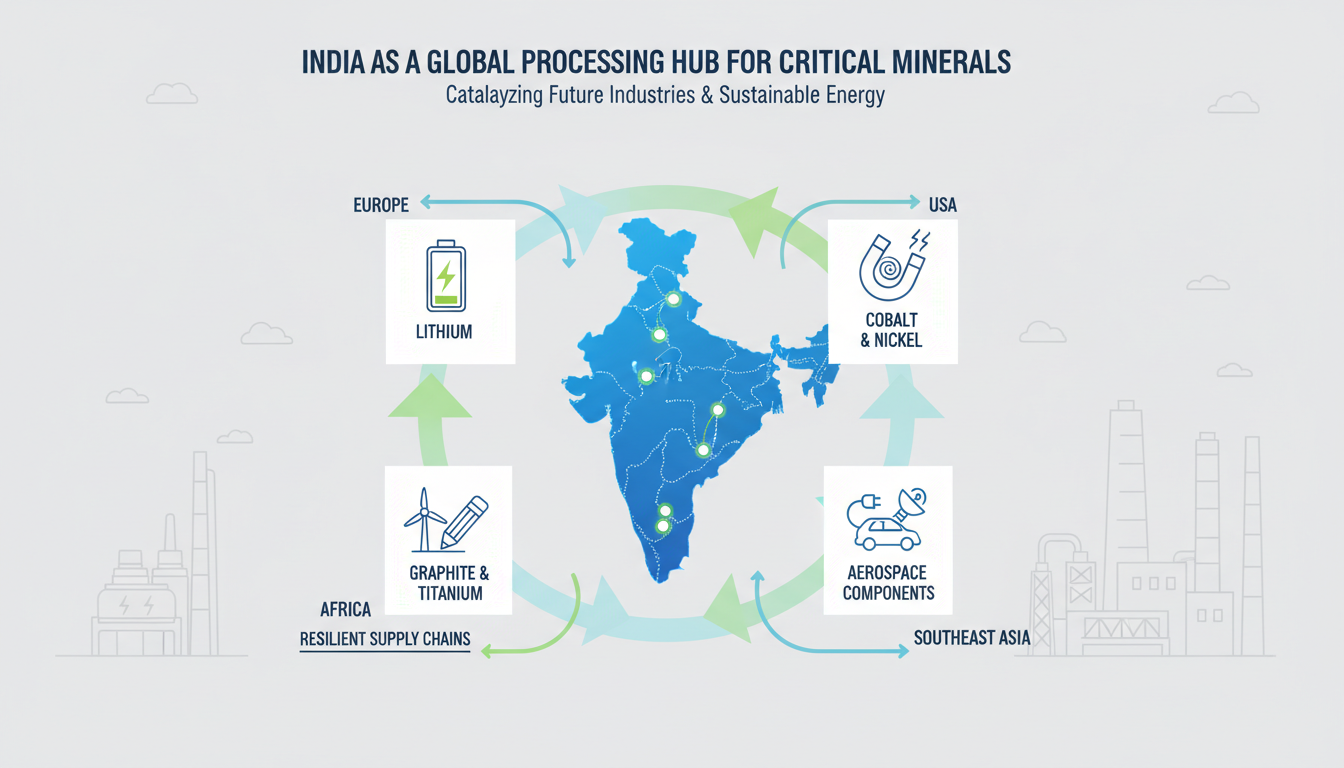
In the 20th century, oil shaped geopolitics. In the 21st century, critical minerals are assuming that role. Lithium powers electric vehicle batteries. Rare earth elements enable wind turbines, permanent magnets, and advanced defence systems. Cobalt, nickel, graphite, and titanium underpin clean energy storage, aerospace, and high-performance manufacturing. These materials are no longer niche industrial inputs; they are the foundation of the global energy transition and digital economy.
As countries accelerate decarbonization and advanced manufacturing, control over mineral processing and refining, not just mining, has emerged as the true strategic lever. Processing determines who captures value, who sets standards, and who commands supply chain resilience. Recognising this, major economies across Asia, Europe, and the Americas are rapidly reshaping supply chains to reduce overdependence and build trusted networks.
In this historic realignment, India stands at a pivotal moment. With geological potential, industrial capability, policy momentum, and geopolitical credibility, the country is uniquely positioned to evolve into a global processing hub for critical minerals. The question is no longer whether the opportunity exists; it is whether India can execute at scale and speed.
India’s Geological and Industrial Foundations
India possesses significant and diverse mineral resources that form a strong sovereign base for critical mineral development. Among the most notable are:
• Thorium reserves (among the largest globally)
• Titanium-bearing minerals such as ilmenite and rutile
• Bauxite (for Aluminium production)
• Graphite
• Rare earth elements
India’s public sector enterprise IREL (India) Limited already operates a Rare Earth Extraction Plant at Chhatrapur, Odisha, and a Rare Earth Refining Unit at Aluva, Kerala, processing substantial volumes annually. These facilities demonstrate that India is not starting from zero, it has a functioning base in mineral separation and refining.
Beyond geology, India’s broader industrial ecosystem offers distinct advantages:
1. A large and diversified manufacturing basecapable of downstream integration.
2. Established chemical and metallurgical expertise,critical for hydrometallurgical and pyrometallurgical processing.
3. Cost competitiveness,especially in skilled technical labour.
4. A growing innovation ecosystem,including IITs and national laboratories.
Processing critical minerals requires complex chemical engineering, environmental management, and high-precision metallurgy. India’s experience in refining petroleum, producing speciality chemicals, and manufacturing advanced materials gives it a structural platform to scale mineral processing operations.
From Vision to Strategy: The National Critical Mineral Mission
A turning point in India’s mineral strategy came with the launch of the National Critical Mineral Mission (NCMM). Backed by an allocation of ₹34,300 crore over seven years (FY 2024–25 to FY 2030–31), the mission represents India’s most comprehensive push to build an end-to-end critical mineral value chain.
Key pillars of the NCMM include:
1. Accelerated Exploration
Targeting approximately 1,200 domestic geological exploration projects by 2031 to identify viable deposits across the country.
2. Overseas Asset Acquisition
Through Khanij Bidesh India Ltd (KABIL), India is securing equity stakes and exploration rights abroad. A notable example includes lithium exploration rights in Argentina’s Catamarca province, strengthening upstream security.
3. Mineral Processing Parks
Dedicated processing zones are being conceptualised to provide shared infrastructure, logistics, utilities, testing labs, and environmental compliance frameworks, reducing entry barriers for investors.
4. Recycling Incentives
A ₹1,500 crore recycling incentive scheme is designed to strengthen recovery of lithium, cobalt, rare earths, and other minerals from e-waste and spent batteries, embedding circular economy principles.
5. Research and Innovation
A target of 1,000 patents in critical mineral technologies by FY 2030–31, supported by Centres of Excellence at institutions such as Indian Institute of Technology Bombay and other leading technical institutes.
6. Trade and Fiscal Support
Duty exemptions on select critical minerals and policy reforms to make domestic processing globally competitive.
Collectively, these measures indicate a deliberate shift, from opportunistic participation to structured industrial strategy.
The Rare Earth Imperative
Rare earth elements (REEs) are indispensable for permanent magnets used in EV motors, wind turbines, robotics, and defence systems. Recognising this, India has taken additional targeted steps.
The Union Budget announced Dedicated Rare Earth Corridors across Odisha, Kerala, Andhra Pradesh, and Tamil Nadu, integrated ecosystems combining mining, processing, research, and magnet manufacturing.
Complementing this is a ₹7,280 crore Rare Earth Permanent Magnet (REPM) Manufacturing Scheme aimed at building 6,000 MTPA integrated capacity, from rare earth oxides to finished magnets, supported by sales-linked incentives and capital subsidies.
The Geological Survey of India has identified over 480 million tonnes of rare earth ore resources, providing a geological anchor to this ambition.
If implemented effectively, this integrated approach, from ore to magnet, could significantly elevate India’s position in advanced materials manufacturing.
Domestic Demand: A Built-In Market Advantage
Unlike smaller economies that rely solely on exports, India benefits from massive and growing domestic demand:
• EV penetration targets of 30% by 2030
• 500 GW renewable energy capacity goal
• Expansion in grid storage systems
• Rapid growth in electronics manufacturing
• Increasing defence indigenisation
This internal demand offers two advantages:
1. Scale assurance for domestic processors.
2. Value capture within the country, enabling integration into battery manufacturing, renewable energy equipment, and electric mobility ecosystems.
A strong home market reduces volatility risks and strengthens investor confidence.
Global Partnerships and Strategic Positioning
India’s diplomatic positioning has become a strategic asset. Through partnerships with Australia, Argentina, the United States, Japan, and other like-minded nations, India is embedding itself within trusted mineral supply chains.
As global companies seek diversification and resilience, India offers:
• A democratic and transparent regulatory framework
• A large domestic market
• Competitive production costs
• Increasing policy clarity
With the global critical minerals market projected to exceed USD 770 billion by 2040, supply chain diversification is no longer optional; it is strategic. India’s ability to combine geopolitical trust with industrial scale enhances its attractiveness as a processing destination.
Challenges That Must Be Addressed
While the opportunity is significant, execution challenges remain:
1. Technology Gaps
Advanced separation and refining technologies for lithium, cobalt, and rare earths require continuous R&D and global collaboration.
2. Environmental and Social Compliance
Processing critical minerals involves hazardous chemicals and tailings management. Strict environmental safeguards and transparent ESG practices are essential.
3. Infrastructure Readiness
Reliable power, water availability, logistics, and port connectivity are vital for processing hubs.
4. Skilled Workforce
Specialised training in extractive metallurgy, electrochemistry, and process automation must scale rapidly.
5. Global Competition
Other nations are simultaneously investing in processing capacity, intensifying competition for capital and technology.
Addressing these challenges requires coordinated action across ministries, state governments, PSUs, academia, and private industry.
The Circular Economy Opportunity
One of India’s most promising strengths lies in recycling. The country already has a growing e- waste and battery recycling industry. With structured incentives under the NCMM:
• Lithium recovery from spent batteries
• Rare earth recovery from magnets and electronics
• Cobalt and nickel extraction from scrap
can significantly reduce import dependence.
Recycling also improves ESG performance and reduces environmental impact, key considerations for global investors and customers.
The Road Ahead: Execution Will Define Success
India’s ambition to become a global processing hub is credible. The ingredients are present:
• Geological potential
• Policy clarity
• Fiscal support
• Domestic demand
• Strategic partnerships
• Industrial capability
However, the next five years will be decisive. Operationalizing processing parks, accelerating technology transfers, ensuring environmental compliance, and maintaining investor confidence will determine whether India merely participates in the mineral economy, or leads it.
The opportunity is historic. If executed well, India can shift from being primarily a raw material supplier to becoming a value-added processor and advanced materials manufacturer, capturing greater economic and strategic returns.
iCEM: Powering the Knowledge Engine Behind India’s Mineral Ambition
At the heart of sustainable mineral development lies knowledge and innovation. The International Centre of Excellence in Mining Safety & Automation (iCEM), founded in 2016 by the Government of Gujarat and promoted by GMDC as a not-for-profit knowledge organisation, is playing a critical enabling role.
Located near Ahmedabad, iCEM operates at the intersection of mining technology, sustainability, and industry collaboration. Its work spans AI-enabled mine management, IoT integration, water recovery systems, blue hydrogen exploration, and digital mining practices.
Through partnerships with institutions such as Indian Institute of Technology (Indian School of Mines), Dhanbad, Monash University, and CIMFR, iCEM bridges global research excellence with India’s operational realities.
As India scales its critical mineral ambitions, institutions like iCEM ensure that growth is technologically advanced, environmentally responsible, and globally competitive.
Frequently Asked Questions (FAQs)
1. What are critical minerals, and why are they important?
Critical minerals are essential raw materials—such as lithium, cobalt, nickel, graphite, and rare earth elements—that are vital for clean energy technologies, electric vehicles, electronics, aerospace, and defence. They are considered “critical” due to their economic importance and supply chain risks.
2. Why is mineral processing more important than mining alone?
Processing converts raw ore into refined materials suitable for manufacturing. The highest value addition, technology control, and supply chain influence lie in processing rather than extraction alone.
3. What is the National Critical Mineral Mission (NCMM)?
The NCMM is a government initiative aimed at building India’s end-to-end critical mineral value chain, including exploration, overseas acquisitions, processing parks, recycling incentives, and research support.
4. How does recycling contribute to India’s mineral security?
Recycling reduces import dependence, improves sustainability, and recovers valuable materials from e-waste and used batteries. It also strengthens India’s circular economy and ESG performance.
5. Can India realistically compete with established global processors?
Yes, provided it accelerates technology acquisition, ensures environmental compliance, builds robust infrastructure, and maintains policy consistency. India’s large domestic market and geopolitical positioning provide significant competitive advantages.