Fueling Innovation
for Excellence
Fueling Innovation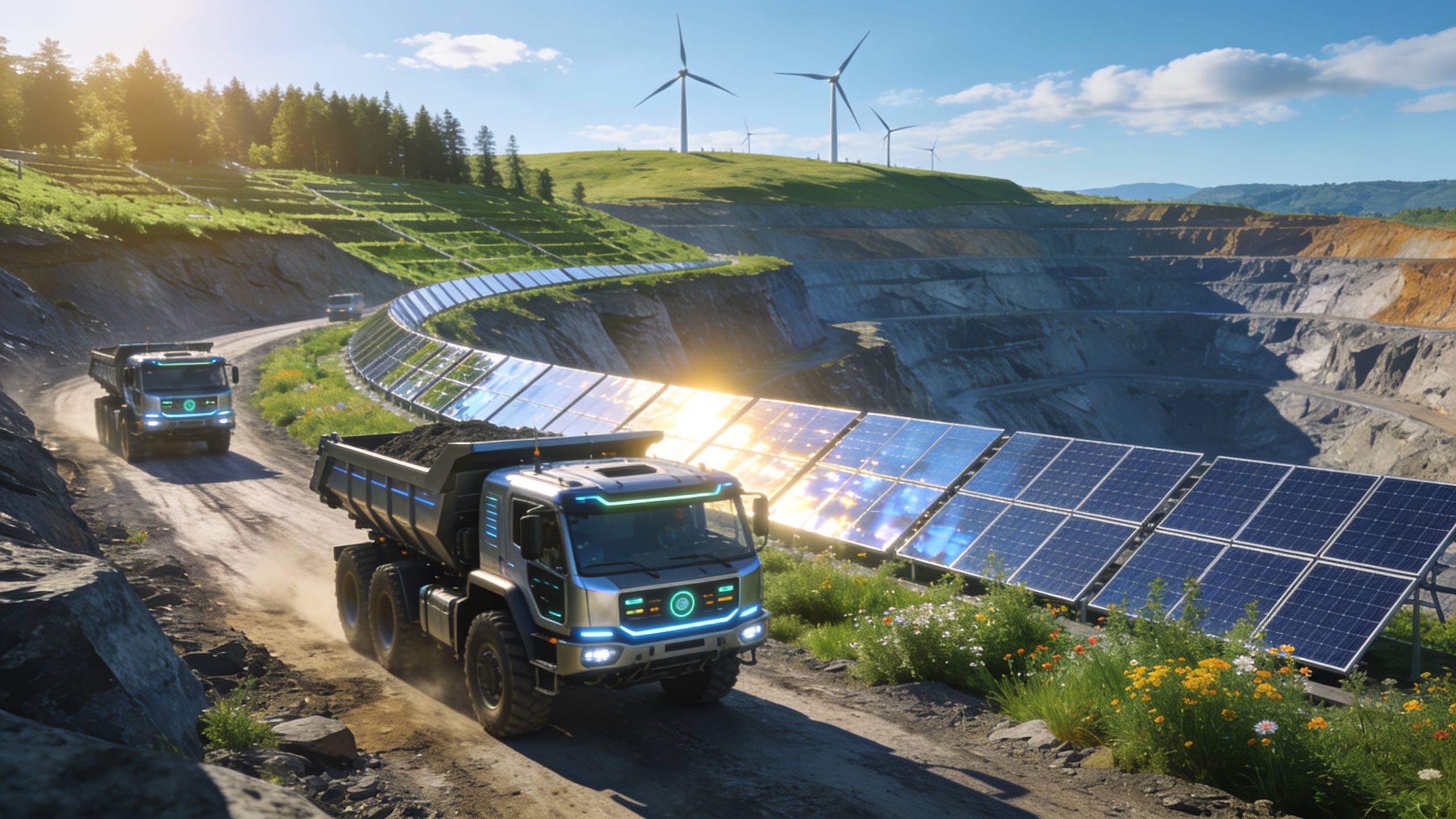
How innovation, energy efficiency, and skilled talent are reshaping mining for a low-carbon future
Mining stands at the centre of one of the defining challenges of our time.
The world cannot achieve its climate and energy-transition ambitions without minerals. Copper, lithium, nickel, cobalt, graphite and rare earth elements are essential to electric vehicles, renewable-energy systems, battery storage, transmission infrastructure and other technologies powering the transition to a low-carbon economy.
Yet there is an important paradox: the minerals needed to decarbonise the global economy must themselves be extracted and processed through operations that can be energy-intensive and carbon-intensive.
Resolving this tension is becoming one of the mining industry’s most important sustainability priorities. The future will not be about choosing between mining and climate action. It will be about transforming how minerals are explored, extracted, processed, transported and ultimately reused.
A Sector in Transition
The scale of the challenge is significant, but so is the opportunity.
A 2026 baseline study by the International Council on Mining and Metals (ICMM), developed with Wood Mackenzie and covering 1,700 facilities across 14 commodities representing approximately 87% of global production, estimates that mining and metals together account for around 11% of global greenhouse-gas emissions. Approximately 3% comes from extraction, while around 8% is associated with downstream metal processing. Importantly, non-coal mining, including many transition minerals such as copper, lithium and cobalt, accounts for a much smaller share, estimated at approximately 0.54% of global emissions.
At the same time, demand for these minerals is rising rapidly.
The IEA’s Global Critical Minerals Outlook 2025 projects that, under current stated policies, lithium demand could increase approximately fivefold by 2040. Graphite and nickel demand could double, while cobalt and rare-earth demand could increase by around 50–60%. Copper demand is also projected to rise by approximately 30%, largely driven by clean-energy technologies and electric-vehicle deployment.
This creates a fundamental challenge: the world needs more minerals for the energy transition, but expanding production without transforming mining practices could increase the industry’s absolute environmental footprint.
The answer lies in making mining smarter, cleaner, more efficient and more resilient.
Five Pathways to a Lower-Carbon Mining Future
1. Electrification and Renewable Energy Integration
One of the most significant opportunities lies in reducing dependence on diesel.
Electric and hybrid haul trucks, loaders, drills and other mobile equipment are increasingly being explored as alternatives to conventional diesel-powered fleets. Beyond reducing direct combustion emissions, electrification can improve energy efficiency and potentially lower operating costs over the life of equipment.
For remote mining operations, renewable-energy microgrids combining solar, wind and battery storage can also reduce reliance on diesel generators. This approach can create a more resilient energy system while helping mines progressively reduce their operational carbon footprint.
2. Digitalisation and Energy Efficiency
Digital technology is becoming a powerful enabler of sustainable mining.
Digital twins, automation, autonomous haulage, artificial intelligence and real-time analytics can help operators understand and optimise energy consumption across the mining value chain.
Processes such as drilling, crushing and mineral processing can be particularly energy-intensive. Better data and predictive analytics can help identify inefficiencies, optimise equipment utilisation, reduce unnecessary movement and improve production planning.
The result is an important principle for the future of mining: produce more value from every unit of energy, water and material consumed.
3. Alternative Fuels for Hard-to-Electrify Operations
Not every mining activity can be electrified immediately.
Heavy-duty haulage, long-distance transportation and operations in remote locations can present significant technical and infrastructure challenges. This is where alternative fuels such as green hydrogen and other low-carbon fuel solutions may become increasingly relevant.
At the same time, decarbonising logistics, through electrified transport, rail-based movement and more efficient corridors between mines, processing facilities and ports, can address emissions beyond the mine site itself.
4. Circularity and Recycling
Sustainable mining cannot focus only on extracting new resources. It must also recognise the value of materials already in circulation.
Recycling critical minerals can complement primary mining by recovering valuable resources from batteries, electronic waste and end-of-life products. According to the IEA, recycled nickel, cobalt and lithium can have greenhouse-gas emissions roughly 80% lower than primary mined materials. Scaling recycling could also reduce the need for new mining investment by close to 30% through 2040.
This points towards a more circular minerals economy, one where mining, recycling, processing and manufacturing work together rather than operating as isolated parts of the value chain.
5. Water Stewardship and Climate Resilience
Climate change is not only about reducing emissions. It is also about preparing mining operations for a changing physical environment.
Extreme rainfall, droughts, water scarcity and other climate-related risks can disrupt mining operations and create additional environmental and operational pressures.
Closed-loop water systems, real-time water-quality monitoring, improved water efficiency and more resilient tailings-management approaches can help mines prepare for these challenges. Dry-stack tailings, where technically and economically appropriate, can also provide an alternative to conventional wet tailings storage.
The future of sustainable mining therefore requires both decarbonisation and climate resilience.
India’s Critical Role in the Minerals Transition
India is an important part of this global story.
The country’s climate ambitions, including reducing the emissions intensity of GDP by 45% by 2030 from 2005 levels, achieving 50% of installed electric-power capacity from non-fossil sources by 2030 and reaching net-zero emissions by 2070, will require a secure and sustainable supply of critical minerals.
The National Critical Mineral Mission (NCMM), covering FY 2024–25 to FY 2030–31, represents a major step in this direction. With an overall outlay of approximately ₹16,300 crore, the mission targets 1,200 exploration projects, domestic production of at least 15 critical minerals and a dedicated recycling incentive aimed at recovering 400 kilotonnes of material from e-waste and battery scrap. It also recommends establishing a Centre of Excellence on Critical Minerals to strengthen strategy, research and future planning.
For India’s mining and metals ecosystem, this transformation will create demand not only for minerals and technology, but also for specialised talent, exploration geologists, mining and processing engineers, ESG professionals, sustainability specialists, data experts and recycling – technology professionals.
Why Skills Will Define the Transition
Technology alone cannot create sustainable mines.
An electric fleet still requires people who understand charging infrastructure, energy management and equipment safety. A digital mine requires professionals capable of interpreting data and translating insights into operational decisions. A closed-loop water system requires engineers and site teams who understand water management, monitoring and risk.
The same principle applies to ESG.
As regulatory expectations, investor scrutiny and stakeholder expectations increase, sustainability must move beyond corporate commitments and become part of everyday decision-making at the mine and processing-plant level.
This makes skills development one of the most important enablers of sustainable mining.
Organisations that invest in workforce capability today will be better equipped to adopt emerging technologies, improve operational efficiency, manage environmental risks and respond to evolving regulations tomorrow.
iCEM: Building Capability for the Future of Mining
This is where the role of the International Centre of Excellence in Mining (iCEM) becomes particularly significant.
As a Centre of Excellence in mining, iCEM works with corporate and institutional partners to strengthen technical capability, operational competence, leadership and sustainability-focused thinking. Its training and competency-development initiatives help translate global best practices into practical, industry-relevant learning.
The objective is not simply to prepare professionals for today’s mining environment, but to equip them for the mine of tomorrow, one that is increasingly digital, electrified, resource- efficient, circular and climate-resilient.
As the world enters what is increasingly being described as the “Minerals Age,” the mining industry has a unique responsibility and opportunity. The minerals it produces will help build a cleaner energy system, but the way those minerals are produced will determine how sustainable that transition truly is.
The path forward is therefore clear: mine responsibly, innovate continuously, use resources efficiently, build resilience and invest in people.
Sustainable mining is not a destination. It is an ongoing transformation, and the organisations that combine technology with human capability will be best positioned to lead it.
iCEM is strengthening its role as a trusted partner in this transformation, expanding its training portfolio and deepening its engagement across corporate training and higher-education accreditation. By developing the people who will operate, manage and lead the mines of the future, iCEM is helping turn the ambition of sustainable mining into practical, measurable action.
FAQs
1.Why is sustainable mining important for addressing climate change?
Mining provides critical minerals such as copper, lithium, nickel, cobalt and rare earth elements that are essential for renewable energy, electric vehicles, batteries and power infrastructure. Making mining more sustainable is therefore essential to achieving the broader global energy transition.
2. How can mining companies reduce their carbon footprint?
Mining companies can reduce emissions through fleet electrification, renewable-energy integration, energy-efficient operations, digitalisation, alternative fuels, improved logistics and greater use of recycling and circular-economy practices.
3. What role does technology play in sustainable mining?
Technologies such as digital twins, autonomous equipment, real-time analytics and renewable- energy systems can improve energy efficiency, optimise operations and reduce resource consumption. Technology can also support better water management and climate-risk monitoring.
4. Why are skills and training important for the future of sustainable mining?
New technologies and sustainability practices require a workforce with specialised technical, operational and ESG capabilities. Training helps engineers, managers and site teams safely implement electrification, digital systems, energy efficiency, water stewardship and other sustainability initiatives.
5. How is iCEM supporting the future of sustainable mining?
iCEM supports the mining sector through training and competency-development programmes focused on technical, operational, leadership and sustainability capabilities. By translating global best practices into practical, industry-relevant learning, iCEM helps organisations build the skills needed for a more efficient, resilient and sustainable mining future.