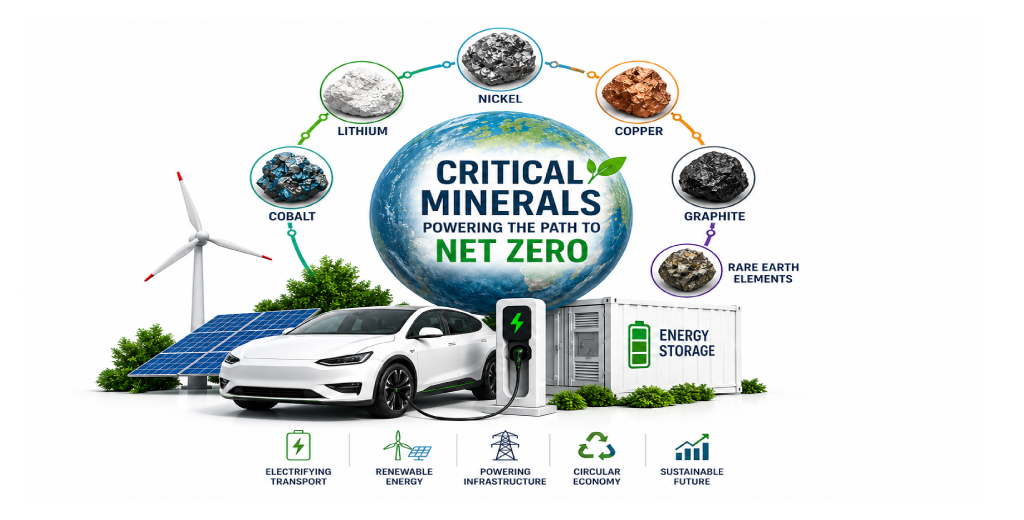
Introduction: The Invisible Backbone of Net Zero
The global commitment to achieving net zero emissions by 2050 represents one of the most ambitious transformations in modern history. Governments, industries, and institutions across the world are investing heavily in renewable energy, electrification, and sustainable infrastructure to decarbonize economies.
Yet, beneath this transition lies a less visible, but absolutely essential, foundation: critical minerals.
Lithium, cobalt, nickel, copper, graphite, and rare earth elements are not merely raw materials; they are the building blocks of clean energy systems. From electric vehicle (EV) batteries and wind turbines to solar panels and grid infrastructure, these minerals power the technologies designed to replace fossil fuels.
As the world accelerates toward climate targets, a crucial question emerges:
Can mineral supply realistically keep pace with climate ambition?
The Demand Surge: Opportunity at an Unprecedented Scale
The demand outlook for critical minerals is nothing short of transformative.
According to global projections aligned with net zero pathways:
○ Demand for critical minerals could triple by 2030
○ By 2050, total demand may rise to over 3.5 times current levels, reaching nearly 40 million tonnes annually
○ Lithium demand alone is expected to grow fivefold by 2040
○ Copper demand, driven by electrification, could increase by 30% or more
These numbers reflect more than just consumption, they signal a fundamental restructuring of global industrial systems.
Sector-Specific Pressure
Different sectors are driving this demand surge:
○ Electric Vehicles (EVs): Require lithium, nickel, cobalt, and graphite for batteries
○ Renewable Energy: Wind turbines rely on rare earth magnets; solar systems depend on copper and silver
○ Power Infrastructure: Copper is essential for transmission, distribution, and grid expansion
To meet 2030 climate goals alone, estimates suggest the world may need:
• ~80 new copper mines
• ~70 new lithium and nickel mines each
• ~30 new cobalt mines
This scale of development demands massive capital investment, estimated between $360 billion and $450 billion by 2030, while still leaving a significant funding gap.
A Strategic Opportunity
Rather than viewing this surge as a constraint, it represents a generational opportunity:
• Strengthening global supply chains
• Driving innovation in extraction and processing
• Creating new economic ecosystems around sustainable mining
However, unlocking this opportunity requires proactive planning and systemic alignment.
The Time Lag Challenge: Mining vs. Climate Timelines
One of the most critical disconnects in the net zero transition lies in timelines.
Developing a mine is a long, complex process involving:
○ Geological exploration
○ Feasibility studies
○ Environmental approvals
○ Community consultations
○ Infrastructure development
On average:
○ Mines take 15–20 years from discovery to production
○ In some regions, timelines extend to 25–30 years
This creates a structural mismatch:
Climate Goals Mining Reality
2030 targets → Mines started today may not be operational
2050 targets → Require decisions made right now
Impending Supply Gaps
Even under current policy scenarios:
○ Copper supply could face a 30% shortfall by 2035
○ Lithium could face a 40% deficit
Compounding the issue:
○ Declining ore grades
○ Rising operational costs
○ Slower discovery of new deposits
These trends highlight a clear conclusion:
Without immediate action, supply constraints could delay or derail climate goals.
Geopolitical Concentration: A Risk Multiplier
Another layer of complexity lies in the geographic concentration of mineral resources and processing capabilities.
Current Concentration Patterns
○ A significant share of cobalt production is concentrated in a single region
○ Nickel supply is dominated by a handful of countries
○ Processing capacity for many minerals is heavily centralized
This creates multiple risks:
○ Supply disruptions due to geopolitical tensions
○ Price volatility affecting project viability
○ Strategic dependency for importing nations
Recent export restrictions and policy shifts have already demonstrated how fragile these supply chains can be.
Climate Meets Geopolitics
Ironically, many mineral-rich regions are also vulnerable to climate change impacts:
○ Droughts
○ Heat stress
○ Extreme weather events
This means the very resources needed for climate mitigation are themselves at risk from climate-related disruptions.
The Circular Economy: A Critical but Partial Solution
Recycling and reuse of minerals offer a powerful pathway to reduce pressure on primary supply.
Benefits of Recycling
○ Up to 80% lower greenhouse gas emissions compared to primary mining
○ Reduced environmental footprint
○ Improved resource efficiency
Projected Impact
By 2040–2050:
○ Recycling could reduce primary demand by 10–30%
○ Potential reduction in new mine requirements:
○ ~40% reduction for copper and cobalt
○ ~25% reduction for lithium and nickel
Limitations
However, recycling is not a complete solution:
○ Current volumes of end-of-life products are still limited
○ Infrastructure for large-scale recycling is still developing
○ Demand growth far outpaces recycled supply
Conclusion:
A circular economy is essential, but it must complement, not replace, responsible mining.
Technology & Innovation: Reducing Pressure on Resources
Innovation is playing a crucial role in optimizing mineral use.
Key Developments
○ Alternative battery chemistries (e.g., LFP, sodium-ion) reducing reliance on scarce materials
○ Material efficiency improvements in solar and electronics
○ Substitution strategies for critical elements
Reality Check
While promising, these innovations:
○ Take time to scale
○ Cannot fully offset demand growth
○ Introduce new dependencies
Technology is part of the solution, but not a silver bullet.
Aligning Systems: What Realistic Net Zero Planning Requires
Achieving net zero is not just about ambition, it’s about alignment across systems.
1. Policy and Regulation
○ Faster, more efficient permitting processes
○ Clear and stable regulatory frameworks
○ Balancing speed with environmental and social safeguards
2. Investment Mobilization
○ Bridging the global funding gap
○ Encouraging public-private partnerships
○ Supporting early-stage exploration
3. Supply Chain Diversification
○ Reducing over-reliance on specific regions
○ Building regional processing capabilities
○ Strengthening international cooperation
4. Early-Stage Exploration
The mines needed in 2040 must be discovered and developed today.
This requires:
○ Advanced geological mapping
○ Data-driven exploration
○ Long-term strategic planning
Sustainable Mining: The Core of the Transition
Mining must be responsible, sustainable, and future-ready.
○ Strong ESG (Environmental, Social, Governance) frameworks
○ Community engagement and equitable development
○ Reduced environmental footprint through innovation
○ Integration of digital and automation technologies
The future of mining is not just about extraction, it’s about value creation with responsibility.
Bridging the Gap: The Role of Knowledge and Collaboration
The gap between climate ambition and mineral reality is not just technical, it is also institutional and knowledge-driven.
Organizations working at the intersection of mining, sustainability, and policy play a critical role in:
○ Building workforce capabilities
○ Driving research and innovation
○ Facilitating global collaboration
○ Translating policy into actionable strategies
By connecting academia, industry, and government, such institutions help ensure that the transition to net zero is both practical and achievable.
Conclusion: From Ambition to Execution
The journey to net zero is fundamentally a materials transition.
Clean energy technologies may define the vision, but critical minerals determine whether that vision can be realized.
The path forward requires:
○ Urgent action
○ Long-term thinking
○ Coordinated global effort
The world does not face a shortage of ambition.
What it must now ensure is alignment between ambition and execution.
Because ultimately, the race to net zero is not just about reducing emissions,
it is about securing the resources that make decarbonization possible.
The race to net zero is about securing resources for decarbonization.
FAQs
1. What are critical minerals?
Essential materials like lithium, cobalt, nickel, and copper.
2. Why supply risk?
Due to slow mining, geopolitics, and rising demand.
3. Can recycling replace mining?
No, it complements but cannot replace it.
4. Mine development time?
15–20 years average.
5. Biggest challenge?
Aligning climate targets with supply chains.