Powering the Future While Paying an Invisible Price
Every electric vehicle battery, wind turbine blade, solar panel, and smartphone screen depends on a class of materials that remain largely invisible to the public eye- critical minerals. Lithium, cobalt, nickel, graphite, and rare earth elements form the backbone of modern clean energy systems and digital infrastructure. Without them, the global transition to renewable energy and electrification would simply not be possible.
Yet, while these minerals power a sustainable future, the systems governing their lifecycle remain rooted in an outdated paradigm: extract, process, use, and discard.
The scale of demand is accelerating at an unprecedented pace. According to global projections, demand for critical minerals could increase up to fourfold by 2040, driven by electric mobility, renewable energy expansion, and energy storage systems. Under more ambitious net-zero scenarios, this demand may rise even further.
This growth is accompanied by a structural challenge- geographic concentration. A handful of countries dominate the production and processing of these materials, creating supply vulnerabilities:
• The Democratic Republic of Congo dominates cobalt production
• South Africa leads in platinum output
• China controls a significant share of rare earth processing
For India, the implications are particularly significant. The country currently imports nearly 100% of its lithium and cobalt requirements and depends heavily on limited global suppliers for processing capabilities. This dependency introduces economic, geopolitical, and supply chain risks that demand urgent strategic attention.
From Linear Consumption to Circular Thinking
For decades, industrial growth has been powered by a linear economic model– extract raw materials, manufacture products, and dispose of them after use. While effective for rapid development, this approach is increasingly unsustainable in a resource-constrained world.
A more resilient alternative is emerging: the circular economy.
Circularity challenges the very notion of “waste.” Instead of viewing materials as disposable, it seeks to keep them in use for as long as possible, extracting maximum value across multiple life cycles.
Importantly, circularity extends beyond recycling. It includes:
• Designing products for longevity
• Repairing and refurbishing existing assets
• Remanufacturing components
• Reusing materials across applications
For instance, an electric vehicle battery that is no longer suitable for mobility can still serve as a stationary energy storage unit, extending its functional life before eventual recycling.
At its core, circularity is about rethinking systems at every stage– from design to disposal.
The Lifecycle Lens: Unlocking Value at Every Stage
Adopting a lifecycle approach reveals opportunities to enhance efficiency, reduce waste, and retain material value across four key stages:
1. Design Stage: Building for Longevity
Circularity begins long before a product reaches the market- it starts at the design table.
Modern design philosophies emphasize:
• Modularity – allowing easy replacement of components
• Standardization – simplifying repair and reuse
• Material traceability – enabling efficient recovery
For example, modular battery systems in electric vehicles allow individual cells to be replaced instead of discarding the entire battery pack.
Globally, regulatory frameworks are accelerating this shift. Policies are increasingly mandating recycled content, repairability standards, and lifecycle accountability. In India, evolving e- waste and battery management regulations signal a move in the same direction, though further progress is needed to embed circularity deeply into product design.
Design decisions made today will determine whether future products become valuable resources or complex waste streams.
2. Use Stage: Extending Product Life
The way products are used and managed has a profound impact on material efficiency.
Emerging business models are transforming ownership and responsibility:
• Product-as-a-Service (PaaS)
• Battery leasing and swapping systems
• Manufacturer buyback programs
These models incentivize companies to design durable products and maintain long-term engagement with their assets.
Technological advancements further enhance this stage. AI-driven predictive maintenance and digital monitoring systems can detect potential failures before they occur, enabling timely repairs and minimizing unnecessary replacements.
For a country like India- with a rapidly growing EV ecosystem and renewable energy base- these innovations are critical. The operational choices made today will directly influence how much material value is preserved in the coming decades
3. End-of-Life Stage: Recovering Hidden Value
End-of-life is no longer the end- it is a new beginning for material recovery.
Urban mining and advanced recycling technologies are transforming waste into a valuable resource stream. Key sources include:
• Used batteries
• Electronic waste
• Industrial scrap
• Metallurgical residues
The scale of opportunity is immense.
Studies indicate that secondary sources- such as coal ash, industrial waste, and discarded electronics- contain significant quantities of critical minerals. In some cases, these secondary reserves rival or even exceed traditional mining outputs.
For instance:
• Coal ash deposits contain substantial rare earth elements
• Unrecovered copper waste globally could reach millions of tonnes in the coming decades
• IRecycling could reduce the need for new mining by 25% to 40% by 2050
For India, this presents a strategic opportunity. With large volumes of industrial by-products and e-waste, the country possesses a largely untapped secondary resource base
Developing efficient recovery systems can significantly reduce import dependency while creating new economic value streams.
4. Waste Management Stage: From Liability to Asset
Mining and industrial processes generate vast quantities of waste- tailings, overburden, and residues. Historically, these materials were treated as environmental liabilities.
Today, that perception is changing.
Advances in geochemical analysis, AI-based sorting, and mineral processing technologies are enabling the recovery of valuable elements from previously discarded materials.
Globally, mining companies are already piloting tailings reprocessing initiatives, unlocking additional value from legacy waste.
In India, decades of mining activity have resulted in extensive residue stockpiles across mineral- rich regions. Many of these deposits remain uncharacterized and underutilized, representing a significant opportunity for secondary extraction.
Reframing waste as a resource requires:
• Technical expertise
• Policy support
• Institutional collaboration
When effectively managed, waste streams can become critical contributors to future supply chains.
Technology as a Catalyst for Circularity
The transition to a circular minerals economy is being accelerated by technological innovation.
Key enablers include:
• Advanced robotics and AI for efficient material sorting
• Digital product passports for traceability and lifecycle tracking
• Hydrometallurgical and direct recycling processes for high-purity material recovery
• IoT-enabled monitoring systems for real-time performance insights
These technologies are eliminating traditional barriers- such as quality loss in recycled materials- making secondary resources increasingly competitive with virgin extraction.
At the same time, global policy momentum is strengthening. Governments worldwide are investing heavily in recycling infrastructure, supply chain resilience, and critical mineral strategies.
India’s National Critical Mineral Mission marks a significant step forward, recognizing recycling and secondary recovery as essential pillars of long-term resource security.
The Role of Collaboration in Building Resilient Systems
No single organization or country can address the complexities of critical mineral supply chains alone.
Collaboration across industry, academia, and government is essential to:
• Accelerate innovation
• Share knowledge and best practices
• Develop scalable solutions
International partnerships are playing a key role in advancing research, improving processing technologies, and building resilient supply networks.
Such collaborative ecosystems ensure that advancements are not only theoretical but also practically deployable at scale.
iCEM: Driving Innovation in a Circular Mining Future
The International Center of Excellence in Mining Safety and Automation (iCEM) represents a forward-looking approach to mining- one that integrates innovation, sustainability, and operational excellence.
As a knowledge-driven institution, iCEM operates at the intersection of:
• Advanced technologies
• Responsible mining practices
• Lifecycle optimization
Its work reflects a broader shift in the mining sector- from purely extractive operations to holistic resource management systems.
Through partnerships with leading academic and research institutions, iCEM facilitates the translation of global research into real-world applications tailored to Indian conditions.
A key initiative in this direction is the Australia–India Critical Minerals Research Hub, which brings together expertise from both countries to address challenges across the mineral lifecycle- from exploration to recycling.
This collaborative model enables:
• Development of advanced processing techniques
• Improved resource characterization
• Scalable solutions for end-of-life recovery
As India advances its critical mineral strategy, institutions like iCEM will play a vital role in shaping a mining ecosystem that is efficient, resilient, and future-ready.
Building a Truly Sustainable Mineral Economy
The global transition to clean energy depends fundamentally on critical minerals- but sustainability cannot be achieved through extraction alone.
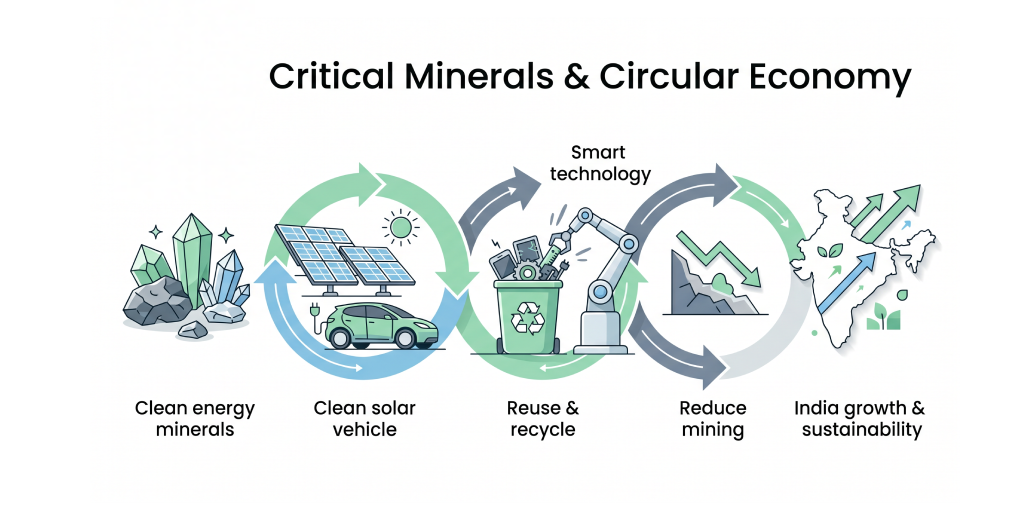
A truly resilient system requires a shift toward circularity, where materials are continuously reused, recovered, and reintegrated into the economy.
This transformation demands:
• Forward-thinking design
• Responsible consumption models
• Advanced recycling technologies
• Strong policy frameworks
• Deep collaboration across sectors
For India, the stakes are particularly high. By embracing circular principles, the country can reduce import dependency, strengthen supply chains, and unlock new economic opportunities
The future of critical minerals lies not just beneath the earth- but within the systems we build to use them wisely, recover them efficiently, and sustain them indefinitely.
FAQs
1. What are critical minerals and why are they important?
Critical minerals are essential raw materials used in technologies such as electric vehicles, renewable energy systems, and electronics. They are crucial for energy transition but often face supply risks due to limited geographic availability.
2. What is a circular economy in the context of mining?
A circular economy focuses on keeping materials in use for as long as possible through reuse, repair, remanufacturing, and recycling- reducing the need for new extraction.
3. How can recycling reduce dependence on mining?
Recycling recovers valuable materials from used products and waste streams, reducing the demand for virgin resources and lowering environmental impact.
4. What role does technology play in circular mining?
Technologies like AI, robotics, and advanced recycling processes improve efficiency, enable material traceability, and increase recovery rates of critical minerals.
5. How can India benefit from adopting circular mineral strategies?
India can reduce import dependence, strengthen supply chain resilience, create new industries, and achieve sustainability goals by leveraging recycling and secondary resource recovery.