Introduction: Mining Enters the Quantum Age
For centuries, mining has been defined by physical effort, digging deeper, drilling harder, and extracting more. Progress was measured in tonnage, depth, and scale. But today, the industry stands at the edge of a very different frontier, one that is not buried beneath the earth, but embedded in computation.
Quantum computing is emerging as a transformative force that could fundamentally reshape how the mining sector explores, extracts, and manages critical mineral resources. Instead of relying solely on expanding physical operations, the future of mining will increasingly depend on computational intelligence, solving complex problems faster, optimizing resources, and unlocking value from existing assets.
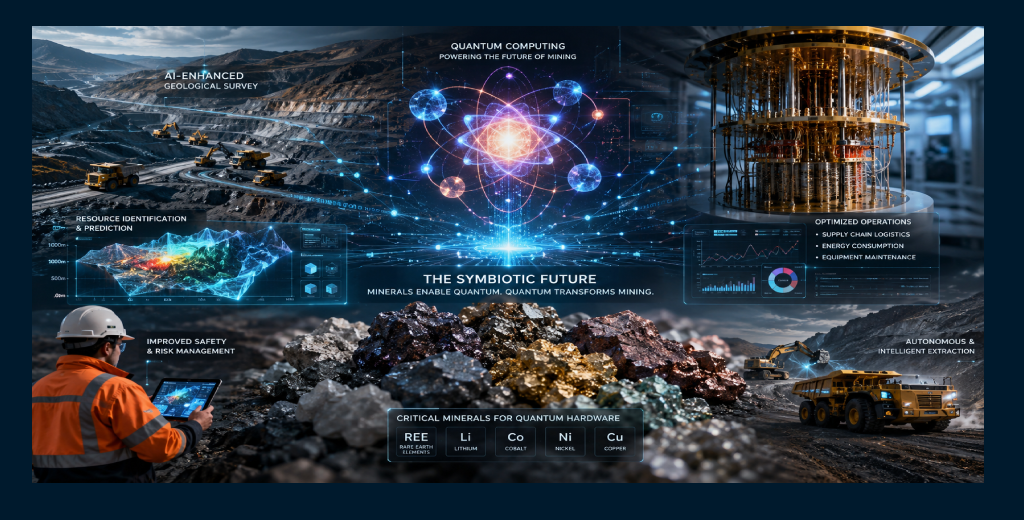
At the same time, the global demand for critical minerals is surging. Rare earth elements such as europium, neodymium, ytterbium, and holmium are essential for clean energy systems, advanced electronics, defense technologies, and even quantum computing itself. This creates a powerful feedback loop: minerals are required to build quantum technologies, and quantum technologies are needed to secure mineral supply chains.
The traditional response to rising demand has been straightforward, open more mines. But in a world of environmental constraints, regulatory complexities, and capital intensity, that approach is no longer sufficient. The emerging solution lies in doing more with less, and doing it smarter.
Understanding Quantum Computing: A New Paradigm
Quantum computing operates on fundamentally different principles than classical computing. Instead of binary bits (0s and 1s), quantum systems use qubits, which can exist in multiple states simultaneously through superposition. Combined with entanglement, this allows quantum computers to evaluate vast numbers of possibilities at once.
In practical terms, this means that problems that would take classical systems years, or even centuries, to solve could potentially be addressed in hours.
For the mining industry, this computational leap opens up unprecedented opportunities:
• High-precision geological modeling of subsurface structures
• Real-time simulation of ore bodies for improved planning
• Optimization of drilling and blasting sequences
• Predictive maintenance for heavy equipment fleets
• Accelerated discovery of alternative materials and substitutes
This is not just about efficiency, it is about redefining what is possible.
The Dual Relationship: Minerals Power Quantum, Quantum Powers Mining
A unique and strategic relationship exists between mining and quantum computing.
Rare earth elements are not only targets of mining, they are foundational to quantum hardware:
• Europium is used in photonic quantum systems
• Ytterbium functions as a qubit in trapped-ion processors
• Neodymium contributes to quantum memory technologies
• Holmium-based alloys are critical for cryogenic cooling systems
This creates a circular dependency. The advancement of quantum computing depends on secure access to critical minerals, while the future of mineral discovery and processing increasingly depends on quantum-enabled tools.
However, global supply chains for rare earth elements remain highly concentrated. This poses strategic risks for countries aiming to build independent quantum ecosystems.
Quantum computing offers a potential solution, by enabling:
• Faster identification of domestic mineral deposits
• Advanced simulation of extraction and separation processes
• Discovery of synthetic or alternative materials
In essence, quantum technologies could help reduce dependence on constrained supply chains while simultaneously accelerating innovation.
From Exploration to Extraction: Transformational Use Cases
Quantum computing is not a distant concept, it is already beginning to influence key aspects of mining operations.
1. Smarter Exploration
Traditional exploration methods rely on geological surveys, sampling, and probabilistic models. Quantum-enhanced algorithms can process vast geological datasets, identifying patterns and anomalies that may indicate mineral deposits with far greater accuracy.
This reduces exploration risk, lowers costs, and shortens discovery timelines.
2. Optimized Operations
Mining operations involve complex decision-making across multiple variables, equipment utilization, ore quality, energy consumption, and environmental constraints.
Quantum optimization models can evaluate millions of scenarios simultaneously to identify the most efficient operational strategies.
3. Sustainable Resource Management
Sustainability is no longer optional, it is a core requirement. Quantum simulations can help design processes that minimize waste, reduce water and energy usage, and improve recovery rates from lower-grade ores.
4. Materials Innovation
One of the most promising applications lies in materials science. Quantum computing can accelerate the discovery of new materials or substitutes for scarce minerals, reducing pressure on supply chains.
The Skills Shift: Why Human Capital Matters More Than Ever
While technology is advancing rapidly, its success ultimately depends on people.
The mining industry is entering a phase where traditional skill sets must evolve. The future workforce will need to operate at the intersection of mining, data science, and advanced computing.
Key Skill Areas for a Quantum-Ready Mining Workforce
• Data literacy and analytics
• Understanding of AI and computational modeling
• Digital twin and simulation expertise
• Cross-disciplinary thinking (geology + technology)
• Sustainability and systems thinking
Importantly, not every professional needs to become a quantum physicist. What is required is a foundational understanding of how these technologies work and how they can be applied in mining contexts.
Reskilling as a Strategic Imperative
Organizations that invest in reskilling and upskilling today will gain a significant competitive advantage. This includes:
• Partnering with academic institutions
• Developing industry-focused training programs
• Encouraging continuous learning and experimentation
The global quantum workforce is expected to grow exponentially in the coming years. Mining companies that fail to prepare risk being left behind, not due to lack of resources, but due to lack of capability.
Global Momentum: Policy and Investment Trends
Governments worldwide are recognizing the strategic importance of quantum technologies and their link to critical minerals.
• Large-scale public investments are being directed toward quantum research and workforce development
• National strategies are integrating quantum computing with resource security
• Countries are focusing on building domestic capabilities across the value chain
India’s National Quantum Mission is a significant step in this direction, positioning the country as a key player in the global quantum ecosystem. For the mining sector, this creates opportunities to align with national priorities and access emerging technologies.
A New Definition of Value in Mining
Traditionally, value in mining was measured by output, how much material could be extracted and sold.
In the quantum era, value will increasingly be defined by:
• Efficiency (more output with fewer resources)
• Intelligence (better decision-making through data)
• Sustainability (reduced environmental impact)
• CResilience (secure and diversified supply chains)
This shift requires a fundamental change in mindset. Mining is no longer just an extractive industry, it is becoming a technology-driven ecosystem.
From Resources to Capabilities: The Strategic Shift
The future of mining will not be determined solely by who has the most resources, but by who can utilize them most effectively.
Organizations must transition from a resource-centric approach to a capability-driven model. This means:
• Investing in technology alongside infrastructure
• Building interdisciplinary teams
• Creating innovation ecosystems through partnerships
Companies that embrace this shift will be better positioned to navigate uncertainty and capture emerging opportunities.
The Role of Institutions in Enabling the Transition
Institutions play a critical role in bridging the gap between technological potential and industry adoption.
They act as:
• Knowledge hubs for emerging technologies
• Training centers for workforce development
• Collaboration platforms connecting industry, academia, and government
By fostering innovation and building capabilities, such institutions accelerate the transition toward a quantum-enabled mining ecosystem.
The Future is Computational and Human
Quantum computing represents one of the most profound technological shifts of our time. For the mining industry, it offers a pathway to greater efficiency, sustainability, and resilience.
However, technology alone is not enough.
The real differentiator will be the ability to integrate these tools into existing systems, build the right talent, and foster a culture of innovation.
The future of mining is not just about discovering new deposits, it is about unlocking new possibilities.
And that future will be shaped not only by machines and algorithms, but by people who are ready to think differently, learn continuously, and lead boldly.
FAQs
1. What is quantum computing and how is it relevant to mining?
Quantum computing uses advanced principles like superposition and entanglement to solve complex problems much faster than classical computers. In mining, it can optimize exploration, improve operational efficiency, and accelerate material discovery.
2. Can quantum computing replace traditional mining methods?
No, quantum computing will not replace mining, it will enhance it. It acts as a powerful tool to improve decision-making, reduce costs, and increase efficiency across the mining value chain.
3. Why are rare earth elements important for quantum technologies?
Rare earth elements such as europium and ytterbium are essential for building quantum hardware, including qubits and photonic systems. This makes mining critical for the advancement of quantum computing.
4. What skills are required for the future of mining?
Future mining professionals will need skills in data analytics, AI, computational modeling, and sustainability, along with traditional mining knowledge.
5. How can mining companies prepare for the quantum era?
Companies can prepare by investing in workforce training, adopting digital technologies, collaborating with research institutions, and exploring pilot projects involving advanced analytics and optimization tools.
25 May, 2026