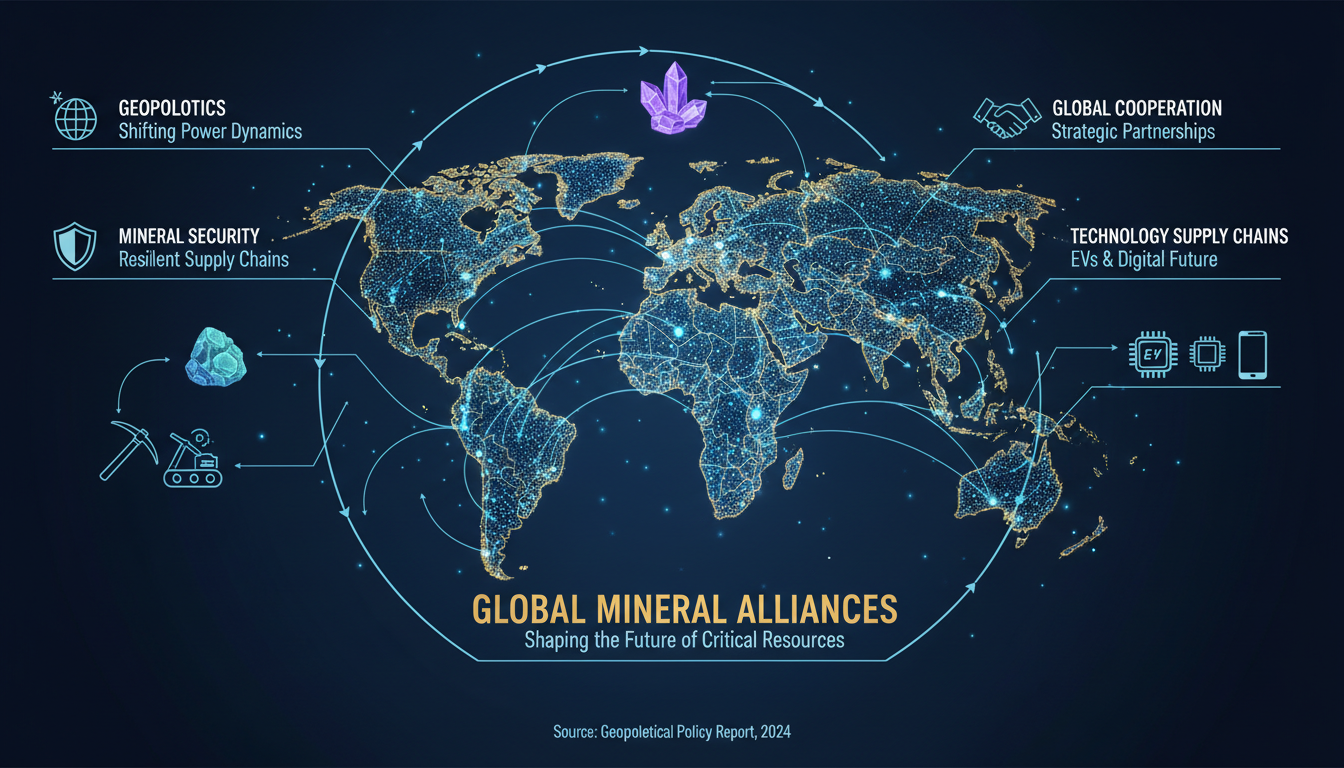
The New Geopolitics of Critical Minerals
Critical minerals, such as lithium, cobalt, nickel, copper, and rare earth elements, have become the backbone of the modern global economy. They are essential for powering electric vehicles, renewable energy systems, advanced electronics, aerospace technologies, and modern defense infrastructure. As countries accelerate their commitments toward decarbonization, digital transformation, and advanced manufacturing, demand for these strategic minerals has increased dramatically.
However, unlike many traditional commodities, the supply chains for critical minerals are highly concentrated, technologically complex, and geopolitically sensitive. A limited number of countries control significant portions of mining, processing, and refining capacity. This imbalance has created vulnerabilities in global supply chains and raised concerns about long – term resource security.
As a result, governments and industries worldwide are shifting their approach. Instead of relying solely on domestic extraction or competitive trade relationships, nations are increasingly forming strategic mineral alliances, collaborative frameworks designed to strengthen supply security, share technology, and build resilient global value chains.
In this new landscape, collaboration is no longer optional. It has become a strategic necessity.
Why Global Collaboration is Essential for Mineral Security
The geographic distribution of critical minerals is uneven. Some nations possess abundant natural reserves but lack processing infrastructure, technological capabilities, or investment capital. Others have advanced industrial capacity but limited access to raw materials. These imbalances make unilateral resource strategies difficult to sustain.
Strategic cooperation between countries enables them to combine complementary strengths, resources, capital, technology, and industrial capabilities, to create integrated supply chains.
Several key factors explain why collaboration is now central to mineral security.
1. Diversifying Supply Chains to Reduce Risk
One of the greatest vulnerabilities in the global minerals’ ecosystem is supplying concentration. When a single country or region dominates extraction or processing, disruptions, whether caused by geopolitical tensions, trade restrictions, or natural disasters, can have cascading impacts across global industries.
Strategic mineral alliances help address this challenge by diversifying sourcing across multiple regions. By working together, partner nations can develop alternative supply corridors, reduce reliance on dominant suppliers, and create more resilient supply networks.
Diversification does not simply distribute risk, it also improves transparency and stability in global mineral markets, ensuring that industries dependent on these materials can operate with greater certainty.
2. Standardization and Responsible Development
Another benefit of international cooperation is the ability to harmonize regulatory frameworks and sustainability standards.
Mining projects increasingly face scrutiny regarding environmental protection, community engagement, and responsible resource management. Aligning environmental, social, and governance (ESG) standards across partner nations helps ensure that mineral development remains sustainable and socially responsible.
Shared regulatory approaches also create predictable investment environments. When countries align their policies on export controls, investment screening, and sustainability compliance, they reduce uncertainty for investors and accelerate the development of mining and processing projects.
3. Technology Sharing and Innovation
The true value of critical minerals extends beyond extraction. Processing, refining, and advanced material manufacturing often require specialized technologies and decades of technical expertise.
International collaboration enables cross-border research partnerships, joint innovation programs, and technology transfer initiatives. Such cooperation accelerates the development of advanced processing techniques, improves efficiency, and enables emerging economies to build stronger industrial capabilities.
For advanced economies, these partnerships also ensure secure access to critical materials required for cutting-edge technologies such as batteries, semiconductors, artificial intelligence infrastructure, and aerospace systems.
4. Economic Development and Industrial Growth
Global mineral alliances also create opportunities for inclusive economic development.
Many mineral-rich countries historically exported raw materials while value-added processing and manufacturing occurred elsewhere. Strategic partnerships increasingly aim to change this dynamic by integrating extraction, refining, and downstream manufacturing within regional ecosystems.
This model enables resource-rich nations to develop domestic industries, create employment opportunities, and capture greater value from their natural resources. At the same time, industrialized nations gain reliable access to responsibly sourced minerals.
The result is a more balanced and sustainable global minerals economy.
Emerging Global Mineral Alliances and Strategic Frameworks
In recent years, governments around the world have launched several initiatives to strengthen cooperation on critical mineral supply chains. These alliances demonstrate how international partnerships are reshaping resource diplomacy and industrial policy.
Forum on Resource Geostrategic Engagement (FORGE)
A recent addition to the global minerals landscape is the Forum on Resource Geostrategic Engagement (FORGE), launched in 2026 during the inaugural Critical Minerals Ministerial. The initiative focuses on strengthening international coordination across the entire mineral value chain, from upstream exploration to downstream manufacturing.
FORGE emphasizes regulatory alignment, coordinated project development, and shared financing mechanisms. By creating a collaborative framework for policy dialogue and industrial cooperation, the forum aims to develop diversified and transparent supply networks among trusted partners.
Unlike traditional trade agreements, FORGE prioritizes strategic integration, ensuring that partner countries can coordinate investments, infrastructure development, and environmental standards.
Minerals Security Partnership (MSP)
Established in 2022, the Minerals Security Partnership represents one of the most prominent global coalitions focused on critical minerals. It brings together several major economies, including the United States, the European Union, Japan, Canada, Australia, South Korea, and India, to address supply chain vulnerabilities.
The partnership supports responsible mining practices, promotes high ESG standards, and facilitates coordinated investments in mineral projects worldwide. By pooling resources and expertise, MSP members aim to develop secure and sustainable supply chains that reduce dependence on concentrated suppliers.
Even as new alliances emerge, MSP continues to serve as a foundational platform for international cooperation in the mineral sector.
Pax Silica Initiative
Another evolving framework is the Pax Silica initiative, which expands the conversation beyond raw materials to include advanced technology supply chains.
This initiative links mineral security with semiconductor manufacturing, artificial intelligence infrastructure, and advanced industrial ecosystems. By addressing vulnerabilities in technology supply chains, Pax Silica emphasizes the strategic relationship between resource availability and technological leadership.
Participation by countries such as India highlights the growing recognition that mineral security is inseparable from digital and industrial competitiveness.
G7 Critical Minerals Production Alliance
The G7 nations have also launched collaborative efforts to strengthen mineral supply chains. The Critical Minerals Production Alliance, led by Canada, focuses on accelerating investment in mining and refining projects among partner countries.
The alliance seeks to support clean energy transitions, strengthen defense supply chains, and reduce concentrated supply risks by developing integrated production ecosystems across allied nations.
Bilateral and Regional Partnerships
In addition to multilateral alliances, bilateral agreements are playing an increasingly important role in mineral diplomacy. Countries are forming targeted partnerships to leverage complementary strengths and develop specific resource corridors.
Examples include:
• Canada and Germany cooperating on mineral investment and processing
• Canada and Chile collaborating on sustainable mining development
• India and Brazil expanding cooperation on rare earth exploration
• India and Canada strengthening secure sourcing strategies
Together, these agreements illustrate a broader global shift toward strategic mineral partnerships rather than purely transactional trade relationships.
Real-World Examples of Mineral Collaboration
Strategic alliances are not just policy concepts; they are already influencing global mineral supply chains.
The Quad Critical Minerals Initiative
The Quad partnership, comprising the United States, Australia, Japan, and India, has expanded its focus from regional security cooperation to include critical mineral supply chains.
Australia’s vast mineral reserves, combined with the technological capabilities of the United States and Japan and India’s growing industrial capacity, create a powerful collaborative ecosystem. By coordinating infrastructure development, processing capabilities, and supply chain logistics, the Quad aims to strengthen mineral resilience in the Indo-Pacific region.
India–Brazil Rare Earth Collaboration
Brazil possesses some of the world’s largest rare earth reserves, while India has growing demand for these materials to support its manufacturing and energy sectors.
Recent cooperation agreements between the two countries aim to enhance exploration, investment, and processing capabilities. Such partnerships help both nations reduce dependence on dominant suppliers while strengthening their strategic industrial capabilities.
Australia–United States Strategic Mineral Reserves
Australia, a leading global producer of lithium and other critical minerals, has partnered with the United States to strengthen strategic reserves and invest in refining infrastructure.
These initiatives include large-scale funding programs designed to expand mining capacity, develop processing facilities, and build strategic stockpiles. Joint efforts such as these signal a growing recognition that resource security requires long-term collaborative planning.
Impact on Global Industries and National Security
Global mineral alliances are reshaping multiple industries and policy priorities.
Accelerating the Clean Energy Transition
Electric vehicles, solar panels, and wind turbines rely heavily on critical minerals. Secure supply chains help stabilize costs and ensure that renewable energy technologies can scale rapidly to meet climate targets.
Strengthening Semiconductor and Technology Manufacturing
Materials such as gallium, germanium, and rare earth elements are essential for semiconductor production. Integrating mineral supply strategies with technology policy ensures that countries can maintain leadership in high-tech industries.
Enhancing Defense Supply Chains
Modern defense systems require specialized materials, including rare earth magnets, titanium alloys, and advanced composites. Reliable mineral partnerships help ensure that defense manufacturing remains resilient during geopolitical tensions.
Supporting Economic Industrialization
Strategic partnerships help channel investment, technology, and expertise into emerging economies. By integrating these countries into global manufacturing ecosystems, mineral alliances promote long-term economic development and shared prosperity.
Structural Challenges in Global Mineral Collaboration
Despite their promise, mineral alliances face several structural challenges
Resource–Production Imbalances
Some countries possess significant mineral reserves but lack sufficient production capacity. For example, certain nations hold notable rare earth deposits but contribute only a small share of global output due to limited infrastructure or investment.
Processing Concentration
A large portion of global rare earth refining and processing remains concentrated in a single region. This concentration continues to pose risks for industries dependent on these materials.
Infrastructure and Project Timelines
Mining projects require significant capital investment and long development timelines. Exploration, permitting, construction, and operational ramp-up can take a decade or more, making rapid supply expansion difficult.
Institutional and Workforce Capacity
Developing sustainable mineral industries requires strong institutions, skilled labor, advanced technologies, and adherence to safety and environmental standards. Building this capacity remains a long-term challenge for many emerging producers.
The Road Ahead: A Collaborative Mineral Future
Global mineral alliances are no longer theoretical concepts, they are rapidly reshaping economic strategies, industrial policies, and geopolitical relationships.
As nations continue investing in collaborative frameworks such as FORGE, MSP, and regional partnerships, the global minerals ecosystem is evolving into a network of interconnected supply chains built on trust, transparency, and shared strategic interests.
Countries that embrace cooperation will gain access to secure mineral supplies, strengthen industrial competitiveness, and accelerate technological innovation. Those that pursue isolation risk supply vulnerabilities and economic disadvantage.
Ultimately, the future of critical minerals, and the technologies they enable, will be shaped not by competition alone, but by strategic collaboration and collective action.
iCEM: Advancing Knowledge and Collaboration in the Mineral Sector
The International Centre of Excellence in Mining Safety and Automation (iCEM) recognizes the importance of global cooperation in securing responsible and sustainable mineral supply chains.
Through research initiatives, technology platforms, and international engagement, iCEM works with policymakers, industry leaders, and researchers to strengthen capacity in mining safety, automation, and strategic mineral development.
By fostering dialogue, supporting knowledge exchange, and enabling innovation, iCEM aims to contribute to a resilient global minerals’ ecosystem, one that balances economic growth with sustainability and responsible resource management.
Frequently Asked Questions (FAQs)
1. What are critical minerals and why are they important?
Critical minerals are raw materials essential for modern technologies and national security. They are used in electric vehicles, renewable energy systems, electronics, aerospace components, and defense technologies. Their strategic importance stems from both high demand and limited supply sources.
2. Why are global mineral alliances becoming more common?
Mineral alliances help countries diversify supply chains, reduce dependence on single suppliers, share technology, and coordinate investments. Collaboration strengthens resilience against geopolitical risks and supply disruptions.
3. How do mineral partnerships support clean energy transitions?
Renewable energy technologies rely heavily on minerals like lithium, cobalt, nickel, and rare earth elements. Secure and diversified supply chains ensure that renewable infrastructure can expand without resource bottlenecks.
4. What challenges exist in building new mineral supply chains?
Developing new mining and processing capacity requires large investments, advanced technologies, skilled labor, and long project timelines. Regulatory approvals, environmental concerns, and infrastructure gaps can also slow development.
5. What role does India play in global mineral collaboration?
India is increasingly participating in international mineral partnerships and alliances to secure supplies for its growing manufacturing, clean energy, and technology sectors. Collaborations with countries such as Australia, Brazil, and Canada aim to strengthen exploration, processing, and supply chain resilience.