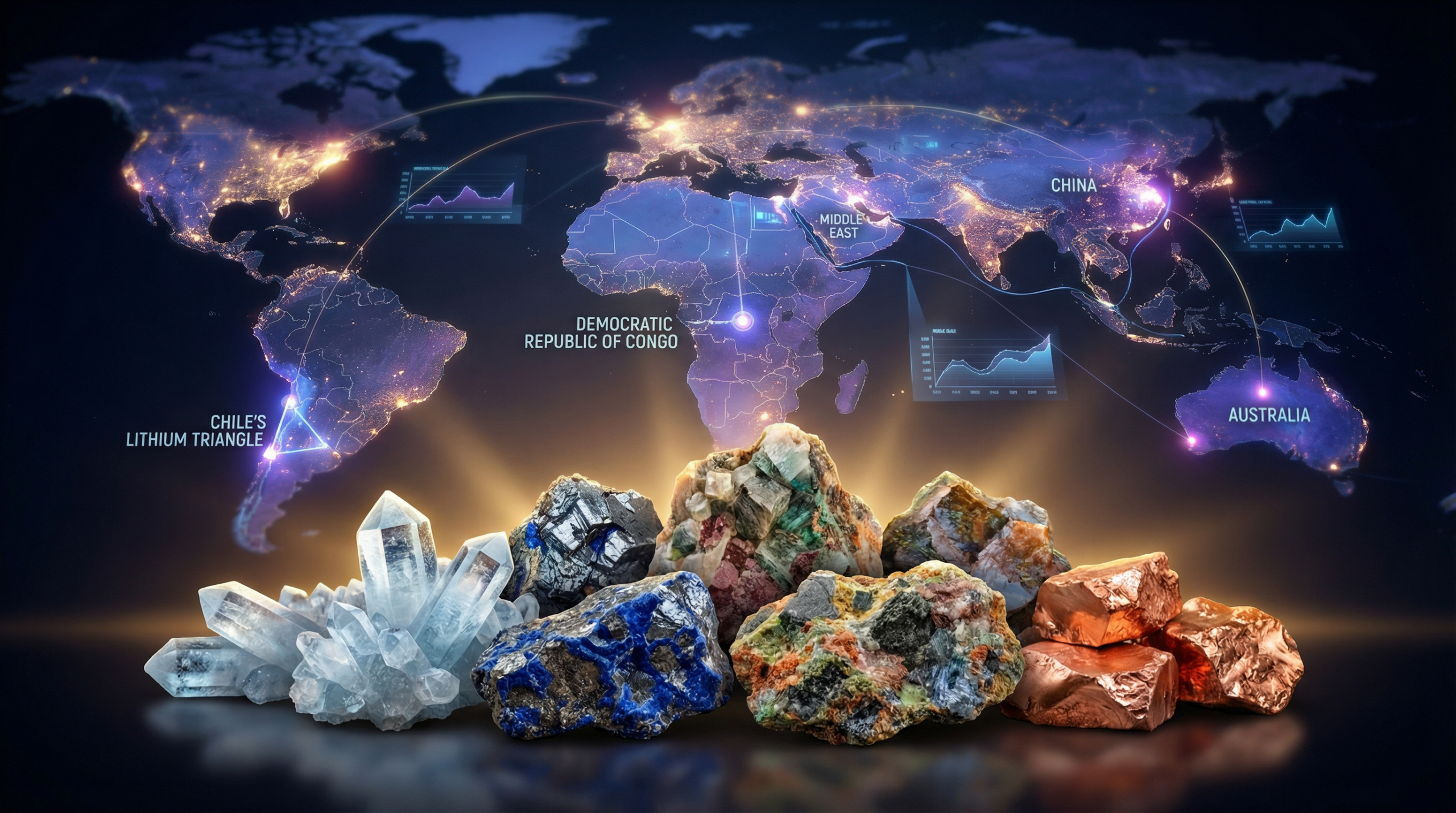
A global map of critical mineral reserves tells a story fundamentally different from traditional geopolitics. Unlike oil, whose concentration in the Middle East shaped much of the 20th century’s political and economic power, critical minerals are dispersed across continents in complex, often counterintuitive patterns. Yet this apparent geographical diversity masks a deeper reality: access to minerals alone does not translate into power. Instead, control over processing, refining, technology, infrastructure, and supply chains determines who truly holds influence.
As the world accelerates toward clean energy transitions, electric mobility, digital infrastructure, and advanced defence systems, critical minerals have emerged as the new strategic assets. The question of who controls these minerals, and who depends on them, is redrawing global power boundaries that will shape economic security, industrial competitiveness, and geopolitical stability for decades to come.
Global Mineral Reserves: Availability Does Not Equal Advantage
The global distribution of critical minerals is highly fragmented. Lithium reserves are concentrated primarily in South America, yet Australia leads global lithium production. Cobalt is overwhelmingly sourced from the Democratic Republic of the Congo (DRC), one of the world’s most politically and economically fragile regions. Rare earth elements are found across multiple continents, but nearly all processing and refining occur in China. Even minerals with relatively dispersed reserves, such as nickel, copper, and graphite, are refined and processed in only a handful of countries.
This fragmentation reveals a critical truth: geological endowment is only the first step. Minerals derive strategic value only when supported by enabling ecosystems, stable governance, modern infrastructure, advanced processing technology, environmental compliance, skilled labour, and access to capital. Countries lacking these capabilities often remain resource-rich but economically constrained, while those with processing dominance exert disproportionate global influence.
Concentration of Supply Chains: The Real Vulnerability
Despite wide geological dispersion, global critical mineral supply chains remain extremely concentrated. South America holds major lithium reserves, but production leadership lies elsewhere. The DRC dominates cobalt mining, creating severe supply and ethical risks. China controls a significant share of rare earths, graphite, and downstream processing. Base metals such as copper and nickel are concentrated in a small group of countries including Indonesia, Australia, Chile, and Peru.
This concentration creates systemic vulnerabilities. Disruptions, whether political instability, export restrictions, environmental regulation, or strategic coercion, can ripple across global industries, from electric vehicles and renewable energy to semiconductors and defence manufacturing.
The Geography of Dependence: A New Resource Thriller
The geopolitics of critical minerals reads like a modern geopolitical thriller. Approximately 56% of the world’s lithium reserves lie within South America’s “Lithium Triangle”, Bolivia, Chile, and Argentina. Yet production tells a different story. In 2024, Bolivia, despite possessing the world’s largest known lithium reserves (around 21 million tonnes), produced only a few hundred tonnes. In contrast, Chile produced nearly 49,000 tonnes, while Argentina contributed around 18,000 tonnes.
Bolivia’s struggle illustrates a recurring pattern: lack of infrastructure, limited investment, regulatory uncertainty, and insufficient technical capability can prevent resource-rich nations from converting geological wealth into economic power.
An even starker example is cobalt in the Democratic Republic of the Congo. The DRC holds over half of global cobalt reserves and accounts for more than 70% of global cobalt mining. Yet vast mineral wealth coexists with deep poverty, governance challenges, and humanitarian concerns. An estimated 40,000 children, some as young as seven, are involved in hazardous artisanal mining. Compounding the issue, 15 of the 19 cobalt-producing mines in the DRC are owned or financed by Chinese companies, effectively extending China’s control over this critical resource from extraction to export.
Rare earth elements represent perhaps the most striking concentration of all. In 2024, China produced roughly 60% of global rare earth mining output, but its dominance intensifies downstream, accounting for over 91% of global separation and refining capacity. Even more telling, China now produces 94% of the world’s sintered permanent magnets, up from around 50% two decades ago. These magnets are indispensable for electric vehicles, wind turbines, robotics, and advanced military systems.
India’s Reality: High Demand, Limited Reserves, Rising Exposure
India’s economic ambitions are deeply intertwined with critical minerals. The country targets 500 GW of renewable energy capacity, 30% electric vehicle penetration, major expansion of electronics manufacturing, and accelerated defence modernisation. Each of these goals depends heavily on minerals such as lithium, cobalt, nickel, rare earths, graphite, and copper, resources that India currently produces only in limited quantities.
As a result, India imports most of its critical mineral requirements, exposing the economy to price volatility, geopolitical disruptions, export controls, and supply manipulation by dominant producers. Unlike fossil fuels, critical minerals often lack viable substitutes, making supply disruptions far more de-stabilising for long-term industrial growth.
However, India is not without opportunity. The country possesses significant beach sand minerals containing rare earth elements, unexplored mineral belts across several states, and a strong scientific and engineering talent base capable of developing advanced mineral technologies. Unlocking this potential requires coordinated policy, investment, and institutional capacity-building.
A World in Flux: Navigating a Fragmented Mineral Landscape
Globally, critical minerals are distributed unevenly, lithium in South America, cobalt in the Congo, rare earths in China and Vietnam, graphite in Mozambique and China, and nickel in Indonesia. Yet, as history shows, reserves alone do not confer power. Control emerges through processing expertise, supply chain intelligence, environmental stewardship, and technological leadership.
For India, navigating this fragmented landscape demands strategic balance. The country must avoid overdependence on any single nation while building a diversified network of partnerships with reliable allies such as Australia, the United States, Japan, the European Union, and resource-rich African nations. Simultaneously, India must accelerate domestic exploration, processing, and refining to strengthen self-reliance and reduce long-term vulnerabilities.
Critical minerals are no longer a peripheral concern. They now sit at the heart of India’s foreign policy, trade negotiations, industrial planning, and national security strategy.
Global Critical Mineral Strategies: Lessons for India
Countries that have emerged as leaders in critical minerals have done so through long-term planning and integrated value-chain development. Successful strategies link mining with processing, refining, research, and downstream manufacturing, transforming minerals into a strategic national asset rather than a raw export commodity.
India’s path will be shaped by its own priorities, but global experiences offer valuable lessons. By steadily expanding domestic processing and refining capacity, fostering research and innovation ecosystems, investing in skill development, forming strategic international partnerships, and treating mineral security as a long-term national objective, India can build resilience and strengthen its position in the global critical minerals ecosystem.
iCEM: A Cornerstone of India’s Mineral Self-Reliance
iCEM represents a pivotal institutional step toward strengthening India’s mineral ecosystem.
Beyond addressing current import dependence, iCEM is designed to position India for a future where mineral intelligence, processing capability, automation, and technical sophistication determine global relevance. By influencing partnerships, workforce development, technology adoption, and policy frameworks, iCEM aligns mineral strategy with national economic and security goals.
As India forges strategic partnerships with mineral-rich and technologically advanced nations, institutions like iCEM will play a defining role in ensuring that mineral wealth translates into sustainable growth, resilience, and global competitiveness.
Frequently Asked Questions (FAQs)
1. Why are critical minerals geopolitically important today?
Critical minerals are essential for clean energy, electric vehicles, electronics, and defence systems. Control over their supply chains directly impacts economic security, technological leadership, and national defence capabilities.
2. Why does China dominate critical mineral processing despite global reserves being widespread?
China invested early in processing, refining, infrastructure, and downstream manufacturing, allowing it to control value chains beyond mining. Processing dominance, not reserves, creates strategic power.
3. What are India’s biggest risks in critical mineral supply chains?
India faces risks from import dependence, price volatility, geopolitical disruptions, export restrictions, and limited domestic processing capacity for key minerals.
4. Can India realistically reduce its dependence on imported critical minerals?
Yes, through diversified international partnerships, domestic exploration, expansion of processing and refining capacity, technological innovation, and long-term institutional support.
5. What role does iCEM play in India’s mineral strategy?
iCEM acts as a national anchor for mineral safety, automation, skills, and policy alignment, helping India build technical capability, improve resilience, and advance toward mineral self- reliance.
10 Feb, 2026