Fueling Innovation
for Excellence
Fueling Innovation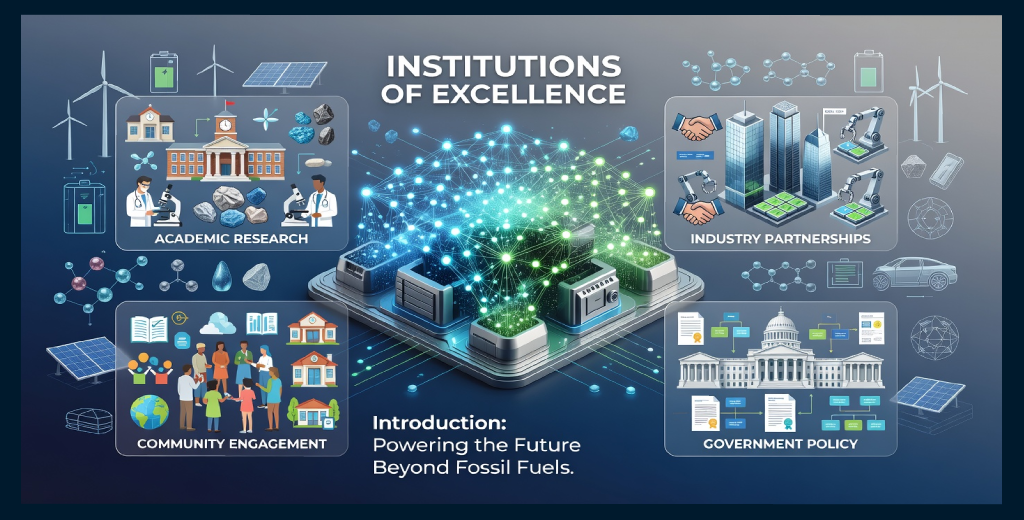
Introduction: Powering the Future Beyond Fossil Fuels
The global economy is undergoing a profound and irreversible transformation—one that is no longer powered solely by fossil fuels like coal and oil, but increasingly by a new class of resources known as critical minerals. These include lithium, cobalt, graphite, nickel, and rare earth elements—materials that form the backbone of modern technologies such as electric vehicles (EVs), renewable energy systems, advanced electronics, and defence infrastructure.
As nations accelerate toward decarbonization and digitalization, the demand for these minerals is rising at an unprecedented pace. However, the future of mining is no longer defined only by the size of reserves or capital investments. Instead, it is increasingly shaped by knowledge, innovation, sustainability, and institutional strength.
In this evolving landscape, institutions of excellence emerge as pivotal enablers. They serve not merely as academic centers, but as dynamic knowledge ecosystems bridging the gap between research, industry, policy, and community development. These institutions are instrumental in building a mining sector that is intelligent, responsible, and future-ready.
Critical Minerals: The Backbone of a Clean and Digital Economy
The importance of critical minerals has grown significantly over the past decade. According to global industry trends, demand for lithium alone surged by nearly 30% in 2024, while minerals such as cobalt, nickel, and graphite continue to see steady annual growth. This surge is primarily driven by:
• Rapid adoption of electric vehicles
• Expansion of renewable energy infrastructure (solar, wind, storage)
• Growth in semiconductor and electronics manufacturing
• Increasing demand for energy-efficient technologies
These minerals are no longer optional they are strategic assets that influence economic competitiveness, energy security, and geopolitical positioning.
As a result, countries across the world are transitioning from being mere resource extractors to becoming integrated players in the mineral value chain focusing on exploration, processing, refining, recycling, and innovation.
India’s Strategic Push Toward Critical Mineral Security
India has recognised the strategic importance of critical minerals and is taking decisive steps to strengthen its position in this sector. Through the National Critical Mineral Mission (NCMM), the Government of India has identified 30 minerals as essential for economic growth and technological advancement.
This initiative aligns closely with India’s broader ambitions:
• Achieving net-zero emissions by 2070
• Reducing carbon intensity
• Expanding non-fossil fuel energy capacity
• Building a self-reliant industrial ecosystem
However, India currently faces significant challenges. The country imports nearly all of its lithium and cobalt requirements and depends heavily on external sources for rare earth processing. This dependency highlights the urgent need to move beyond resource acquisition and toward institutional and knowledge development.
True self-reliance, Atmanirbhar Bharat in the critical minerals space will depend on India’s ability to build:
• Advanced research capabilities
• Skilled human capital
• Technological innovation ecosystems
• Sustainable mining practices
Understanding Knowledge Ecosystems in Mining
A knowledge ecosystem in mining is far more than a collection of academic programs or research labs. It is a collaborative and evolving network where diverse stakeholders including researchers, engineers, policymakers, industry leaders, and communities come together to solve complex, real-world challenges.
These ecosystems are characterised by:
• Continuous knowledge exchange
• Integration of emerging technologies
• Focus on sustainability and safety
• Alignment with industry needs
Such environments enable progress in critical areas like:
• Environmentally responsible mining technologies
• Circular economy and mineral recycling
• Community engagement and social responsibility
• Digital transformation of mining operations
Institutions that successfully build these ecosystems play a crucial role in shaping not only industry practices but also national strategies for resource management.
Global Benchmarks: Learning from Leading Institutions
Around the world, several institutions have demonstrated how knowledge ecosystems can drive meaningful transformation in mining.
Leading universities and research centers have developed strong industry partnerships, enabling them to translate academic research into practical solutions. These institutions focus on areas such as:
• Automation and robotics in mining
• AI-driven exploration techniques
• Environmental monitoring and remediation
• Advanced material processing
What sets these institutions apart is their ability to bridge theory and practice, ensuring that innovation is not confined to laboratories but implemented in real mining environments.
Their success offers valuable lessons for emerging economies like India particularly the importance of collaboration, interdisciplinarity, and long-term vision.
The Three Pillars of Institutions of Excellence
Effective knowledge ecosystems are built on three interconnected pillars: Research, Training, and Industry Collaboration.
1.Research: Driving Innovation and Sustainability
Research forms the foundation of any institution of excellence. It transforms theoretical concepts into practical solutions that enhance efficiency, safety, and sustainability in mining operations.
Key areas of innovation include:
• Sensor-based safety systems for underground mining
• Biotechnological solutions for wastewater treatment
• Energy-efficient processes such as hydrogen integration
• Advanced material discovery using computational tools
Research also plays a critical role in shaping policy frameworks related to environmental standards, ethical sourcing, and emissions reduction.
By fostering partnerships between academia, industry, and government, institutions can ensure that research outcomes have a real-world impact and contribute to long-term societal benefits.
2.Training: Building a Future-Ready Workforce
Technology alone cannot transform the mining industry people are the true enablers of progress.
As mining evolves into a technology-driven sector, there is a growing demand for professionals skilled in:
• Data analytics and artificial intelligence
• Automation and robotics
• Environmental management
• Digital systems and IoT applications
Modern training approaches are increasingly leveraging augmented reality (AR) and virtual reality (VR) to simulate mining environments. These tools allow trainees to:
• Practice safety protocols in controlled settings
• Operate equipment virtually
• Reduce onboarding time and operational risks
In addition, institutions must focus on:
• Continuous reskilling of existing workforce
• Industry-aligned curriculum development
• Scholarships and internships for young talent
A strong training ecosystem ensures that the workforce is not only skilled but also adaptable to future technological shifts.
3.Industry Collaboration: Bridging Theory and Practice
The true value of research and training is realized when they are aligned with industry needs.
Institutions that actively collaborate with mining companies can:
• Address real operational challenges
• Test and deploy innovative technologies
• Develop scalable solutions
• Accelerate adoption of best practices
Such collaborations create a feedback loop, where industry insights inform research priorities, and academic innovations enhance industry performance.
These partnerships are essential for building a mining sector that is both globally competitive and locally relevant.
From Resource Strength to Knowledge Leadership: India’s Opportunity
India stands at a critical juncture in its mining journey. While the country possesses significant geological potential, its long-term success will depend on its ability to transition from resource strength to knowledge leadership.
Key priorities for India include:
• Developing world-class research institutions
• Investing in digital and technological infrastructure
• Promoting sustainable and responsible mining practices
• Strengthening global collaborations
The integration of advanced technologies such as AI, IoT, and automation can help India address challenges related to efficiency, safety, and environmental impact at scale.
By focusing on knowledge ecosystems, India can not only meet its domestic needs but also position itself as a global hub for mining innovation.
iCEM: Shaping the Future of Mining in India
The International Center of Excellence in Mining Safety and Automation (iCEM) represents a forward-thinking initiative in India’s mining landscape.
Established by the Government of Gujarat under the aegis of Gujarat Mineral Development Corporation Ltd. (GMDC), iCEM operates as a not-for-profit institution dedicated to advancing knowledge, innovation, and collaboration in the mining sector.
A Vision Beyond Conventional Institutions
iCEM is not just an academic body it is a collaborative platform designed to:
• Foster innovation in mining technologies
• Promote safety and sustainability
• Enable knowledge exchange across stakeholders
Its areas of focus reflect the evolving needs of the industry, including:
• Water recovery and environmental remediation
• Clean energy integration (hydrogen, energy storage)
• Digital transformation using AI and IoT
• Advanced mining and processing technologies
Collaborative Strength and Global Connectivity
One of iCEM’s key strengths lies in its collaborative approach. It has established partnerships with leading institutions and organizations, both in India and internationally.
These collaborations enable:
• Access to global best practices
• Exchange of knowledge and expertise
• Development of context-specific solutions for India
By combining international insights with local understanding, iCEM plays a crucial role in building a robust and connected knowledge ecosystem.
Building the Foundations of a Sustainable Mining Future
As the world moves toward a cleaner, more technology-driven future, the importance of critical minerals will only continue to grow. However, the real differentiator in this new era will not be access to resources alone, but the ability to manage them intelligently and sustainably.
Institutions of excellence are central to this transformation. By integrating research, training, and industry collaboration, they create ecosystems that drive innovation, build capacity, and enable responsible development.
For India, this represents both a challenge and an opportunity. By investing in knowledge ecosystems and strengthening institutional capabilities, the country can secure its place in the global critical minerals value chain.
The journey from extraction to excellence begins with knowledge—and institutions like iCEM are leading the way.
Frequently Asked Questions (FAQs)
1.What are critical minerals and why are they important?
Critical minerals are essential raw materials used in advanced technologies such as electric vehicles, renewable energy systems, and electronics. They are important because they support clean energy transitions, technological innovation, and economic growth.
2.What is a knowledge ecosystem in mining?
A knowledge ecosystem in mining is a collaborative network that connects research institutions, industry players, policymakers, and communities to share knowledge, drive innovation, and solve real-world challenges in a sustainable manner.
3.Why does India need institutions of excellence in mining?
India needs such institutions to build technical expertise, reduce dependency on imports, develop sustainable mining practices, and strengthen its position in the global critical minerals supply chain.
4.How does technology impact the future of mining?
Technologies like AI, IoT, automation, and data analytics are transforming mining by improving efficiency, enhancing safety, reducing environmental impact, and enabling smarter decision- making.
5.What role does iCEM play in India’s mining sector?
iCEM acts as a collaborative platform for innovation, research, and training in mining. It helps develop advanced solutions, promotes safety and sustainability, and strengthens India’s knowledge ecosystem for critical minerals.