Fueling Innovation
for Excellence
Fueling Innovation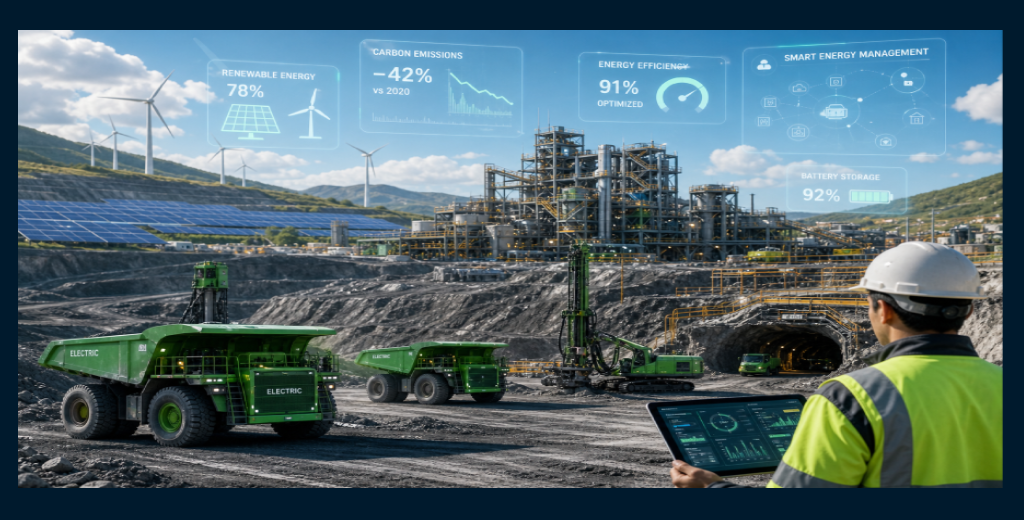
Mining sits at the heart of modern economic development and increasingly, at the heart of the global energy transition. Minerals and raw materials are essential for renewable energy infrastructure, electric mobility, battery storage, digital technologies and advanced manufacturing. Yet extracting and processing these resources can require significant amounts of electricity and fuel.
This creates one of the mining industry’s most important challenges: how can mines supply the materials required for a lower-carbon future while progressively reducing the environmental footprint of their own operations?
A significant part of the answer lies in the way mines generate, consume and manage energy.
Renewable energy, electrification, energy efficiency, lowcarbon fuels, digital energy management and smarter operational planning can collectively support the transition towards mining operations that are not only lower-carbon, but also more efficient, resilient and future-ready.
Understanding Energy Use and Emissions in Mining
Energy consumption occurs across virtually every stage of the mining value chain from exploration and mine development to extraction, crushing, grinding, processing, material handling and transportation.
However, the energy profile of every mine is different.
In open-pit operations, haul trucks and other heavy mobile equipment can be major fuel consumers. Underground mines may require substantial electricity for ventilation, pumping, hoisting and material movement. Mineral processing, particularly crushing and grinding, can also represent a significant energy load.
For this reason, there is no universal decarbonisation solution for mining.
An effective strategy should consider the mine’s energy profile, operating conditions, remaining mine life, infrastructure, grid availability, equipment requirements, economics and regulatory environment. The goal is to create an integrated energy strategy, rather than implementing technologies independently.
Four areas can form the foundation of this transition: renewable energy integration, electrification, energy efficiency and the use of lower-carbon fuels or emerging technologies where direct electrification is difficult.
1. Integrating Renewable Energy into Mining Operations
Increasing the share of renewable electricity can help mines reduce their dependence on conventional fossil-fuel-based power.
Depending on location and operating requirements, this may involve on-site solar or wind installations, cleaner grid electricity, renewable power purchase agreements or hybrid energy systems.
For remote mining operations, the benefits can extend beyond emissions reduction. A diversified energy mix may improve resilience by reducing exposure to fuel-price volatility and supply disruptions.
However, renewable integration requires careful planning. Solar and wind generation are variable, while mining operations often require reliable power around the clock. Energy storage, hybrid configurations, demand management and intelligent control systems can therefore become important components of the overall energy architecture.
The question is not simply, “How much renewable energy can we install?” It is, “How can renewable energy be integrated reliably and economically into the operating profile of this mine?”
2. Electrifying Mining Equipment and Processes
Electrification offers another important pathway towards reducing direct fossil-fuel consumption.
Diesel-powered mobile equipment remains an important consideration at many mines, particularly in heavy material movement. Where technically and economically feasible, electric mining equipment, battery-electric systems and trolley-assist technologies can help reduce direct fuel combustion.
The benefits may extend beyond greenhouse gas reduction. Lower diesel use can contribute to reduced local air pollutants, improved energy efficiency and lower exposure to fluctuations in fuel prices and supply.
This can be particularly relevant underground, where reducing emissions from diesel equipment may also influence ventilation requirements.
Full electrification, however, may not be immediately practical for every application. Mines can therefore evaluate a phased combination of battery-electric equipment, trolley-assist systems, hybrid configurations, energy-efficient equipment and alternative lower-carbon fuels.
The transition should be based on operational realities rather than technology adoption for its own sake.
3. Making Energy Efficiency the First Step
Decarbonisation does not necessarily begin with a major capital investment.
Often, the most practical starting point is understanding where energy is being consumed, why it is being consumed and where avoidable losses are occurring.
Energy monitoring and benchmarking can identify highconsumption activities, inefficient equipment and opportunities for optimisation. Mines can establish energy baselines and track indicators such as energy consumed per tonne of production, allowing performance to be compared over time.
Operational measures can include optimising crushing and grinding, improving pumping and ventilation efficiency, reducing equipment idle time, improving equipment utilisation and recovering usable waste heat where technically feasible
These improvements matter because the cleanest unit of energy is often the one that does not need to be consumed in the first place.
Efficiency can also strengthen the economics of subsequent decarbonisation measures. When total demand is reduced, renewable generation, storage and electrification infrastructure can potentially be designed around a more efficient energy profile.
4. Using Digitalisation to Turn Energy Data into Decisions
A modern energy strategy requires more than measuring monthly electricity or fuel consumption.
Real-time monitoring, analytics, automation, IoT-enabled systems and digital dashboards can help mines shift from periodic measurement towards continuous energy management.
For example, connected systems can help operators understand when and where demand peaks occur, identify abnormal equipment consumption, compare performance between assets and integrate energy information into operational decisions.
The real value of digitalisation is therefore not the volume of data generated it is the quality of the decisions enabled by that data.
Over time, stronger integration between energy management, mine planning, maintenance and production systems can help organisations identify opportunities that may remain invisible when each function is managed independently.
5. Exploring Low-Carbon Fuels for Hard-toElectrify Applications
Some mining applications may remain difficult to electrify, particularly where equipment requires high power, long operating periods or infrastructure that is not yet readily available.
In these situations, alternative lower-carbon fuels and emerging technologies may complement electrification. Green hydrogen, for example, may have potential in selected hard-to-electrify applications. However, its suitability depends on factors including technology maturity, infrastructure availability, economics and sitespecific operating requirements.
This reinforces an important principle: decarbonisation should be technology-neutral but outcome-focused. Mines should assess solutions according to their technical feasibility, lifecycle economics, reliability, emissions impact and compatibility with the operation.
Building a Practical Roadmap for Mine Decarbonisation
Successful energy transition is unlikely to result from one technology or one project. It requires a structured roadmap.
A practical approach can begin with establishing an energy and emissions baseline, identifying the largest energy consumers, improving efficiency, evaluating renewable energy opportunities and assessing which equipment or processes can realistically be electrified. Projects can then be prioritised according to their operational impact, feasibility and economics.
Pilot projects and proof-of-concept programmes can be especially valuable before large-scale deployment. They allow organisations to test technologies under real mining conditions, develop internal capabilities, understand infrastructure requirements and identify operational challenges before committing to wider adoption.
Equally important is workforce capability. New technologies require people who can operate, maintain, analyse and continuously improve them. Decarbonisation is therefore not purely an engineering challenge, it is also a skills, knowledge and organisational transformation challenge.
iCEM: Enabling Sustainable and FutureReady Mining
The International Centre of Excellence in Mining (iCEM), promoted by Gujarat Mineral Development Corporation (GMDC), is positioned at the intersection of mining, technology, sustainability, innovation and capability development.
The approach combines technology adoption, applied knowledge, innovation and skill development. A particularly important role is helping bridge the gap between emerging technologies and their practical application in mining by identifying promising solutions, assessing their relevance and supporting proof-of-concept and pilot-scale validation before wider adoption.
iCEM also supports industry-aligned training, knowledgebuilding and skill-development initiatives across areas including sustainability, digitalisation, safety, environmental management and operational excellence.
This combination of technology, knowledge and people is critical because the mine of the future will require more than cleaner equipment. It will require professionals capable of understanding interconnected energy systems, interpreting data, evaluating new technologies and translating sustainability objectives into operational decisions.
The Path Forward
The transition towards lower-carbon mining is not a single destination or a one-size-fits-all exercise.
For some operations, the immediate opportunity may be energy efficiency. For others, it may be renewable power, equipment electrification, hybrid systems or digital optimisation. Hard-to-electrify applications may require alternative technologies as they mature.
What matters is that these measures are approached as part of a coordinated strategy.
By combining renewable energy, electrification, efficiency, digitalisation, emerging technologies and workforce capability development, the mining industry can progressively reduce its energy and emissions footprint while strengthening operational resilience.
The ultimate objective extends beyond decarbonisation. It is to build mining operations that are smarter, more efficient, more adaptable and better prepared for the demands of the future.
Frequently Asked Questions (FAQs)
1. Why is decarbonisation important for the mining industry?
Mining requires considerable electricity and fuel, while the minerals it produces are essential to renewable energy, electric mobility, storage and modern manufacturing. Decarbonisation helps address this relationship by reducing the operational footprint associated with producing these essential resources.
2. What are the main pathways for reducing mining emissions?
Major pathways include renewable electricity, electrification of equipment and processes, energyefficiency improvements, digital energy management, operational optimisation and lower-carbon fuels for applications that are difficult to electrify.
3. Can mining operations run entirely on renewable energy?
The feasibility varies by mine. Location, grid infrastructure, renewable resources, energy demand, storage requirements, reliability, mine life and economics all influence how much renewable energy can practically be integrated.
4. How can electrification benefit mining operations?
Where suitable, electrification can reduce direct diesel consumption and greenhouse gas emissions while also contributing to lower local air pollutants and reduced exposure to fuel-price and supply volatility.
5. What role does digital technology play in sustainable mining?
Real-time monitoring, IoT systems, analytics, automation and digital dashboards can provide better visibility into energy consumption and help operators identify inefficiencies, optimise assets and make more informed operational decisions.