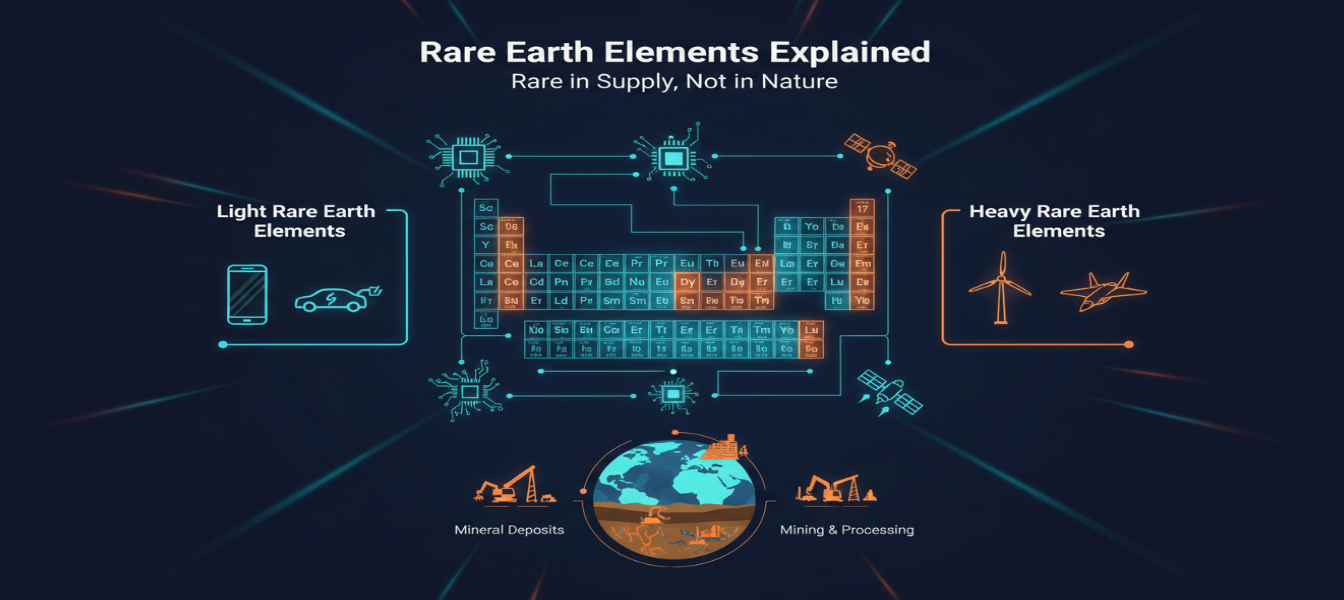
The term “rare earth elements” often creates the impression of extreme scarcity, metals hidden deep within the planet and difficult to find. In reality, the story is far more nuanced. Most rare earth elements (REEs) are relatively abundant in the Earth’s crust, in some cases more common than widely used industrial metals such as copper or lead. Their “rarity” does not stem from geological absence, but from the complexity of extracting, separating, refining, and processing them economically and responsibly.
Today, rare earth elements sit at the center of modern technological progress. They power clean energy systems, enable advanced electronics, strengthen national security infrastructure, and support the digital economy. As global industries transition toward electrification, renewable energy, and advanced manufacturing, understanding why rare earths are constrained in supply, despite natural abundance, has never been more important.
What Are Rare Earth Elements?
Rare earth elements consist of a group of 17 metallic elements on the periodic table: the 15 lanthanides, along with scandium and yttrium. Although chemically similar, each element possesses unique magnetic, optical, and catalytic properties that make them indispensable in modern technology.
They are typically classified into two categories:
Light Rare Earth Elements (LREEs)
These include lanthanum, cerium, praseodymium, and neodymium. LREEs are generally more abundant and occur in higher concentrations within mineral deposits, making them comparatively easier to mine and process.
Heavy Rare Earth Elements (HREEs)
Elements such as dysprosium, terbium, and erbium fall into this category. HREEs are less commonly concentrated in economically viable deposits and are significantly more challenging and costly to separate and refine. Despite lower volumes, they often command higher market value due to their critical performance roles in high-temperature magnets and advanced electronics.
The Invisible Backbone of Modern Technology.
Rare earth elements rarely appear in headlines, yet they are embedded in nearly every aspect of modern life. A single smartphone can contain up to 16 rare earth elements, enabling vibrant displays, compact speakers, and efficient battery performance.
Their applications extend far beyond consumer electronics:
❖Permanent magnets used in electric vehicle motors and wind turbines rely heavily on neodymium and dysprosium.
❖MRI machines, fibre optics, and laser systems depend on rare earth optical properties.
❖ GPS systems, aerospace technologies, and advanced defence equipment require high- performance REE alloys.
❖ Energy-efficient lighting and catalytic converters rely on rare earth chemical stability.
While the global rare earth market itself is relatively small, valued between approximately $4 billion and $8 billion, the industries enabled by these materials represent trillions of dollars in economic activity. Clean energy, advanced manufacturing, telecommunications, and aerospace sectors collectively form an economic ecosystem projected to exceed $6 trillion by 2030. This disproportionate impact explains why rare earth elements are considered strategically critical materials worldwide.
Geological Abundance: A Resource Hidden in Plain Sight
Contrary to popular belief, rare earth elements are not geologically rare. Many occur widely throughout the Earth’s crust. Cerium, for example, is more abundant than copper, and several lanthanides occur more frequently than precious metals such as gold or silver.
The challenge lies in concentration, not existence.
Rare earth elements rarely form large, high-grade deposits. Instead, they are typically dispersed across minerals, requiring extensive processing to separate usable quantities. Economically viable deposits must meet strict conditions involving concentration levels, accessibility, and environmental feasibility.
REE deposits generally occur in two main geological forms:
Primary Deposits
These originate from magmatic and hydrothermal processes and are commonly found in carbonatite and alkaline igneous rock formations. Such deposits often host large volumes of light rare earth elements and form the backbone of global supply.
Secondary Deposits
Weathering processes can concentrate rare earths into ionic clay deposits. These are particularly valuable because they often contain higher proportions of heavy rare earth elements and may allow relatively lower-impact extraction methods compared to hard-rock mining.
Global reserves are widely distributed across multiple continents, demonstrating that geological availability is not the limiting factor. Instead, transforming these resources into refined materials remains the central challenge.
Why Rare Earths Are Rare in Supply
If rare earth elements are abundant, why does supply remain constrained? The answer lies in the complexity of the supply chain, particularly in processing and refining.
1. Complex Processing and Separation
Rare earth elements occur together chemically and must be separated through highly technical processes involving multiple stages of crushing, chemical leaching, solvent extraction, and purification. Separating individual elements can require hundreds of sequential processing steps.
This complexity demands specialized expertise, significant capital investment, and advanced chemical engineering capabilities. Processing facilities often represent the most valuable and technologically intensive stage of the supply chain.
2. Environmental and Regulatory Challenges
Rare earth ores can contain naturally occurring radioactive materials and require careful waste management. Historically, environmental concerns limited investment in processing facilities in several regions, concentrating refining capacity in a small number of countries.
Modern operations are increasingly adopting cleaner extraction chemistry, closed-loop water systems, and improved waste containment practices, but building environmentally responsible facilities requires time, regulatory alignment, and sustained investment.
3. Economic Barriers
Rare earth prices are volatile, driven by policy shifts, technological demand, and geopolitical factors. Establishing new mines and processing plants involves long development timelines and high upfront costs, making investors cautious without stable long-term demand signals.
4. Technical Expertise and Workforce Development
Unlike traditional mining commodities, rare earth production requires interdisciplinary expertise spanning geology, metallurgy, chemistry, materials science, and advanced manufacturing. Developing skilled talent pipelines is essential to scaling global supply.
Processing: Where Value Is Truly Created
Mining represents only the beginning of the rare earth value chain. The majority of economic value emerges during processing and downstream manufacturing.
The supply journey typically includes:
🧱 Mining and beneficiation – extracting and concentrating ore.
🧱 Chemical separation – isolating individual rare earth oxides.
🧱 Refining and metal production – converting oxides into usable metals.
🧱 Alloy and magnet manufacturing – producing high-performance industrial components.
Each step significantly increases product value. Countries investing in refining and advanced manufacturing capture far greater economic benefits than those exporting raw ore alone.
Today, global efforts are underway to diversify processing capacity, creating more resilient supply chains and reducing dependence on limited refining hubs.
Geopolitics and Supply Chain Resilience
Rare earth elements have moved from industrial commodities to strategic resources. Governments increasingly view secure access to REEs as essential for energy independence, technological competitiveness, and national security.
Policy initiatives worldwide now focus on:
🧿 Developing domestic refining capabilities.
🧿 Supporting allied supply chains through partnerships.
🧿 Funding research into alternative materials and recycling technologies.
🧿 Encouraging responsible mining standards
Rather than creating scarcity, geopolitical attention is accelerating diversification and investment, helping build a more balanced global ecosystem.
Innovation Transforming Extraction and Sustainability
Technological innovation is reshaping how rare earth elements are produced. New approaches aim to reduce environmental impact while improving efficiency.
Key developments include:
💎 Advanced solvent extraction techniques that reduce chemical usage.
💎Bioleaching methods using microorganisms to extract metals.
💎 Membrane-based separation technologies.
💎 Automation and AI-driven ore analysis to optimize recovery rates.
Equally important is the rise of circular economy solutions. Recycling rare earth magnets from electronic waste, electric vehicles, and industrial equipment is emerging as a secondary supply source. Urban mining, the recovery of materials from discarded electronics, may become a significant contributor to future supply security.
Fueling the Clean Energy Transition
Rare earth elements are fundamental to the global shift toward sustainable energy systems.
Permanent magnets enable high-efficiency electric motors and wind turbine generators. Energy- efficient lighting reduces power consumption worldwide. Advanced batteries and power electronics rely on rare earth-enhanced materials to improve performance and durability.
As renewable energy adoption accelerates and electric mobility expands, demand for rare earth elements continues to grow steadily. Renewable power generation is expected to account for nearly half of global electricity production by 2030, further strengthening the importance of a reliable REE supply
The clean energy transition is therefore not only an environmental transformation but also a materials revolution, one powered quietly by rare earth elements.
Emerging Opportunities for Resource-Rich Nations
Countries with untapped rare earth resources are entering a period of unprecedented opportunity. Nations across Asia, Africa, South America, and North America are exploring how to move beyond resource extraction toward full value-chain participation.
Success increasingly depends on collaboration between governments, research institutions, and industry partners to develop:
🔬 Responsible mining frameworks.
🔬 Local processing capacity.
🔬 Skilled technical workforces.
🔬 Sustainable investment models.
The future rare earth economy will likely be more geographically distributed, reducing supply risks while supporting regional economic development.
The Opportunity Ahead
Every major industrial era has been defined by access to transformative materials, steel in the industrial revolution, silicon in the digital age, and now rare earth elements in the clean technology era.
What was once viewed primarily as a supply vulnerability is now recognized as a powerful industrial opportunity. Advances in processing technology, environmental stewardship, and international cooperation are reshaping the rare earth landscape.
The path forward is clear: build diversified supply chains, invest in innovation, train skilled professionals, and ensure responsible production practices. With these foundations in place, rare earth elements can support sustainable growth while enabling the technologies that define modern civilization.
Rare earths were never truly rare. Humanity is simply learning how to unlock their value more intelligently.
iCEM: Bridging Knowledge and Real-World Impact
In a sector defined by complexity and rapid evolution, institutions dedicated to knowledge- sharing and responsible development play a critical role. iCEM contributes to the global rare earth ecosystem by advancing research, professional training, and policy collaboration focused on sustainable mining and processing practices.
Through partnerships with governments, industry stakeholders, and academic institutions, iCEM supports the development of environmentally responsible resource strategies while helping nations maximize long-term economic value from their mineral resources.
By investing in education, innovation, and collaboration, iCEM helps prepare the next generation of geologists, engineers, policymakers, and industry leaders who will shape the future of the rare earth sector.
Frequently Asked Questions (FAQs)
1. Why are rare earth elements called “rare” if they are abundant?
Rare earth elements are widely distributed in the Earth’s crust, but they rarely occur in concentrated deposits that are economically viable to mine and process. The difficulty lies in extraction and refining, not natural scarcity.
2. What industries depend most on rare earth elements?
Key industries include electric vehicles, renewable energy, consumer electronics, aerospace, defence systems, telecommunications, medical imaging, and advanced manufacturing.
3. Why is processing rare earth elements so challenging?
REEs have very similar chemical properties, making separation complex. Processing involves multiple chemical stages requiring specialized technology, strict environmental controls, and significant investment.
4. Can rare earth elements be recycled?
Yes. Recycling from electronic waste and used magnets is becoming increasingly important. While still developing at scale, recycling can reduce environmental impact and strengthen long – term supply security.
5. Will the world run out of rare earth elements?
Current geological reserves are substantial. The main challenge is expanding sustainable mining and processing capacity to meet growing demand, rather than a lack of natural resources.