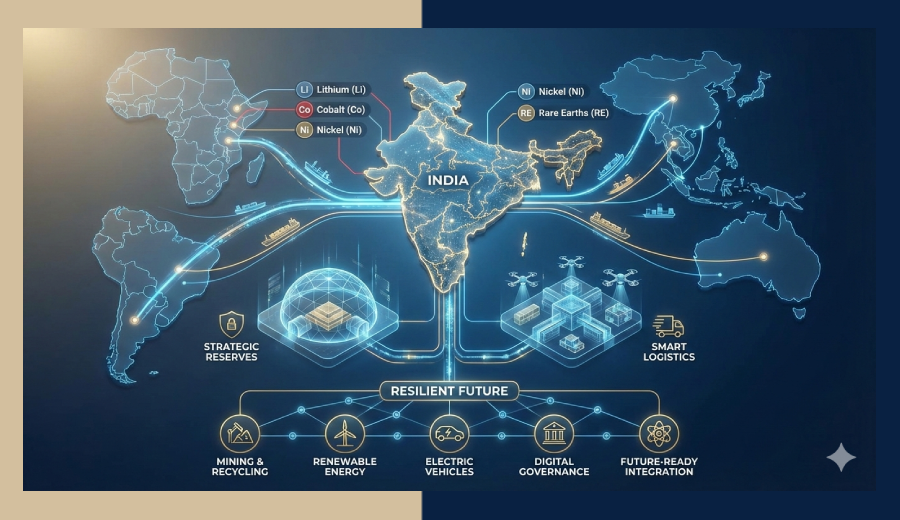
In the twenty-first century, minerals have quietly become the new oil. They fuel electric vehicles, power renewable energy systems, enable advanced electronics, and strengthen defence capabilities. As nations race toward a technology-driven future, the demand for minerals such as lithium, cobalt, rare earth elements, nickel, and graphite is skyrocketing. Yet, their supply chains remain deeply vulnerable, threatened by geopolitical tensions, export controls, trade wars, and disruptions caused by global events.
For a fast-developing nation like India, ambitious in its clean energy goals, electric mobility plans, manufacturing expansion, and national security aspirations, the dependence on imported critical minerals is not merely an economic challenge. It is a strategic risk. One that could slow growth, derail key industries, and compromise competitiveness.
This is where strategic stockpiling emerges as a powerful tool. More than an insurance policy, it is a proactive blueprint for futureproofing India’s technological transformation. Just as energy security reshaped national priorities in the past, mineral security will define sovereignty and competitiveness in the decades to come.
The Hidden Dependencies: Understanding India’s Mineral Landscape
India’s technological and industrial dreams increasingly hinge on critical minerals. These minerals have become integral to modern infrastructure and innovation:
• Solar panels depend on silver, silicon, and tellurium.
• Electric vehicle batteries require lithium, cobalt, nickel, and graphite.
• High-speed rail and wind turbines rely on rare-earth magnets
• Semiconductor chips need gallium and germanium.
• Defence systems require tungsten, titanium, and cobalt-based alloys.
These minerals are not optional, they are the backbone of India’s renewable energy transition, transport revolution, and strategic manufacturing.
Yet, India faces significant vulnerabilities. China alone controls nearly 70% of global rare-earth mining and over 90% of processing capacity. India sources nearly 60% of its rare-earth imports from China and is entirely import-dependent for minerals such as lithium, cobalt, and nickel.
Six minerals reveal especially high import exposure:
• Bismuth – 85.6%
• Lithium – 82%
• Silicon – 76%
• Titanium – 50.6%
• Tellurium – 48.8%
• Graphite – 42.4%
Meanwhile, demand is surging:
• Copper demand will rise by 50% by 2040
• Nickel and cobalt demand will double.
• Graphite demand will quadruple.
• Lithium demand could grow eightfold.
With India targeting a 30% EV penetration by 2030, uninterrupted access to these minerals becomes crucial for battery manufacturing, power storage systems, and renewable energy infrastructure.
The Strategic Stockpile Solution: India’s Master Plan
Recognising the gravity of the challenge, India launched the National Critical Minerals Mission (NCMM) in January 2025, backed by a substantial seven-year budget of ₹34,300 crore. A landmark provision within this mission is the National Critical Minerals Stockpile, supported by an initial allocation of ₹500 crore.
The plan begins with a two-month reserve of rare earth elements and will gradually expand to include lithium, cobalt, nickel, graphite, and other essential minerals.
The Four Strategic Imperatives of Stockpiling
1. Supply Chain Resilience
Strategic reserves act as a buffer against global disruptions, ensuring Indian industries remain stable even when international
markets fluctuate.
2. Price Stabilisation
Stockpiles help governments intervene during periods of extreme price volatility, protecting manufacturers and consumers
alike.
3. Strengthened Negotiation Power
Countries with reserves negotiate trade deals from a position of strength, reducing reliance on single-source suppliers.
4. Catalysing Domestic Manufacturing
Assured mineral availability boosts investor confidence, enabling expansion in sectors such as EV manufacturing, electronics,
defence, and renewable energy.
Global Best Practices: Learning from Successful Models
India’s ambition builds upon decades of global expertise. Several countries have successfully implemented advanced mineral stockpiling frameworks.
Japan: Precision and Stability through JOGMEC
Japan’s JOGMEC maintains mineral reserves covering 60–180 days, ensuring uninterrupted supply for high-tech industries. Similar models can help Indian manufacturers plan long-term and avoid production disruptions.
South Korea: Phased, Practical, and Future-Ready
South Korea’s gradual expansion of petroleum and mineral reserves demonstrates a pragmatic approach to reducing import dependency. Its plan to halve reliance by 2030 offers valuable insights for phased stockpiling strategies.
United States: Defence-Centric Resilience
The U.S. National Defence Stockpile highlights an important lesson: stockpiling raw minerals is not enough. Nations must also develop downstream processing and refining capabilities to convert raw ore into usable materials.
Australia: The Public-Private Partnership Advantage
Australia’s $1.2B Critical Minerals Stockpile Plan uses the government as a guaranteed buyer, enabling miners to secure upfront investments. This blend of state backing and private sector execution is a model India can adapt to boost domestic mining.
India’s Integrated Mineral Security Strategy
Strategic stockpiling is only one pillar of India’s broader mineral security architecture. The country is simultaneously advancing domestic exploration, global partnerships, recycling capabilities, and innovation ecosystems.
1. Unlocking Domestic Geological Potential
With nearly 80% of India’s geological wealth still unexplored, opportunities are vast. Key resources include:
• 163.9 million tonnes of copper deposits
• 44.9 million tonnes of cobalt ore
• 5.9 million tonnes of recently discovered lithium in Jammu & Kashmir
Following amendments to the Mines and Minerals Act (2023), 24 critical mineral blocks have already been auctioned, and NCMM aims for 1,200+ exploration projects by 2030–31.
2. Strengthening Global Supply Chains
KABIL (Khanij Bidesh India Limited) is acquiring overseas assets, with agreements across:
• Argentina (lithium blocks)
• Chile
• Australia
India is also part of the Minerals Security Partnership (MSP) and Quad Critical Minerals Initiative, building diversified, future-ready global supply chains.
3. Advancing a Circular Economy
India is rapidly scaling its recycling ecosystem:
• ₹1,500 crore incentives for recycling technologies
• 270 kilotonnes of annual recycling capacity targeted
• 40 kilotonnes of minerals already recovered from battery and e-waste
• Mandatory 5% recycled content in all new non-ferrous products from 2027-28
This transition reduces pressure on imports and promotes sustainability.
4. Driving Indigenous Innovation
India is building technological self-reliance through:
• Seven Centres of Excellence across IITs and CSIR labs
• Research targets of 1,000 patents by 2030–31
• Indigenous technologies for mineral extraction, processing, and substitution
This innovation-led approach reduces dependence on foreign technologies and strengthens domestic value chains.
Securing India’s Mineral Future
Strategic stockpiling symbolises foresight in an unpredictable world. While diplomacy supports cooperation and markets enhance efficiency, long-term resilience requires preparedness.
The National Critical Minerals Mission, led by the stockpiling initiative, signals India’s commitment to technological leadership, economic empowerment, and strategic independence.
With rare earth reserves in Rajasthan, cobalt in Andhra Pradesh, and lithium in Jammu & Kashmir, India is charting a pathway toward secure, diversified, and sustainable mineral sourcing. Combined with recycling systems, international partnerships, domestic exploration, and innovation ecosystems, stockpiling forms an essential keystone of India’s mineral security architecture.
A two-month rare earth reserve may seem like a modest beginning, but it represents something far greater: strategic maturity. It gives India the confidence to negotiate, the cushion to withstand disruptions, and the flexibility to grow industries without bottlenecks.
Strategic stockpiling is not simply about holding materials it is about building capability, trust, and independence. It is an investment in India’s technological future, industrial strength, and global competitiveness.
iCEM: Contributing to India’s Mining Transformation
The International Centre of Excellence in Mining (iCEM) stands as a contributor to India’s mining evolution. iCEM has emerged as the center for advancing safety, automation, digitalisation, and skill development in mining.
Through advanced training, global collaborations, and applied research, iCEM plays a vital role in:
• Developing skilled mining professionals
• Advancing safe and responsible mining practices
• Supporting automation and future-ready mining technologies
• Strengthening India’s critical minerals ecosystem
As India accelerates its search for strategic minerals essential for energy and technology, iCEM remains a powerful bridge between policy, innovation, and implementation, ensuring the mining sector evolves sustainably and competitively.
18 Dec, 2025