Fueling Innovation
for Excellence
Fueling Innovation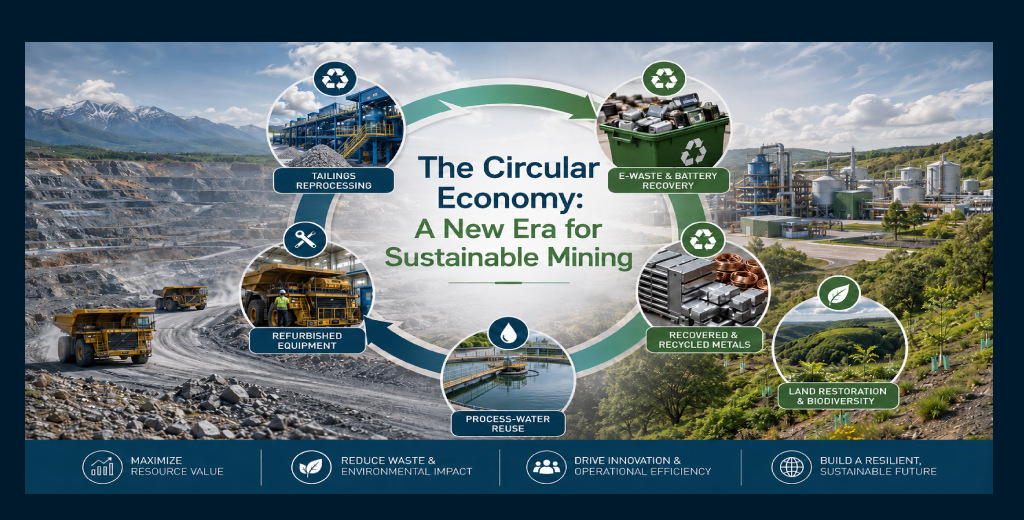
Discover how recycling, resource efficiency and resource recovery are helping the mining industry build a more sustainable, resilient and future-ready ecosystem.
The global mining industry is undergoing a significant structural transformation. For decades, the sector has largely followed a linear take-make-waste model: minerals are extracted from the earth, processed into materials and products, and eventually discarded at the end of their useful life. However, rising demand for critical minerals, climate commitments, water scarcity, environmental pressures and increasingly unpredictable supply chains are making this model progressively more difficult to sustain.
The future of mining will still depend on primary extraction. Recycled materials alone cannot meet the world’s growing demand for metals and minerals, particularly as economies expand and the energy transition increases demand for resources such as copper, lithium, nickel and cobalt. Yet this does not mean mining must continue operating according to a purely linear model.
This is where the circular economy offers a powerful alternative.
At its core, circularity is about keeping materials, products and resources in productive use for as long as possible while recovering value that would otherwise be lost. In mining, this can involve reprocessing historic tailings, reusing suitable waste rock, recycling process water, recovering valuable minerals from secondary sources such as batteries and electronic waste, extending equipment lifecycles through refurbishment and remanufacturing, and restoring land after mine closure.
The objective is not simply to produce more from less. It is to rethink how value flows through the entire mining lifecycle, from exploration and extraction to processing, waste management, equipment use and eventual closure. As the industry moves towards a more resource-conscious future, circularity can help reduce environmental pressures, improve operational efficiency and strengthen long-term mineral supply resilience.
Traditionally, mining performance has often been measured through production volumes, grades, costs and tonnes processed. These metrics will remain important, but the mining enterprise of the future will increasingly be judged through a broader and more balanced framework.
1. Mineral Recovery and Yield
Every percentage point of improved recovery can represent significant additional value from an existing resource base. Circular mining focuses on maximising the economic recovery of minerals from primary ore bodies while also investigating value locked within historic tailings and other secondary materials.
This approach encourages mining companies to look beyond the immediate production circuit and continuously identify opportunities to recover materials that were previously uneconomic or technologically difficult to extract.
2. Resource and Energy Efficiency
Mining is resource-intensive by nature. Ore processing requires substantial quantities of energy and, in many operations, significant volumes of water. Circular practices aim to improve resource productivity by reducing energy consumption, minimising freshwater withdrawals and increasing the reuse of materials and process inputs.
The goal is not only environmental improvement. Greater efficiency can also strengthen operational resilience and help companies manage rising input costs.
3. Responsible Waste Stewardship
Tailings and waste rock are among the largest material streams generated by mining operations. A circular approach does not treat all of this material as automatically reusable. Instead, it applies rigorous scientific and engineering assessment to determine whether value can be safely recovered or whether materials can be used in suitable applications.
At the same time, materials that cannot be reused must continue to be managed responsibly, with long-term attention to physical stability, geochemical behaviour and environmental protection. Materials that cannot be reused must also be managed responsibly, with long-term attention to physical stability, geochemical behaviour, and environmental protection.
4. Secondary Sourcing and Asset Optimisation
Circularity expands the concept of mineral supply beyond newly extracted ore. Valuable metals can also be recovered from scrap, batteries, electronic waste and other secondary streams. In parallel, heavy mining equipment can be refurbished, components rebuilt and subassemblies remanufactured to extend asset lifecycles.
Together, these practices can reduce unnecessary demand for virgin resources while improving the productivity of materials and equipment already in circulation.
5. Land Regeneration and Governance
Circular mining should extend beyond the production phase. Progressive rehabilitation, mine- closure planning, water management, ecological restoration and long-term monitoring are all essential parts of a responsible lifecycle approach.
A former mine site may potentially support ecological habitats, community infrastructure, agriculture or renewable-energy development, depending on local conditions, technical feasibility and regulatory requirements. Transparent environmental governance is therefore an important part of converting circular ambitions into credible long-term outcomes.
Tailings Reprocessing: Recovering Value from the Past
Tailings have historically been regarded primarily as waste. However, they may contain residual quantities of valuable minerals such as copper, gold, iron and rare earth elements.
Advances in physical separation, thermal treatment, biological processing and chemical leaching are creating new possibilities for recovering value from materials generated by earlier mining operations. Reprocessing may improve overall mineral recovery, reduce the volume of material requiring long-term storage and, in some cases, reduce pressure to disturb additional land.
However, circularity must never be confused with indiscriminate reuse. Before tailings are reprocessed or repurposed, mining companies need rigorous assessment of their chemistry, heavy-metal concentrations, acid rock drainage potential, water requirements, energy consumption and physical stability.
Research is also exploring the potential use of suitable mine tailings in cementitious and other construction materials. Such applications require appropriate technical testing, environmental assessment and regulatory certification before implementation.
Waste Rock and Industrial By-products: Turning Residues into Resources
Suitable waste rock and industrial by-products may have potential applications in structural backfilling, road construction, aggregate production, mine infrastructure and landform rehabilitation.
Some mining residues are also being investigated for use in cementitious and alkali-activated construction materials. Where technically and environmentally appropriate, such reuse can reduce the footprint of surface waste dumps and lower demand for new raw materials.
The key principle is suitability. Every proposed application should be supported by material testing, environmental assessment, engineering analysis and market evaluation. Circularity creates opportunities, but those opportunities must be based on sound technical evidence rather than assumptions.
Closed-Loop Water Management
Water is essential to many mining activities, including ore grinding, mineral separation, dust suppression, cooling and slurry transport. In regions facing water stress, improving water efficiency is becoming an increasingly important operational priority.
Circular water management aims to treat and reuse process water within the mining operation wherever feasible. By keeping water in circulation for longer, mines can reduce dependence on fresh water and potentially improve resilience to supply constraints.
Repeated reuse, however, can increase concentrations of salts, suspended solids and process chemicals. Effective treatment, monitoring and water-quality management are therefore critical to protect both production efficiency and surrounding watersheds.
A successful circular water strategy must balance conservation with operational reliability and environmental protection.
Extending Equipment Lifecycles
Circular principles apply not only to minerals and water but also to the machinery that powers mining operations.
Heavy equipment represents a significant investment of materials, energy and manufacturing effort. Refurbishing machinery, rebuilding components, remanufacturing subassemblies and extending the useful life of suitable assets can reduce demand for new equipment and lower the environmental impacts associated with manufacturing replacements.
This approach also highlights an important principle of circularity: value should be retained for as long as practical. Rather than automatically replacing an asset at the first sign of wear, organisations can assess whether repair, refurbishment or remanufacturing provides a technically and economically viable alternative.
Mine Closure as the Next Stage of the Lifecycle
A truly circular approach does not end when mineral extraction stops.A truly circular approach does not end when mineral extraction stops.
Mine closure planning should incorporate land restoration, water management, ecological rehabilitation, community considerations and long-term environmental monitoring. Where appropriate, former mining areas can potentially be transformed for ecological, agricultural, community or renewable-energy purposes.
Thinking about closure early, not only at the end of a mine’s operating life, can help companies make better decisions throughout the lifecycle. It also reinforces the idea that responsible mining includes a long-term commitment to the landscapes and communities affected by operations.
Why Circularity Matters for the Future of Mineral Supply
The transition towards cleaner energy systems and advanced technologies is increasing global demand for many minerals. This creates a fundamental challenge: the world requires more mineral resources while simultaneously seeking to reduce environmental impacts and improve supply security.
According to estimates referenced by the International Energy Agency, successful growth in recycling could reduce the need for new mining activity by approximately 25–40% by 2050 in a scenario aligned with announced national climate pledges. The estimates cited in the source indicate reductions of approximately 40% for copper and cobalt and 25% for lithium and nickel.
The same analysis indicates that recycled lithium, nickel and cobalt can have, on average, around 80% lower greenhouse-gas emissions than primary materials produced through mining. Actual outcomes, however, vary according to factors such as technology, energy sources, collection systems, transport and processing methods.
These figures highlight an important point: circularity is not a replacement for responsible primary mining. Instead, it can complement primary supply by improving material efficiency, recovering value from secondary resources and reducing unnecessary pressure on natural resource systems.
For mining companies, the opportunity is therefore strategic as well as environmental. Better recovery, lower waste, improved water efficiency, longer equipment life and diversified secondary supply can contribute to stronger and more resilient operations.
India and the Growing Importance of Secondary ResourcesIndia and the Growing Importance of Secondary Resources
India’s policy direction is also increasingly recognising the importance of critical minerals and secondary resource recovery. The National Critical Mineral Mission includes a focus on exploration, mining, processing, recycling and recovery of critical minerals from secondary sources.
The recycling incentive direction is intended to support the recovery of critical minerals from sources such as electronic waste and battery scrap. This evolution could create growing demand for a wider range of technical capabilities, including metallurgists, mineral-processing engineers, tailings specialists, recycling professionals, environmental scientists, digital-mining analysts and ESG specialists.
The circular mining transition will therefore be as much about people and skills as it is about technology.
Equipment Lifecycle Extension: Maximising Productive Use
Extending the productive life of mining equipment through refurbishment, remanufacturing and component reuse can deliver significant economic and environmental benefits. This includes not only large mobile equipment but also processing plants, pumps, conveyors and other fixed assets.
Longer equipment lifecycles can reduce capital expenditure, lower operational costs and decrease the environmental impact associated with manufacturing new equipment. Digital technologies, predictive maintenance and condition monitoring can help optimise equipment performance and identify opportunities for lifecycle extension.
iCEM: Building Capability for Circular Mining
The transition from circular economy policy to measurable mine-site performance requires practical implementation. Technologies such as advanced sensors, automation and process models can help identify resource losses and inefficiencies, but technology alone cannot deliver circularity.
Mining professionals are needed to interpret operational data, improve recovery, manage geochemical and environmental risks, evaluate reuse opportunities and convert technical insights into measurable improvements.
The International Centre of Excellence in Mining (iCEM) plays an important role in developing this implementation capability. Through industry-aligned training, professional competency development and academic-corporate partnerships, iCEM helps bridge the gap between broad sustainability commitments and practical execution.
Its focus includes specialised areas relevant to circular mining, such as advanced mineral beneficiation and post-closure ecological restoration. By connecting technical expertise with real-world operational challenges, capability development can help mining enterprises pursue verifiable recovery improvements, reduced environmental liabilities and stronger resource productivity.
From Extraction to Resource StewardshipFrom Extraction to Resource Stewardship
The circular economy represents a fundamental evolution in how the mining industry can think about value.
The question is no longer limited to how much material can be extracted from the ground. Increasingly, it is also about how efficiently resources can be used, how much value can be recovered, how responsibly residues can be managed, how long equipment can remain productive and what happens to land after mining ends.
Primary mining will remain essential to meeting the world’s growing mineral requirements. But the future of sustainable mining will increasingly depend on combining responsible extraction with better recovery, secondary sourcing, resource efficiency, reuse and long-term stewardship. Circularity does not eliminate every environmental or operational challenge. It does, however, provide a practical framework for using natural resources more intelligently, reducing avoidable losses and building greater resilience across the mining value chain.
For the mining industry, the transition is clear: the future is not simply about extracting more. It is about creating more value from every resource already within our reach.
1. What is a circular economy in mining?
A circular economy in mining focuses on keeping materials and resources in productive use for as long as possible. This can include recovering minerals from tailings and secondary sources, reusing suitable waste materials, recycling process water, extending equipment lifecycles and restoring land after mine closure.
2. Can recycling completely replace primary mining?
No. Recycled resources alone are not expected to meet the world’s growing demand for minerals and metals. Primary mining will remain important, while recycling and secondary recovery can complement primary extraction and help reduce its environmental footprint.
3. What are the main benefits of circular mining?
Circular mining can improve mineral recovery, reduce waste, lower energy and water use, extend equipment lifecycles, reduce environmental liabilities, and strengthen long-term resource security. It can also support the energy transition by improving the supply of critical minerals.
4. What are the challenges of implementing circularity in mining?
Challenges can include technical feasibility, economic viability, regulatory requirements, environmental risks, and the need for new skills and capabilities. Each operation will need to assess the potential benefits and risks of circular approaches in its specific context.
5. How can mining companies get started with circularity?
Mining companies can start by conducting a comprehensive assessment of their current resource flows, identifying opportunities for improved recovery, reuse and recycling, and developing a roadmap for implementing circular practices. Collaboration with technology providers, researchers, regulators and local communities can also be valuable.
01 Sep, 2026