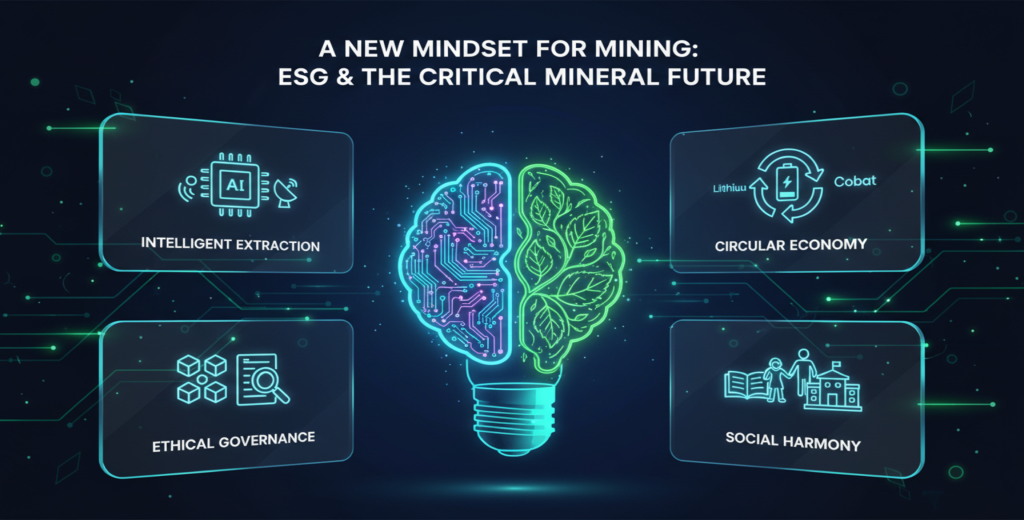
Across boardrooms, policy forums, and investor discussions worldwide, the phrase “responsible mining” has become a central theme in the global conversation about sustainability. Commitments such as carbon neutrality by 2040, zero harm operations, community-first engagement, and fully transparent supply chains increasingly appear in corporate strategies and sustainability reports.
These ambitions reflect a growing recognition that the future of mining must align with environmental protection, social responsibility, and sound governance principles. Yet the real challenge lies not in announcing commitments, but in translating them into measurable outcomes on the ground.
This challenge is particularly significant in the context of critical minerals, which are essential for the global transition to clean energy. Lithium, cobalt, nickel, rare earth elements, and copper are fundamental to technologies such as electric vehicles, renewable energy storage systems, and advanced electronics. As the world accelerates its shift toward low-carbon energy systems, demand for these minerals is increasing at an unprecedented rate.
According to the International Energy Agency, achieving global net-zero emissions by 2050 could require six times more mineral inputs than the world currently uses. This expansion in resource extraction presents both an opportunity and a responsibility. The mining sector must scale production while ensuring that environmental stewardship, social inclusion, and ethical governance remain at the core of operations.
The conversation around ESG (Environmental, Social, and Governance) is therefore evolving from a compliance exercise into something far more significant: a framework for defining how responsible mining should function in practice.
Measuring What Matters: ESG as a Driver of Real Change
In many industries, ESG is often perceived as a reporting requirement. Companies publish sustainability reports, disclose emissions data, and benchmark themselves against international standards. While reporting is important, the true value of ESG lies in how it influences operational decision-making.
In the mining industry, ESG has the potential to reshape how projects are designed, developed, operated, and ultimately closed.
Environmental Responsibility in Practice
Environmental stewardship has become one of the most visible dimensions of responsible mining. Modern mining operations are increasingly deploying advanced technologies to monitor and reduce their environmental footprint.
Real-time monitoring systems powered by artificial intelligence now track emissions, energy consumption, water usage, and land disturbance continuously rather than periodically. This allows operators to identify inefficiencies and environmental risks before they escalate.
Water management has also become a critical focus area. In regions where freshwater resources are limited, progressive mining companies are implementing closed-loop water systems, enabling water to be recycled and reused within the operation. This approach significantly reduces the demand for external freshwater sources.
Similarly, land rehabilitation practices are evolving. Traditionally, environmental restoration was conducted after a mine ceased operation. Today, progressive operations practice progressive rehabilitation, restoring ecosystems in stages throughout the life of the mine rather than waiting until closure.
New scientific techniques are also improving environmental monitoring. One notable innovation is environmental DNA (eDNA) monitoring, which enables scientists to assess biodiversity by analyzing genetic traces in soil and water samples. Such methods provide a deeper understanding of ecosystem health and help mining companies track the real impact of their operations.
These advancements reflect a broader trend: environmental performance is becoming data- driven, transparent, and verifiable.
Governance: Strengthening Transparency and Accountability
Governance forms the structural backbone of ESG implementation. It ensures that sustainability commitments are supported by clear policies, measurable metrics, and accountable leadership.
Over the past few years, the mining industry has seen increasing alignment among global governance frameworks. Major industry bodies such as the International Council on Mining and Metals (ICMM), the Mining Association of Canada, and the World Gold Council have worked to harmonize ESG standards, reducing fragmentation and improving comparability across companies.
At the same time, regulatory expectations are becoming more rigorous. International sustainability disclosure standards such as IFRS S1 and IFRS S2 are introducing mandatory climate-related reporting requirements in many jurisdictions. These frameworks emphasize the concept of double materiality, which requires companies to evaluate both how sustainability issues affect their financial performance and how their operations impact the environment and society.
For mining companies, this means ESG can no longer remain a peripheral function. It must be embedded within corporate governance structures, risk management systems, and long-term strategic planning.
The Social Dimension: Building Partnerships with Communities
While environmental protection and governance structures are vital, the social dimension of ESG often determines whether a mining project ultimately succeeds or fails.
Many critical mineral deposits are located near Indigenous territories or rural communities. Historically, mining projects sometimes struggled to build trust with local populations. Today, responsible mining practices increasingly emphasize community partnerships rather than one- way engagement.
One of the key principles guiding these relationships is Free, Prior, and Informed Consent (FPIC). FPIC ensures that communities have a genuine opportunity to understand proposed projects, evaluate their potential impacts, and participate in decision-making processes.
When implemented effectively, FPIC fosters transparency and mutual respect. Instead of being treated as a regulatory hurdle, it becomes a platform for meaningful dialogue.
Economic inclusion is another essential element of social responsibility. Many responsible mining operations prioritize local hiring and community procurement, ensuring that economic benefits flow directly to nearby communities.
In addition, structured benefit-sharing agreements can channel mining revenues into essential social infrastructure such as schools, healthcare facilities, transportation networks, and community development programs.
Some of the most successful mining operations globally are those that have invested consistently in building community trust. In such cases, a strong social license to operate becomes one of the most valuable assets a company can possess.
From Commitment to Practice: What Leading Mining Operations Are Doing
The most credible mining companies today share several defining characteristics. They have moved beyond ESG as a compliance checklist and instead integrate sustainability considerations into core business decisions.
A global survey by Deloitte found that over 70% of mining CEOs now consider ESG compliance essential for long-term competitiveness. Yet industry leaders go further by embedding sustainability performance into capital allocation decisions, project planning, and executive compensation structures.
Technology as an Enabler
Technological innovation is playing a major role in enabling responsible mining practices.
For example, digital twin technology allows mining companies to simulate operational scenarios before implementing them in the real world. By modelling environmental outcomes digitally, operators can optimise processes to reduce waste, emissions, and environmental impact.
Satellite monitoring systems also provide continuous visibility over large mining sites. These systems can track land-use changes, vegetation health, and tailings storage facilities in near real time, enhancing transparency and risk management.
Another emerging technology is blockchain-based supply chain traceability. This allows downstream buyers, such as electric vehicle manufacturers or battery producers to verify the origin of raw materials and confirm that they were sourced responsibly.
These innovations are transforming ESG from an abstract principle into a measurable operational discipline.
Policy Momentum and Global Market Signals
Government policy is also shaping the future of responsible mining. One notable example is the European Union’s Critical Raw Materials Act, which sets ambitious targets for domestic mineral sourcing while emphasizing sustainable production standards.
Policies like these send strong signals to global markets. Companies that align their operations with robust ESG frameworks are increasingly able to access sustainability-linked financing, attract long-term institutional investors, and secure supply agreements with ESG-focused buyers.
In this sense, responsible mining is no longer just about compliance or reputation management, it has become a competitive advantage in global markets.
Whole-of-Life Planning: Preparing for the Future
Another encouraging trend in modern mining practice is the shift toward whole-of-life planning.
Rather than treating mine closure as a distant challenge, progressive companies incorporate closure strategies into project design from the earliest stages. This includes financial provisioning for environmental restoration, long-term land rehabilitation plans, and economic transition strategies for local communities once mining activities conclude.
Such forward-thinking approaches demonstrate that responsible mining extends beyond the extraction phase. It involves a long-term commitment to environmental stewardship and community well-being.
The Integrity Imperative: Building Trust in the Mining Sector
Perhaps the most significant shift occurring within the mining industry is the increasing emphasis on integrity and verifiable sustainability performance.
Investors, regulators, and consumers are becoming more discerning about sustainability claims. As a result, companies must ensure that credible data, independent verification, and transparent reporting back ESG commitments.
Frameworks such as the Global Reporting Initiative’s GRI 14 Mining Sector Standard, which is scheduled to become widely adopted in the coming years, are helping standardize sustainability disclosures across the industry.
In this evolving landscape, the definition of “responsible mining” is becoming clearer. It is not a self-assigned label but rather a distinction earned through consistent performance, accountability, and transparency.
iCEM: Advancing Responsible Mining Systems
Transforming ESG ambitions into operational reality requires technical expertise, strong safety systems, and measurable performance standards.
As an institution dedicated to mining safety, mechanization, and systems excellence, iCEM – the International Centre of Excellence in Mining engages with industry stakeholders, academic institutions, and policymakers to strengthen the foundations of responsible mining.
This work includes promoting safety-led mechanization, ESG-aligned operational frameworks, advanced monitoring technologies, and workforce capability development across critical mineral value chains.
In this context, responsible mining is defined not by narrative positioning but by engineering precision, transparent data systems, and institutional alignment.
The future of critical mineral mining will ultimately depend on the strength of these systems— ensuring that the sector can meet global resource demand while maintaining the highest standards of safety, sustainability, and accountability.
Frequently Asked Questions (FAQs)
1. What are critical minerals and why are they important?
Critical minerals are natural resources essential for modern technologies and energy systems. They are widely used in electric vehicles, renewable energy infrastructure, electronics, and defense technologies. Examples include lithium, cobalt, nickel, copper, and rare earth elements.
2. What does ESG mean in the mining industry?
ESG stands for Environmental, Social, and Governance. In mining, it refers to how companies manage environmental impacts, engage with communities, and maintain transparent and ethical governance practices.
3. Why is responsible mining important for the clean energy transition?
The shift to renewable energy technologies requires significantly more minerals than traditional energy systems. Responsible mining ensures that the extraction of these resources does not harm ecosystems or communities while supporting global sustainability goals.
4. How do mining companies monitor environmental impact today?
Modern mining operations use technologies such as AI-driven monitoring systems, satellite imaging, environmental DNA (eDNA) testing, and digital twins to track emissions, water usage, biodiversity, and land rehabilitation efforts.
5. What role do institutions like iCEM play in responsible mining?
Institutions such as iCEM contribute by promoting safety standards, mechanization, technology adoption, and workforce training, helping the mining sector implement ESG principles through practical systems and operational excellence.