Fueling Innovation
for Excellence
Fueling Innovation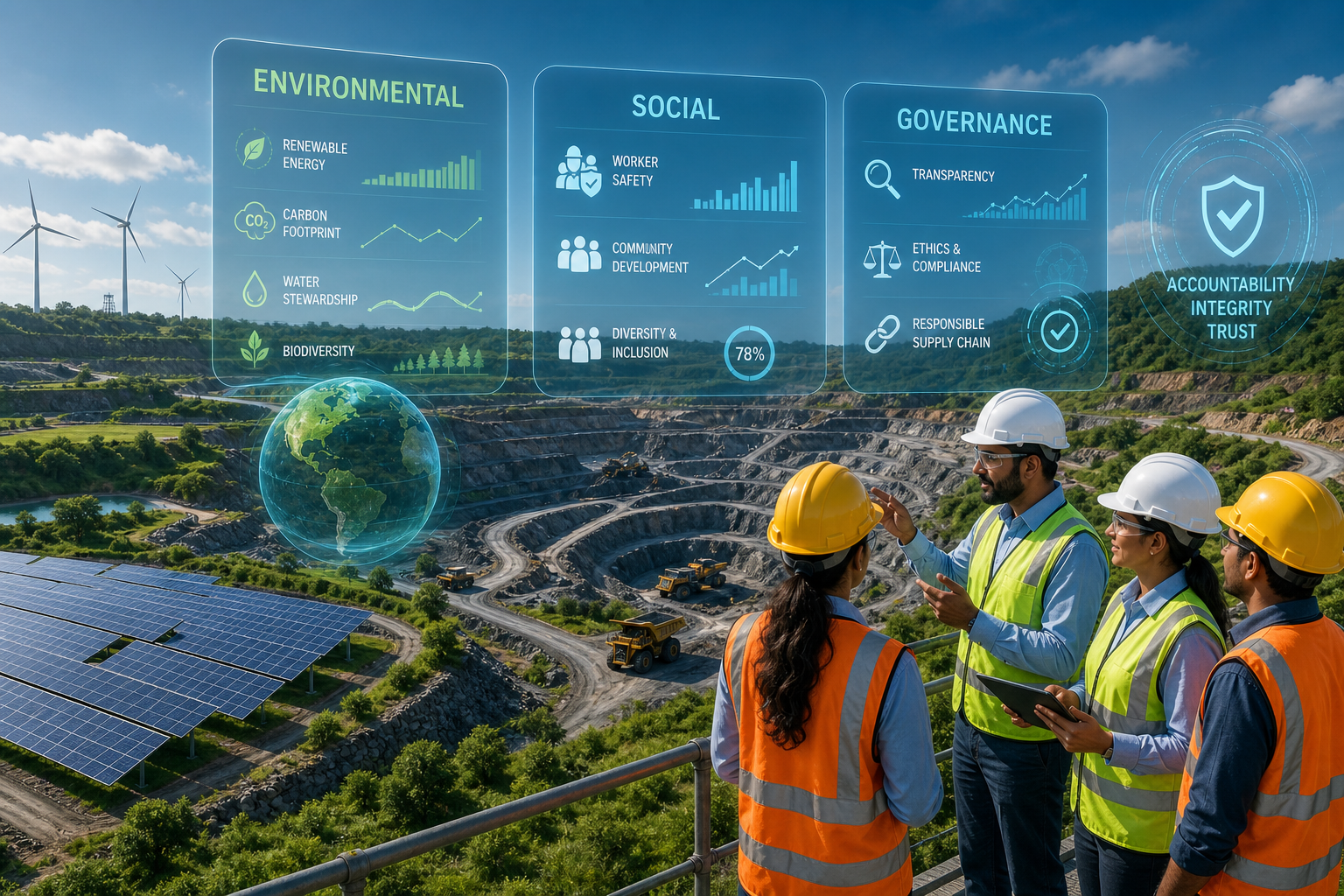
Mining has always been the foundation of human progress. From the steel that shapes our cities and the copper that powers our electrical grids to the lithium, cobalt, and rare earth elements driving electric vehicles and renewable energy, nearly every modern innovation begins beneath the earth’s surface. As global demand for critical minerals continues to accelerate, the mining industry faces a defining challenge: meeting this demand responsibly.
Today, success in mining is no longer measured solely by production volumes or profitability. Increasingly, it is evaluated by how responsibly resources are extracted, how communities are impacted, and how effectively companies protect the environment. This transformation has placed Environmental, Social, and Governance (ESG) principles at the heart of mining operations worldwide.
Once viewed primarily as a regulatory obligation, ESG has evolved into a strategic business imperative. Companies that embrace sustainable mining practices are not only reducing environmental risks but also attracting investment, earning community trust, improving operational efficiency, and securing their long-term licence to operate.
The ESG revolution is not changing mining, it’s redefining it.
ESG: From Compliance to Competitive Advantage
Over the past decade, ESG has moved from boardroom discussions to operational reality. Investors, governments, financial institutions, and local communities increasingly expect mining companies to demonstrate measurable sustainability performance rather than simply publish ambitious commitments.
The introduction of GRI 14: Mining Sector Standard and the growing adoption of international climate disclosure frameworks have accelerated this transition. Sustainability reporting has become more transparent, standardised, and data-driven, making it easier for stakeholders to assess a company’s environmental and social performance.
Forward-thinking mining companies now recognise ESG as a driver of business value rather than an expense. Strong ESG performance can deliver numerous competitive advantages, including:
• Improved access to investment and financing
• Stronger relationships with regulators and local communities
• Reduced operational and environmental risks
• Higher workforce engagement and retention
• Enhanced corporate reputation
• Greater resilience against future regulatory changes
As demand for critical minerals continues to rise due to electrification, renewable energy, battery storage, and digital technologies, mining companies that combine productivity with sustainability will be best positioned to lead the industry.
Environmental Responsibility: Mining with a Smaller Footprint
The environmental pillar of ESG is transforming every stage of the mining lifecycle, from exploration and development to production and mine closure.
Smarter Exploration
Modern exploration techniques use satellite imagery, drone mapping, artificial intelligence, and remote sensing technologies to identify mineral deposits with significantly less ground disturbance. These innovations reduce unnecessary land clearing while improving exploration efficiency.
Progressive Land Rehabilitation
Historically, land restoration often began only after mining operations ended. Today, responsible mining companies are implementing progressive rehabilitation, restoring ecosystems throughout the mine’s life rather than waiting until closure.
Water Stewardship
Water is one of mining’s most valuable resources. ESG-focused operations are increasingly adopting:
○ Closed-loop water recycling systems
○ Rainwater harvesting
○ Advanced water treatment technologies
○ Continuous water quality monitoring
These practices reduce freshwater consumption while protecting surrounding rivers, lakes, and groundwater resources.
Clean Energy Integration
Mining operations are increasingly powered by renewable energy sources such as solar and wind. Electrified mining equipment, energy-efficient processing plants, and real-time emissions monitoring are helping reduce greenhouse gas emissions while lowering operating costs.
Responsible Tailings Management
Tailings storage facilities remain one of mining’s most significant environmental challenges. Leading companies now invest in internationally recognised tailings management standards, independent safety audits, digital monitoring systems, and long-term risk management strategies to minimise environmental and safety risks.
Collectively, these initiatives reflect a fundamental shift, from extracting resources at any cost to managing natural resources responsibly for future generations.
Building Stronger Communities: The Social Dimension of ESG
Mining does not operate in isolation. Every project directly influences nearby communities through employment, infrastructure development, environmental management, and local economic growth.
The social component of ESG asks a simple yet powerful question:
Does mining improve the lives of the people living around it?
Responsible mining companies increasingly answer this question through meaningful engagement and long-term partnerships.
Early Community Engagement
Successful mining projects begin with transparent communication. Rather than consulting communities after key decisions are made, leading companies involve local stakeholders from the earliest planning stages.
This collaborative approach helps build trust, reduce conflicts, and ensure projects address local priorities.
Local Employment and Skills Development
Mining creates significant opportunities for regional economic development. Modern ESG strategies prioritise hiring local talent while investing in training programmes covering:
• Equipment operation
• Mine safety
• Digital mining technologies
• Automation
• Environmental management
• Technical leadership
These initiatives build long-term employment opportunities that continue beyond the life of a single mining project.
Health, Safety and Wellbeing
The mining industry has made remarkable progress in workplace safety through automation, predictive maintenance, wearable safety devices, remote operations, and real-time monitoring technologies.
A strong safety culture protects employees while improving productivity, operational reliability, and workforce confidence.
Creating Shared Value
Responsible mining extends beyond employment. Many organisations invest in:
• Healthcare facilities
• Educational initiatives/span>
• Road and infrastructure development
• Water supply improvements
• Agricultural support programmes
• Small business development
These investments strengthen local economies and create lasting social value long after mining activities conclude.
Governance: The Foundation of Responsible Mining
While environmental and social initiatives often receive the most attention, strong governance forms the backbone of every successful ESG strategy.
Good governance ensures mining companies operate ethically, transparently, and responsibly.
Key governance practices include:
• Transparent ESG reporting
• Ethical business conduct
• Strong corporate leadership
• Regulatory compliance
• Independent audits
• Risk management frameworks
• Responsible supply chain management
• Anti-corruption policies
• Cybersecurity and digital governance
Effective governance builds confidence among investors, governments, employees, and local communities while improving organisational resilience in an increasingly regulated business environment.
Technology is Accelerating ESG Progress
Digital transformation is rapidly strengthening ESG implementation across the mining sector.
Artificial Intelligence, Internet of Things (IoT), autonomous equipment, drones, satellite monitoring, and digital twins enable mining companies to monitor environmental performance in real time while improving operational efficiency.
Predictive analytics help identify equipment failures before they occur, reducing energy consumption and operational downtime. Digital monitoring systems track air quality, water usage, emissions, and biodiversity indicators, allowing companies to respond quickly to potential environmental risks.
Technology is no longer simply improving productivity; it is becoming a critical enabler of sustainable mining.
Why ESG Matters for the Future of Mining
Global demand for critical minerals is expected to grow significantly as countries accelerate the transition toward clean energy, electric mobility, advanced electronics, and digital infrastructure.
Meeting this demand responsibly represents one of the mining industry’s greatest opportunities, and one of its greatest responsibilities.
Companies that embed ESG into their business strategy will be better equipped to:
• Secure investment
• Meet evolving regulatory expectations
• Maintain community trust
• Reduce environmental risks
• Attract skilled talent
• Improve operational resilience
• Deliver sustainable long-term value
The future of mining belongs to organisations that understand profitability and sustainability are no longer competing priorities, they are mutually reinforcing drivers of long-term success.
iCEM: Advancing Sustainable Mining Excellence
Established by the Government of Gujarat under the aegis of the Gujarat Mineral Development Corporation (GMDC), iCEM (International Centre of Excellence in Mining) is committed to building a safer, smarter, and more sustainable mining ecosystem.
Through world-class education, technical training, research, innovation, and industry collaboration, iCEM equips mining professionals with the knowledge and practical skills required to meet the evolving ESG expectations of the global mining sector.
Working alongside leading institutions such as Texmin (IIT-ISM Dhanbad), Monash University, CIMFR, and PDEU, iCEM promotes responsible mining through advanced learning programmes, safety initiatives, leadership development, and industry partnerships.
As ESG continues to redefine the future of mining, iCEM remains dedicated to preparing the next generation of professionals who will drive sustainable, ethical, and technologically advanced mining practices for decades to come.
Frequently Asked Questions (FAQs)
1. What does ESG mean in the mining industry?
ESG stands for Environmental, Social, and Governance. It is a framework that helps mining companies operate responsibly by reducing environmental impact, supporting communities, maintaining ethical governance, and ensuring long-term sustainability.
2. Why is ESG becoming important for mining companies?
Investors, regulators, customers, and communities increasingly expect mining companies to demonstrate responsible business practices. Strong ESG performance improves access to capital, reduces operational risks, enhances reputation, and strengthens long-term business resilience.
3. How does technology support ESG in mining?
Technologies such as Artificial Intelligence (AI), drones, IoT sensors, satellite monitoring, autonomous equipment, and real-time environmental monitoring help improve safety, reduce emissions, optimise water usage, and increase operational efficiency while supporting ESG goals.
4. What are examples of sustainable mining practices?
Examples include renewable energy adoption, water recycling systems, progressive land rehabilitation, responsible tailings management, biodiversity conservation, community engagement, local employment programmes, and transparent ESG reporting.
5. How does iCEM contribute to sustainable mining?
iCEM supports the mining industry’s ESG journey by providing specialised training, skill development, research, innovation, and collaboration with globally recognised academic and industry partners to promote safe, responsible, and sustainable mining practices.