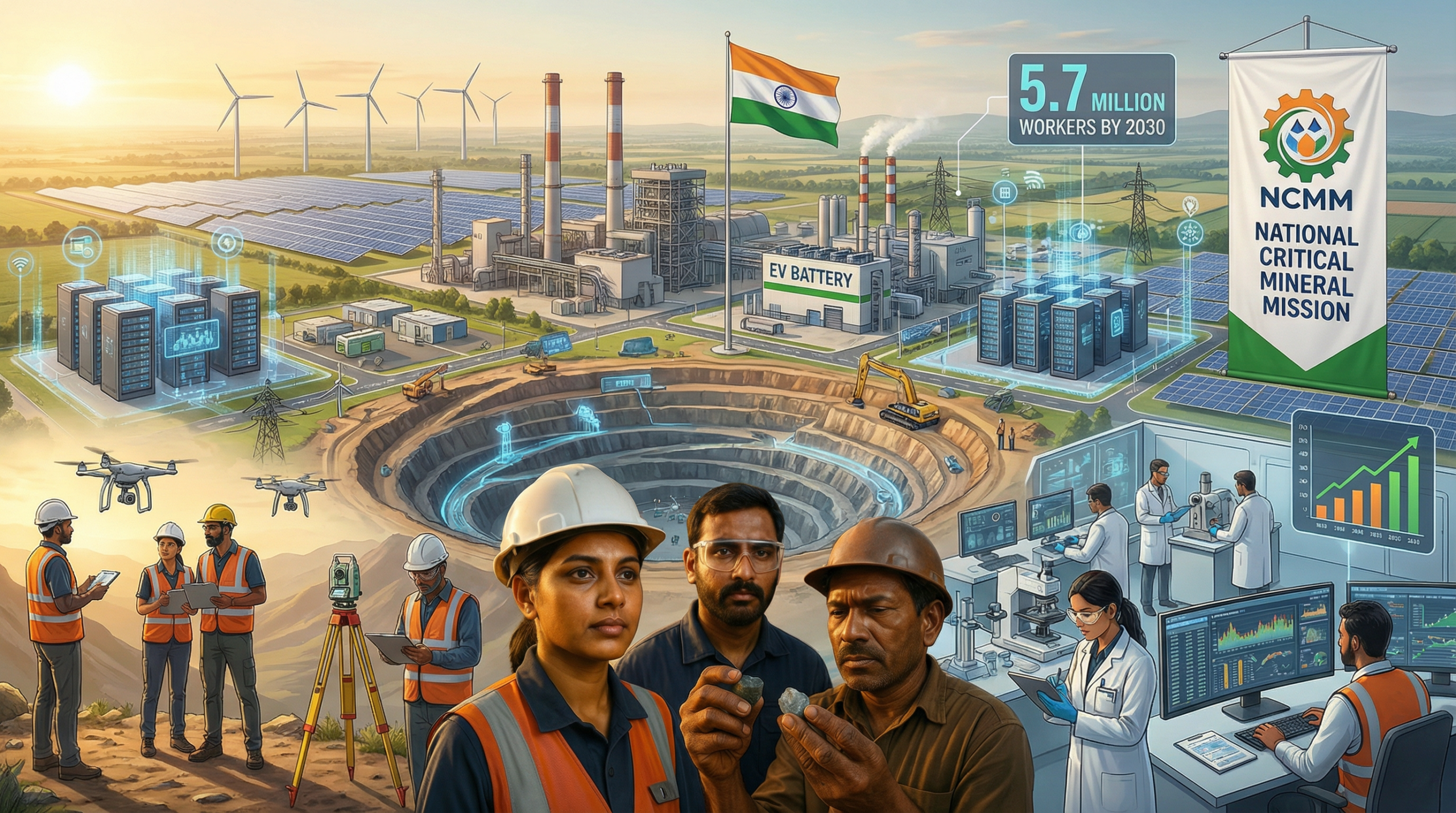
India stands at a defining moment in its industrial and strategic journey. As the world accelerates toward clean energy transitions, electric mobility, advanced manufacturing, and digital infrastructure, critical minerals have emerged as the backbone of modern economies. Recognising this reality, the Government of India has launched the National Critical Mineral Mission (NCMM), an ambitious, future-oriented initiative designed to secure supply chains, boost domestic capability, and reduce import dependence.
At the heart of this mission lies a bold target: training and upskilling 5.7 million workers by 2030. These numbers are impressive, but they point to a deeper truth: technology, policy, and capital alone cannot build a resilient minerals ecosystem. The real differentiator will be people. Without skilled professionals who can explore, extract, process, manage, and innovate responsibly, even the most advanced frameworks remain underutilised.
This is where the human element becomes decisive.
The Skills Gap: A Structural National Challenge
India’s critical minerals sector faces a paradox. While geological potential and policy intent are strong, the availability of specialised talent remains limited. One stark indicator highlights the scale of the challenge: India has fewer than 20 geologists per million people, compared to over 140 per million in Australia. This gap reflects decades of underinvestment in specialised mining education, research exposure, and industry-aligned training.
However, the skills shortage extends far beyond exploration geologists. The modern critical minerals value chain demands expertise across a wide spectrum, ranging from advanced geological sciences to digital automation, environmental stewardship, and circular economy practices.
Key Skill Domains in Demand
1. Exploration and Geological Sciences
The first link in the minerals value chain requires high-level scientific capability:
• Geochemists capable of analysing trace elements and predicting mineral concentration patterns
• GIS and remote sensing experts who can integrate satellite data, AI, and machine learning for precision mapping
• Advanced geophysical surveyors skilled in magnetics, seismic imaging, and AI-driven interpretation
These capabilities are essential for reducing exploration risk, improving discovery rates, and shortening project timelines.
2. Mining and Extraction
Modern mining is increasingly automated, data-driven, and safety-focused:
• Mining engineers trained in low-impact, high-efficiency extraction techniques
• Safety professionals proficient in digital monitoring systems and international compliance standards
• Operators and engineers skilled in autonomous and semi-autonomous mining equipment
This shift represents a move away from labour-intensive practices toward technology-enabled operational excellence.
3. Processing and Beneficiation
Critical minerals are valuable only when processed to ultra-high purity levels:
• Process engineers experienced in solvent extraction, ion exchange, and electrowinning
• Pyrometallurgical specialists skilled in reduction and thermal processing techniques
• Quality control experts ensuring compliance with stringent standards for batteries, semiconductors, and advanced electronics
This stage is vital for value addition and global competitiveness.
4. Digital Technologies and Automation
The future of mining is digital:
• Data scientists applying predictive analytics to optimise exploration, processing, and maintenance
• IoT and sensor integration specialists enabling real-time monitoring of mines and plants
• Cybersecurity professionals safeguarding critical mineral infrastructure from digital threats
Digital capability is no longer optional, it is foundational.
5. Environmental and Social Governance (ESG)
Responsible mining requires strong ESG expertise:
• Environmental scientists specialising in mine closure, land rehabilitation, and biodiversity restoration
• Water management experts ensuring sustainable resource use
• Community engagement professionals balancing industrial growth with social responsibility
These roles are essential for maintaining trust, compliance, and long-term project viability.
6. Advanced Manufacturing and Recycling
As India moves toward a circular economy:
• Battery manufacturing specialists supporting the EV ecosystem
• Urban mining experts extracting critical minerals from electronic waste
• Circular economy professionals designing systems for reuse, recovery, and recycling
This domain represents both an environmental necessity and an economic opportunity.
The National Response: A Multi-Pronged Workforce Strategy
Recognising these gaps, the Government of India has initiated a comprehensive Skills Gap Study (2025–2030) through the Ministry of Mines and the Skill Council for the Mining Sector. This study evaluates workforce requirements across exploration, extraction, processing, and value addition, forming the foundation for a coordinated national response.
Skill Development as a Core Pillar of NCMM
The National Critical Mineral Mission places skill development at its centre through:
• Scholarships and fellowships for specialised mining and mineral programs
• New academic courses aligned with future industry needs
• Targeted training programs for both fresh graduates and existing professionals
To strengthen research and innovation, three Centres of Excellence are being established at leading IITs and national research laboratories, focusing on critical minerals, advanced processing, and sustainable mining practices.
Stronger Institutional Collaboration
Greater coordination between the Ministry of Education, Department of Science & Technology, National Skill Development Corporation, and the Ministry of Mines can further accelerate impact. Structured internships, apprenticeships, and industry immersion programs will help bridge the gap between academic learning and real-world application.
Global Partnerships: Learning from Global Leaders
India’s ambition is global in scale, and global collaboration is essential. Countries such as Australia, the United States, and the United Kingdom offer valuable lessons in mining innovation, safety, and workforce development.
Strategic partnerships are enabling:
• Joint research initiatives
• International faculty and expert exchange
• Exposure to advanced mining technologies and operational models
A notable example is the UK–India Technology Security Initiative, which includes £1.8 million in Phase-2 funding to develop one of the world’s largest industrial data infrastructures for the critical minerals value chain. Such collaborations provide Indian professionals access to cutting – edge tools, global best practices, and co-innovation opportunities.
From Classroom to Mine: Bridging Theory and Practice
Creating skilled professionals is not just about adding courses, it is about ensuring relevance, application, and adaptability.
Key Enablers of Effective Workforce Development
Curriculum Innovation
Technical institutions must integrate critical minerals into mainstream engineering and science programs. Hands-on exposure to technologies such as direct lithium extraction, high-pressure acid leaching, and advanced beneficiation techniques is essential.
Industry–Academia Collaboration
Co-created curricula, industry-led modules, and shared infrastructure ensure that education remains aligned with evolving industry needs.
Continuous Upskilling and Knowledge Transfer
As experienced professionals approach retirement, structured knowledge-transfer programs are vital. Simultaneously, younger professionals must be trained in both conventional expertise and emerging technologies.
Attracting the Next Generation of Talent
The mining sector must reposition itself as a technology-driven, environmentally responsible, and strategically vital industry. Competing with technology firms for top talent requires showcasing innovation, purpose, and long-term career growth.
The Road Ahead: Shaping India’s Minerals Workforce
Building a skilled workforce for India’s critical minerals sector is not merely a capacity-building exercise, it is a nation-building endeavour.
Key Opportunities Ahead
Unprecedented Scale and Collaboration
Training millions of professionals creates opportunities for inter-state collaboration, institutional partnerships, and nationwide knowledge ecosystems.
Global Excellence with Local Context
India can set global benchmarks by blending international standards with indigenous innovation tailored to its geological diversity.
Dynamic Career Pathways
Automation, digitalisation, and sustainability are transforming mining into an exciting, future- facing career option.
Inclusive Growth and Diversity
By encouraging gender diversity and inclusive participation, the sector can unlock a broader talent pool and drive innovation.
Empowering Local Communities
Skill development in mining regions enables local employment, economic resilience, and community ownership of development outcomes.
iCEM: Advancing Excellence in Mining Skills
The International Centre of Excellence in Mining (iCEM), established by GMDC, has focused training programs in sustainable mining, digital transformation, safety, and environmental management, iCEM equips professionals to meet modern industry challenges. It’s collaborations with leading universities and research institutions connect Indian talent with global expertise, fostering innovation and best practices.
By integrating training, research, and industry partnerships, iCEM is helping build a workforce that supports safe, efficient, and sustainable growth across India’s mining ecosystem.
People as the Foundation of Mineral Security
As India charts its path toward critical mineral self-reliance, the success of the National Critical Mineral Mission will ultimately depend on its people. Skilled professionals are not just enablers, they are the foundation of resilience, competitiveness, and sustainability.
Investing in human capital today will determine India’s ability to lead tomorrow. In the race for critical minerals, the human element may well be the most critical resource of all.
Frequently Asked Questions (FAQs)
1. What are critical minerals and why are they important for India?
Critical minerals are minerals essential for strategic sectors such as renewable energy, electric vehicles, electronics, defence, and advanced manufacturing. They are considered “critical” due to their economic importance and the risk of supply disruptions. For India, securing critical minerals is vital for energy transition goals, industrial growth, and national security.
2. What is the National Critical Mineral Mission (NCMM)?
The National Critical Mineral Mission is a flagship initiative by the Government of India aimed at strengthening domestic exploration, mining, processing, and recycling of critical minerals. A key objective of the mission is to build a skilled workforce capable of supporting the entire value chain while reducing import dependence.
3. Why is workforce development central to India’s critical minerals strategy?
While policies, technology, and investments are essential, their success depends on skilled professionals who can implement them effectively. Workforce development ensures that India has the technical, operational, digital, and environmental expertise required to build a resilient and globally competitive critical minerals ecosystem.
4. What is the current skills gap in India’s mining and minerals sector?
India faces a shortage of specialised professionals, particularly in geology, mineral processing, digital mining, automation, ESG, and recycling. For instance, India has fewer than 20 geologists per million people, compared to over 140 per million in countries like Australia, highlighting the urgent need for capacity building.
5. Which skill domains are most critical for the sector’s future?
Key skill areas include:
• Exploration and geological sciences
• Modern mining and automated extraction
• Processing and beneficiation technologies
• Digital technologies, AI, and cybersecurity
• Environmental and social governance (ESG)
• Advanced manufacturing, recycling, and circular economy practices
Together, these skills support the full lifecycle of critical minerals.
04 Feb, 2026