India stands at the cusp of a mineral revolution – one that has the potential to reshape its economic growth, technological advancements, and geopolitical influence. As the nation accelerates towards a future powered by clean energy, electric mobility, and cutting-edge defence systems, its boldest assets are not above ground but hidden beneath it: Critical Minerals.
These minerals are far more than industrial inputs – they are the backbone of modern economies. From lithium fueling electric vehicles to rare earth elements powering wind turbines and advanced defence electronics, their discovery and development are akin to striking a new gold reserve. No longer a passive player, India is poised to become a major force in the global minerals race.
In 2022, the Ministry of Mines identified 30 critical minerals essential for India’s economic and national security. While some deposits exist domestically, India remains heavily dependent on imports – especially from China.
| 1) | In FY 2023–24, India imported $31.9 million worth of rare earth compounds. |
| 2) | Imports of rare earth magnets surged to $291 million, with China as the primary source. |
This dependency represents a strategic risk that India can no longer afford. To counter this, the Government launched the National Critical Mineral Mission (NCMM) – a ₹16,300 crore initiative spanning FY 2024–25 to 2030–31. The mission’s objective is clear: transform India’s mineral landscape through robust exploration, mining reforms, and ecosystem development.
The NCMM is more than a policy – it’s a strategic pivot that aims to:
This proactive approach is shifting India from a reactionary import-dependent economy to a global resource leader.
India’s mineral potential is beginning to be unlocked at an unprecedented pace. Some breakthroughs include:
1) 5.9 million tonnes of lithium discovered in the Salal-Haimana region of Jammu & Kashmir – once considered a mineral-scarce area.
2) Over 368 exploration projects for critical minerals undertaken by the Geological Survey of India (GSI) in the past three years.
3) Discovery of rare earth elements in coal samples from the Singrauli coalfields, Madhya Pradesh.
4) Accelerating offshore exploration for seabed nodules rich in cobalt and nickel.
These developments signal that India’s mineral frontier is far richer and more diverse than previously assumed.
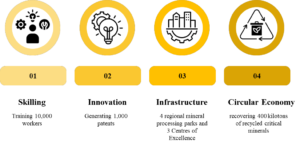
The NCMM’s vision transcends extraction. It aims to foster a self-reliant, innovation-driven ecosystem encompassing mining, refining, and downstream industries. Key focus areas include:
This integrated approach ensures that India not only mines resources but also develops global competitiveness and industrial capacity around them.
| . . |  |
India’s mineral strategy is deeply intertwined with global geopolitics. As supply chains fragment and resource nationalism intensifies, securing domestic access to critical minerals is essential to:
1. Reduce exposure to external shocks
2. Strengthen energy and technology independence
3. Enhance India’s negotiating power in international trade and strategic alliances
By aligning with global leaders like Australia and the United States, India is crafting an ambitious yet balanced model – one that prioritizes sustainability, innovation, and strategic foresight.
The race to unearth India’s critical mineral advantage is more than a resource hunt – it’s a strategic leap towards energy independence, technological sovereignty, and global leadership. Every discovery, policy reform, and innovation reinforces India’s commitment to resilience and self-sufficiency.
The world is watching. Investors, policymakers, and innovators alike must collaborate, innovate, and lead. With its vast reserves and determined vision, India is ready to power the future with its own ingenuity.
1. What are critical minerals and why are they important for India?
Critical minerals are naturally occurring elements essential for advanced technologies like electric vehicles, renewable energy, and defence systems. They are vital for India’s energy independence, industrial growth, and national security.
2. What is the National Critical Mineral Mission (NCMM)?
The NCMM is a ₹16,300 crore government initiative launched to boost exploration, mining, and ecosystem development of 30 critical minerals in India. It aims to reduce dependency on imports and promote self-reliance.
3. Which critical minerals are a priority for India?
The priority minerals include lithium, cobalt, nickel, rare earth elements, graphite, and others that are crucial for clean energy technologies, defence equipment, and high-tech industries.
4. How much lithium has been discovered in India?
A significant discovery of 5.9 million tonnes of lithium was made in the Salal-Haimana region of Jammu & Kashmir, highlighting the untapped potential of domestic mineral reserves.
5. Why is offshore exploration important for India’s mineral future?
Offshore exploration, especially seabed polymetallic nodules rich in cobalt and nickel, offers new avenues to diversify India’s mineral supply and strengthen strategic autonomy in the global energy sector.
6. How does critical mineral development impact India’s economy?
By reducing import dependence, creating jobs, enhancing research, and enabling local industries, critical mineral development plays a key role in boosting India’s economy and global competitiveness.
17 Sep, 2025