The Hidden Treasure in Our Trash
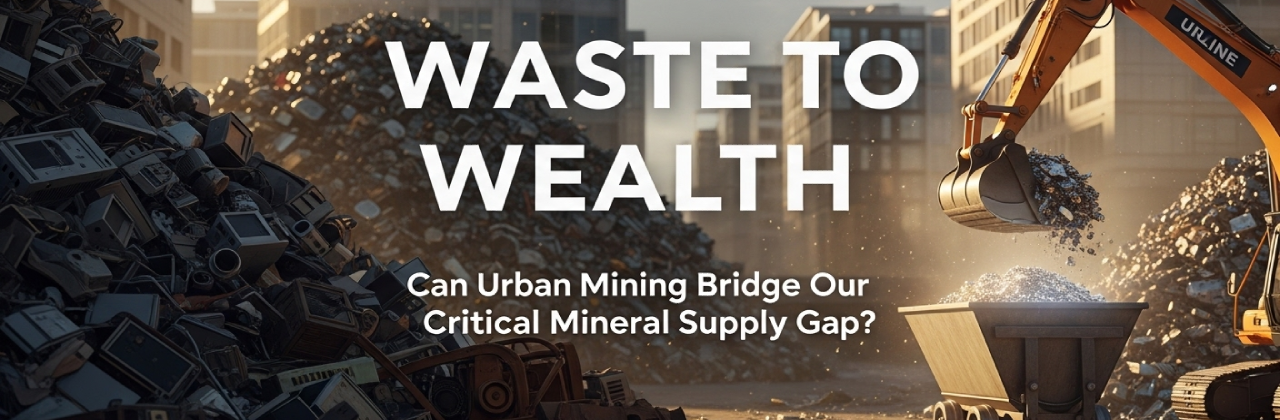
Every discarded smartphone, laptop, and battery is more valuable than we realize. Inside these forgotten devices lie gold, silver, copper, lithium, cobalt, and rare earth elements – materials that the world is struggling to secure. Globally, e-waste now contains an estimated $91 billion worth of precious metals, yet much of it ends up in landfills or informal scrapyards.
This is the promise of urban mining – recovering valuable minerals from e-waste instead of extracting them from the Earth. As nations race toward electrification, clean energy, and digital transformation, the question arises: Can our waste become the answer to our mineral supply crisis?
The Mounting E-Waste Challenge
The statistics tell a sobering story. In 2022, the world generated 62 million tonnes of e-waste – equal to the weight of 107,000 jumbo jets. If lined up, this waste could stretch from New York to Athens. And the problem is growing rapidly. By 2030, global e-waste is expected to reach 82 million tonnes, a 33% increase in less than a decade.
Hidden within this waste mountain are 31 million tonnes of metals – including $19 billion worth of copper, $15 billion in gold, and $16 billion in iron. These are the same materials driving our clean energy revolution. Yet less than 20% of global e-waste is formally recycled. The rest is lost to incineration or unregulated dumping, resulting in both economic loss and environmental harm.
Why Traditional Mining Alone Can’t Meet Demand
As the world transitions to electric mobility and renewable energy, demand for critical minerals such as lithium, nickel, cobalt, copper, and rare earths is skyrocketing. According to the International Energy Agency (IEA), demand for key battery minerals could increase fortyfold by 2040.
However, traditional mining faces serious challenges:
In short, traditional mining cannot keep pace with future demand – environmentally, economically, or geopolitically.
Urban Mining: The Smarter, Sustainable Alternative
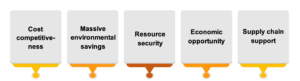
Urban mining offers a powerful complement to conventional extraction, turning waste into a strategic resource. Its advantages span economics, sustainability, and security:
How Urban Mining Works
Urban mining involves sophisticated, multi-step processes to recover valuable materials efficiently:
○ Hydrometallurgy:Uses water-based solvents to extract metals with minimal emissions.
○ Pyrometallurgy:High-temperature smelting to separate metals from waste.
○ Direct Recycling:Preserves battery structure, reducing energy use by up to 70%.
○ Bioleaching: Employs microorganisms to recover metals sustainably.
○ Flash Joule Heating: Rapid heating technique that isolates battery metals efficiently.
Challenges Along the Way
Despite its promise, urban mining still faces roadblocks:
India’s Urban Mining Revolution
India stands at a turning point. As the third-largest producer of e-waste, the nation generated 1.75 million tonnes in 2023–24, a 73% rise in just five years. With over 60,000 tonnes of used lithium-ion batteries generated annually, India’s opportunity for circular resource recovery is immense.
Recognising this, the government launched the $4 billion National Critical Minerals Mission (2023), with urban mining as a central pillar. The 2025–26 budget eliminated customs duties on imports of lithium-ion battery scrap, encouraging the development of recycling infrastructure. Research institutions like IITs and CSIR labs are developing indigenous extraction technologies to strengthen domestic capabilities.
iCEM: Leading India’s Sustainable Mining Transformation
At the forefront of this movement is the International Centre of Mining Excellence (iCEM), established by the Government of Gujarat through GMDC. iCEM serves as a national hub for technology development, capacity building, and sustainable resource innovation.
Through collaborations with global and national leaders – Monash University, IIT-ISM Dhanbad (TexMin), CIMFR, and PDEU – iCEM integrates world-class expertise to develop efficient mineral recovery methods. Its partnership with the Australia-India Critical Minerals Hub supports advanced research in exploration, processing, and recycling.
As India scales up its recycling of lithium, cobalt, and rare earth elements, iCEM’s role becomes pivotal. By fostering innovation, sustainability, and skill development, it is helping India build a future where waste truly becomes wealth.
FAQs
1. What is urban mining?
Urban mining refers to the process of recovering valuable metals and minerals from discarded electronic waste, industrial scraps, and other urban sources. It treats cities as “above-ground mines,” reducing the need for traditional mining and helping create a circular economy.
2. Why is urban mining important for the clean energy transition?
Clean energy technologies such as electric vehicles, solar panels, and wind turbines require large amounts of critical minerals like lithium, cobalt, nickel, and rare earth elements. Urban mining helps bridge the supply gap for these minerals while minimizing environmental damage caused by traditional mining.
3. How does urban mining benefit the environment?
Recycling metals from e-waste reduces greenhouse gas emissions, conserves water, and prevents toxic materials from contaminating soil and groundwater. For example, recycling one kilogram of lithium batteries prevents up to 4.6 kilograms of CO₂ emissions and saves 85% of the water used in traditional extraction.
4. What are the main challenges of urban mining?
Major challenges include low e-waste collection rates, complex product compositions, lack of recycling infrastructure, and economic barriers in scaling advanced recovery technologies.Integrating the informal recycling sector into formal systems is also crucial for safe and efficient operations.
5. How is India promoting urban mining and e-waste recycling?
India’s National Critical Minerals Mission emphasizes recycling and urban mining as key strategies to reduce import dependence. The 2025–26 Union Budget removed customs duties on lithium-ion battery scrap imports, while initiatives worth ₹1,500 crore have been announced to incentivize mineral recycling and recovery projects.
6. What role does iCEM play in India’s urban mining ecosystem?
The International Centre of Mining Excellence (iCEM), established by GMDC, is pioneering sustainable mining through research, technology development, and skill enhancement. By partnering with institutions like Monash University and IIT-ISM Dhanbad, iCEM supports innovation in mineral extraction, processing, and recycling to advance India’s circular mineral economy.
12 Nov, 2025