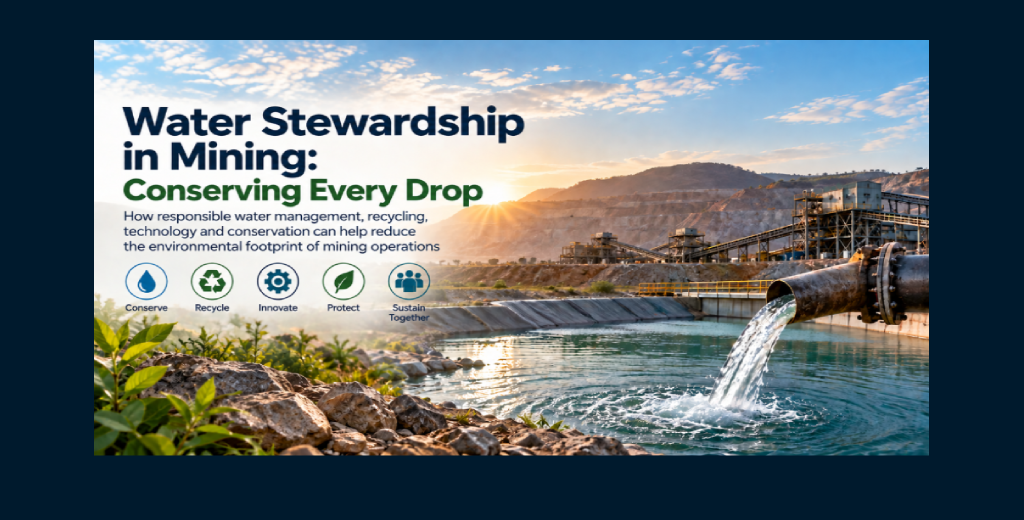
Water is fundamental to mining. From mineral processing and dust suppression to transportation, equipment washing and site rehabilitation, water supports almost every stage of a mining operation. Yet mining also interacts closely with rivers, groundwater systems, catchments and surrounding communities, making responsible water management an important environmental and operational priority.
Mining operations can require significant volumes of water while also generating wastewater and water-bearing tailings. In water-stressed regions, excessive withdrawals can place additional pressure on resources shared by communities, agriculture and ecosystems.
This is why water stewardship is increasingly becoming an integral part of responsible mining.
Rather than viewing water simply as an operational input, water stewardship considers its wider environmental, social and economic value. It encourages mining organisations to understand where water comes from, how efficiently it is used, what happens to it after use, and how mining activities interact with the broader catchment.
Effective stewardship therefore extends beyond conservation. It includes water efficiency, recycling and reuse, pollution prevention, wastewater treatment, tailings management, monitoring, risk assessment and long-term
planning.
How Water Management Can Reduce Mining’s Environmental Footprint
The environmental footprint of mining extends across water consumption, water quality, land disturbance, waste generation, energy use and emissions. Water management can influence several of these dimensions simultaneously.
1. Reducing Freshwater Withdrawals
One of the most direct ways mining operations can reduce their water footprint is by lowering their dependence on freshwater.
Water used during mineral processing does not necessarily have to be discharged after a single use. Depending on operational requirements and water quality, it can be recovered, treated and circulated back into the process.
Closed-loop and semi-closed-loop systems can enable water to move repeatedly through different stages of an operation, reducing the requirement for continuous freshwater intake.
This becomes particularly important in water-stressed regions, where mines may share limited water resources with communities, agriculture and natural ecosystems.
Improving water-use efficiency therefore creates both environmental and operational value.
2. Recycling and Reusing Process Water
Water recycling is one of the most important components of modern mine-water management.
Process water can potentially be recovered from thickeners, tailings facilities, treatment systems and other operational areas and reused for suitable applications. Depending on water quality and site requirements, recycled water may be used for mineral processing, dust suppression, equipment washing and other non-potable purposes.
The objective is simple: keep water circulating productively for as long as technically and environmentally appropriate.
Greater recycling can reduce freshwater demand while simultaneously lowering the amount of wastewater requiring treatment or discharge.
3. Improving Tailings Management and Water Recovery
Tailings management represents another important opportunity for water conservation.
Conventional wet tailings can retain considerable amounts of water. Improved dewatering, thickened tailings and, where technically appropriate, dry-stack systems can enable more water to be recovered and returned to operations.
The original draft also highlights that transitioning toward drier tailings-disposal approaches can help reduce freshwater consumption and tailings-storage volumes.
Recovering water from tailings can therefore deliver multiple benefits: improved water efficiency, reduced reliance on freshwater sources and potentially a smaller physical footprint associated with water-containing waste facilities.
The most appropriate approach, however, depends on site-specific factors including climate, geology, mineral characteristics, operational scale and regulatory requirements.
4. Treating Wastewater as a Resource
A strong water-stewardship strategy does not end when water becomes wastewater.
Mine water may contain suspended solids, dissolved minerals, salts, metals or other contaminants depending on the ore body and mining process. Appropriate treatment can help ensure that water meets the required standards for reuse or environmentally responsible discharge.
Modern treatment strategies may incorporate physical separation, chemical treatment, filtration, biological processes, membrane technologies or combinations of different systems.
The larger objective is to shift thinking from “use and discharge” to “manage, treat, recover and reuse.”
5. Managing Water at the Catchment Level
Water does not follow the boundaries of a mine lease.
Surface water, groundwater, rainfall and drainage systems are interconnected across wider landscapes. Effective water stewardship should therefore consider the mine as part of a broader hydrological system.
Catchment-level planning can help organisations understand how operational withdrawals and discharges interact with other water users and ecosystems.
This broader perspective can also encourage engagement with communities, regulators and other stakeholders, helping organisations identify shared risks and opportunities for more sustainable water management.
Technology Is Transforming Mine-Water Management
Digitalisation is enabling mining companies to understand water systems with greater accuracy and respond to potential risks earlier.
Real-time sensors, automated treatment systems, groundwater models, remote monitoring platforms and predictive analytics can provide greater visibility into how water moves through a mining operation.
Important applications include real-time monitoring of water quantity and quality, leak detection, stormwater-flow prediction, contamination-risk identification, optimisation of process-water use, groundwater monitoring and catchment modelling. These capabilities were also identified as important opportunities in the original draft.
Instead of relying solely on periodic measurements, mining operations can increasingly use continuous data to detect abnormal conditions, support early-warning systems and make more informed operational decisions.
Building Climate Resilience Through Better Water Planning
Climate variability adds another dimension to mine-water management.
Some operations may face prolonged drought and declining water availability, while others may need to manage intense rainfall, flooding or sudden increases in stormwater.
A resilient water strategy should therefore account for both too little water and too much water.
Site-wide water balances, scenario modelling, adequate storage capacity, stormwater infrastructure and contingency planning can help operations prepare for changing conditions rather than reacting only after disruptions occur.
Water Stewardship Should Extend Across the Mine Life Cycle
Effective water management should begin during mine planning and continue through operation, closure and post-closure monitoring.
During the planning stage, hydrogeological assessments and water-balance modelling can identify potential risks before major infrastructure decisions are made. During operations, monitoring, recycling, treatment and efficiency programmes
can continually improve performance.
Closure planning should consider long-term drainage, groundwater recovery, residual contamination risks, tailings facilities and the future stability of local water systems.
This life-cycle approach helps ensure that today’s water-management decisions
do not become tomorrow’s environmental liabilities.
iCEM: Building Capability for Lower-Impact Mining
Technology alone cannot deliver effective water stewardship. Mining organisations also require professionals who understand water systems, environmental risks, operational realities and evolving regulatory
requirements.
The International Centre of Excellence in Mining (iCEM) can contribute to this capability-building through industry-oriented training, professional development and academic–corporate collaboration.
Key areas can include water-balance management, process-water recycling, wastewater treatment, tailings-water recovery, groundwater monitoring, environmental compliance, digital water-management systems and mine-closure planning, reflecting the capability areas identified in the original draft.
By connecting academic knowledge with practical mine-site requirements,
institutions such as iCEM can help professionals translate environmental
objectives into measurable operational practices.
Conserving Every Drop, Creating Long-Term Value
Water stewardship is ultimately about recognising that water is more than a production input.
It is a shared resource that supports communities, ecosystems, agriculture and industry. For mining organisations, it is also closely connected with operational continuity, environmental performance and long-term resilience.
The future of responsible mining will therefore depend not simply on accessing enough water, but on managing every drop more intelligently.
Through conservation, recycling, responsible treatment, improved tailings management, digital monitoring, catchment-level planning and skilled professionals, mining operations can progressively reduce their water-related footprint while supporting sustainable resource development.
Responsible water management can help mining contribute to economic development while reducing its environmental footprint for future generations.